

When convicted Iranian sanctions evader Babak Zanjani claimed he sold cryptocurrency to Iran’s Central Bank, publishing stamped letters with wallet addresses on December 21, 2025, Crystal Intelligence investigated the infrastructure behind his allegations.
We found the wallets, and what they reveal is a sophisticated sanctions evasion infrastructure operating at an institutional scale.
Between April and May 2025, two wallets matching Zanjani’s description When convicted Iranian sanctions evader Babak Zanjani claimed he sold cryptocurrency to Iran’s Central Bank, publishing stamped letters with wallet addresses on December 21, 2025, Crystal Intelligence investigated the infrastructure behind his allegations.
We found the wallets, and what they reveal is a sophisticated sanctions evasion infrastructure operating at an institutional scale.
Between April and May 2025, two wallets matching Zanjani’s description moved $48.9 million in USDT with systematic precision: one routed funds through cross-chain bridges and to Tether-blacklisted wallets, while the other sent 51% directly to OFAC-sanctioned entities. Both received funds from 92-94% uncategorized origins, processed institutional volumes within 15-30 days, then distributed through high-risk infrastructure.
The infrastructure patterns expose three compliance blind spots that enabled $48.9 million to move through sanctions evasion channels undetected, vulnerabilities that extend far beyond Iran.
Zanjani’s allegations and what blockchain forensics reveal
In tweets posted December 29, 2025, Zanjani claimed he sold “a few million dollars’ worth of USDT” to Iran’s Central Bank through Informatics Services Company, a state-owned entity providing banking infrastructure. He published what he described as stamped Central Bank letters documenting the transactions-including cryptocurrency wallet addresses he claimed were controlled by Informatics Services Company on behalf of the Central Bank.
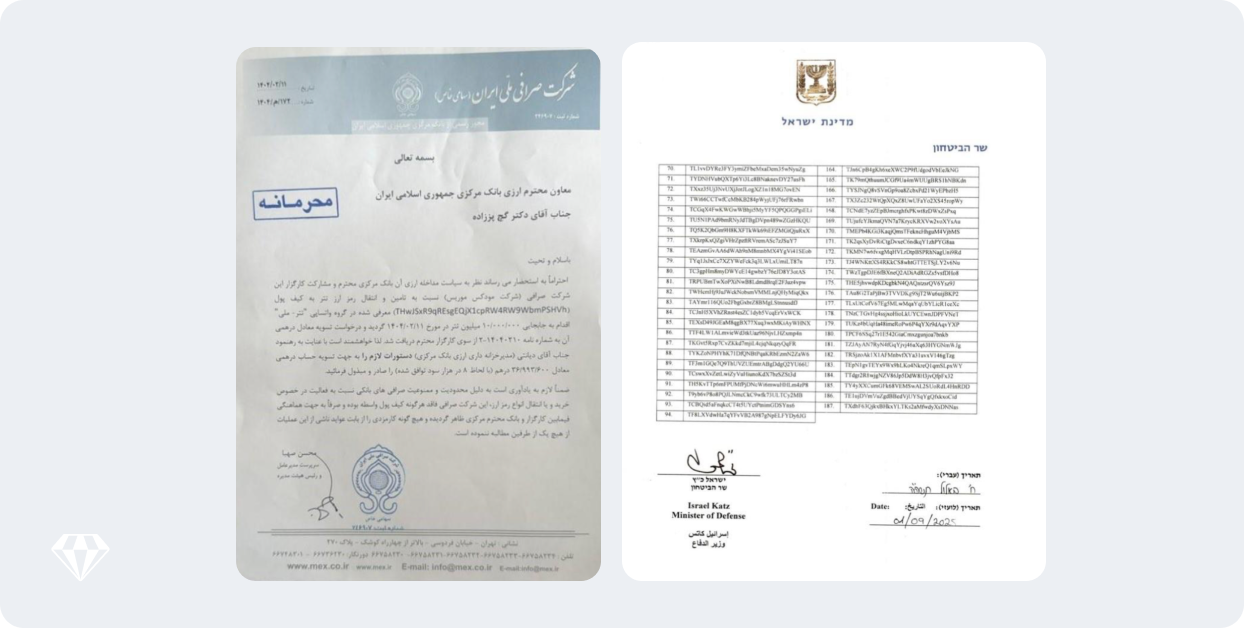
Above: Copies of the documents shared on Babak Zanjani’s X feed on Dec 21, 2025.
Informatics Services Company denied dealing in cryptocurrency. The Central Bank neither confirmed nor denied the allegations.
Zanjani also alleged that shortly after revealing the wallet addresses publicly, they appeared on Israel’s sanctions list – suggesting either internal security breaches or external intelligence collection targeting Central Bank operations.
Crystal identified two wallets matching Zanjani’s description, with transaction patterns, timing, and volumes consistent with his claims of institutional-scale operations during April and May 2025. For compliance purposes, what matters is how the infrastructure operated and the blind spots that enabled it to function.
What the blockchain shows
Crystal identified two wallets matching Zanjani’s description, with timing, volumes, and transaction patterns consistent with his claims of institutional-scale operations during April and May 2025.
Wallet 1: THwJS…..PSHVh
Volume: $28.5 million USDT
Timeframe: April-May 2025
Activity pattern: 15-30 days
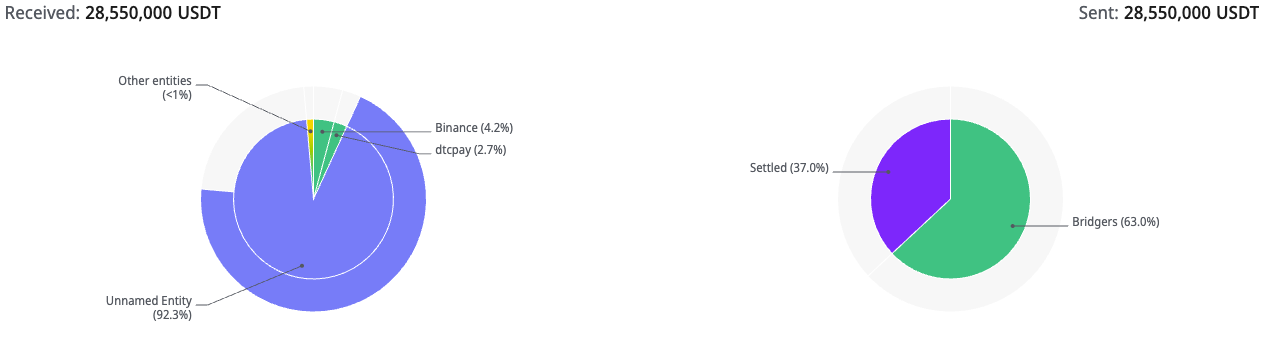
Above: A Crystal Export screenshot of source wallet THwJS…PSHVh
Origin analysis:
- 92.4% from uncategorized sources
- 4.8% from licensed exchanges
- 2.7% from payment processors
Destination analysis:
- Crystal’s forensics show strong connections with blocklisted wallets, NBCTF sanctions, and Iranian VASPs
- Additional analysis indicates systematic routing through Bridgers (cross-chain bridge service) and to Tether-blacklisted wallets
- 100% of outbound funds went to high-risk infrastructure categories
This wallet received 70% of its funds from TWnCR…VXBh, a wallet that did over 515 million USDT in transactions in less than 2 months between April 21 and June 15, 2025.

Above: A Crystal Export screenshot of source wallet TWnCR…aVXBh showing connections with high-risk entities
The above wallet shows strong connections with OFAC- and NBCTF-sanctioned entities linked to Iran and Russia, Iranian crypto exchanges, and crypto cash desks located in Dubai, Hong Kong and Turkey.
Wallet 2: TBaxH…ZvB
Volume: $20.6 million USDT
Timeframe: April-May 2025
Activity pattern: 15-30 days
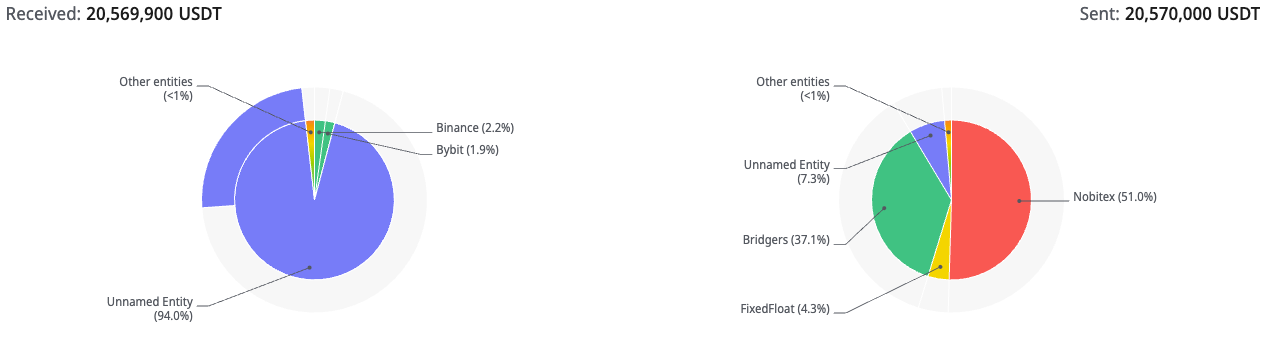
Above: Screenshot from Crystal Expert, illustrating the flows in and out of wallet TBaxHwoXQjAmiNZgRKECoA3b6fsrtmoZvB
Origin analysis:
- 94% from uncategorized sources
- Remaining 6% from mixed categories including illegal services (0.4%), sanctioned entities (0.11%), and licensed exchanges (5.3%)
Destination analysis:
- 51% sent to Nobitex, Iran’s largest crypto exchange
- 37.3% to swap bridges (Bridgers and Symbiosis Finance)
- 7.3% to Ramzinex, another Iranian exchange
- 4.3% to FixedFloat, an unlicensed non-KYC exchange commonly used for swapping crypto tokens
The pattern across both wallets is consistent: funds arrive from largely untraceable origins, process through the wallet within concentrated timeframes, then are distributed systematically either to Iranian VASPs or swapped via bridges to hide onchain tracing. Neither wallet shows mixed legitimate commerce; the transaction patterns indicate dedicated sanctions evasion operations.
Crystal’s origin wallet analysis shows patterns consistent with Garantex and A7A5 operators, both known sanctions evasion facilitators. The transaction volumes -$28.5M and $20.6M processed within 15-30 days – indicate institutional rather than retail scale, regardless of who controlled the operations.
Obfuscation of the source and destination of funds
Our analysis of TRX gas fees for this wallet reveals that it received over 36% of TRX from an NBCTF-sanctioned wallet, providing further evidence that an Iran-linked entity controls the wallet. Furthermore, to obfuscate the on-chain trail, the wallet used two bridges in succession: first, converting USDT-TRX to USDT-ETH using Bridgers, and then converting the same to AEthUSDT using Aave.
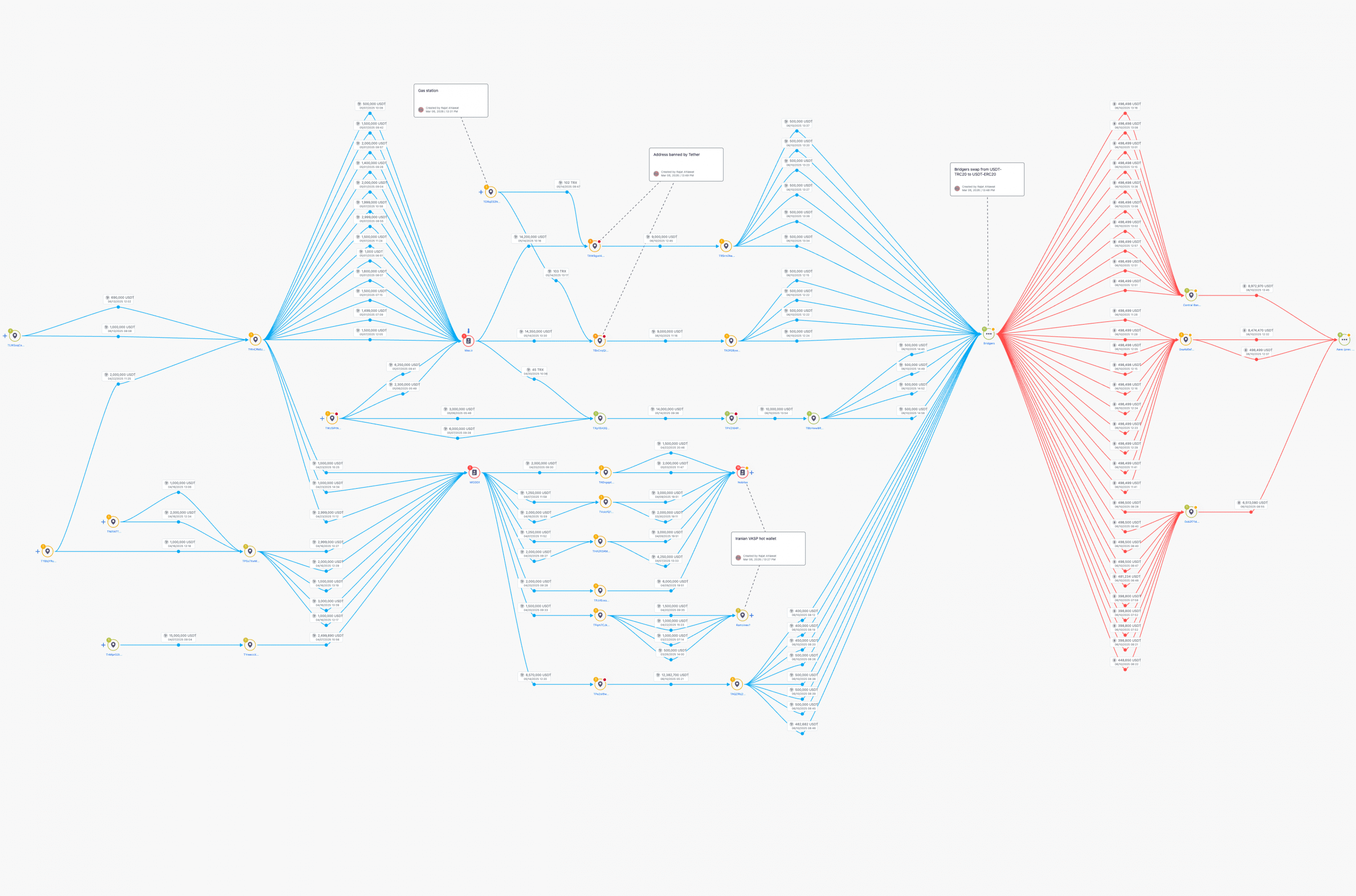
Above: Our analysis in Crystal Expert shows how the trail was obfuscated by converting the funds to ETH
Three compliance blind spots the infrastructure exploited
The wallet analysis reveals systematic vulnerabilities in sanctions compliance monitoring.
1. Cross-chain bridges sever compliance trails
The THwJS wallet shows systematic routing through cross-chain bridges. Crystal’s analysis shows it received over 70% of 28.5 million USDT from TWnCR…aVXBh which shows strong connections with blocklisted wallets, NBCTF sanctions, and Iranian VASPs, with transaction pattern deliberately designed to break transaction history across blockchains.
Most compliance systems track activity within a single blockchain. When funds cross chains through bridge services, Virtual Asset Service Providers (VASPs) lose visibility into prior transaction history. The THwJS wallet exploited this gap: received USDT with 92.4% origins uncategorized, then routed through bridges to sever the chain, emerging on another blockchain with no visible connection to prior infrastructure.
The TBaxH wallet employed bridges alongside direct routing-37.3% of its funds went to categories including Bridgers and FixedFloat, while 58% went directly to Iranian VASPs Nobitex and Ramzinex. The combination demonstrates sophisticated understanding of compliance vulnerabilities: some funds bridge across chains to break traceability, others route directly when the destination accepts the sanctions exposure.
For VASPs, the implication is clear: single-blockchain transaction monitoring cannot detect sanctions exposure that crosses chains. Without cross-chain tracing capabilities, compliance teams often see clean funds, whereas blockchain forensics reveals sanctioned origins.
2. Unlicensed exchanges operate outside compliance frameworks
The TBaxH wallet sent 51% of its $20.6 million directly to Nobitex – Iran’s largest cryptocurrency exchange with over 6 million users. Crystal’s analysis shows that Nobitex is frequently used by the Iranian regime, especially the IRGC, for crypto transactions. Unlicensed and unregistered exchanges create compliance blind spots because they operate entirely outside regulatory frameworks. Many don’t implement KYC and don’t report suspicious activity. When funds move through these platforms, compliance teams at licensed VASPs see wallet addresses they cannot categorize.
The wallet patterns demonstrate how this gap enables institutional-scale sanctions evasion: funds arrive from 94% uncategorized origins at TBaxH, then 58% routes directly to Iran-based crypto exchanges, increasing the likelihood of funds being used for sanctions evasion. From a licensed VASP’s perspective, monitoring only their own compliance perimeter, these transactions appear as movements to unidentified wallets rather than direct flows to sanctioned entities and IRGC-linked infrastructure.
An additional 4.3% of TBaxH funds went to FixedFloat, another unlicensed exchange, reinforcing the pattern of systematic routing through platforms that operate beyond regulatory oversight and lack KYC/CDD controls.
3. Behavioral indicators go undetected without forensic context
Both wallets received funds from largely invisible origins: THwJS shows 92.4% from uncategorized sources, TBaxH shows 94%.
For compliance teams conducting standard screening, this may appear legitimate, with funds arriving from unidentified wallets that could be personal transfers, business payments, or any number of benign sources.
The compliance blind spot isn’t that destinations are unknown. Crystal’s analysis clearly categorized where funds went: systematic routing through bridges via now Tether-blacklisted wallets (THwJS); 51% to Nobitex, 37.3% through bridges (TBaxH). The destinations are visible and high-risk.
The blind spot is that without behavioral analysis, high-risk destination patterns don’t trigger alerts:
- Volume concentration: $28.5M and $20.6M processed within 15-30 day window is institutional-scale activity in compressed timeframes
- Systematic routing: The THwJS wallet shows 100% of outbound funds going to high-risk infrastructure categories. This isn’t mixed legitimate commerce with occasional high-risk transactions. This is a dedicated sanctions evasion infrastructure.
- Destination clustering: TBaxH sent 51% directly to Iran’s largest crypto exchange and 7.3% to another Iranian exchange, not as isolated transactions but as a systematic operational pattern. When combined with 4.3% to an unlicensed exchange (FixedFloat) and 37.3% through bridges for swapping, almost 100% of outbound funds went to high-risk categories.
- Origin obscurity combined with high-risk destinations: Funds arrive from 92-94% uncategorized sources, then distribute with precision to sanctions evasion infrastructure. This pattern-untraceable origins, systematic high-risk routing, institutional volumes, compressed timeframes-indicates sophisticated operations at institutional scale.
- Infrastructure convergence: Both wallets connect to Garantex and A7A5 operator patterns in their origin analysis. These aren’t random wallet addresses engaging in occasional risky behavior. These are nodes within established sanctions evasion networks.
Static sanctions lists cannot detect these patterns. Wallets processing $28.5 million and $20.6 million from 92-94% uncategorized origins over 30 days, then routing systematically to high-risk infrastructure, demonstrate institutional-scale sanctions evasion even if the wallets themselves never appear on OFAC lists.
For compliance teams, this represents the evolution from list-based screening to behavioral analysis. The question shifts from “Is this wallet sanctioned?” to “Does this wallet’s transaction pattern-origin obscurity, volume concentration, systematic high-risk routing, infrastructure clustering-indicate sanctions evasion operations?”
Zanjani’s background and the infrastructure revealed
Babak Zanjani was convicted in 2016 of defrauding the Iranian government of $2.8 billion through sanctions evasion schemes during the Ahmadinejad era. He received a death sentence, later commuted, and was released from prison in December 2024. OFAC sanctioned Zanjani on January 30, 2026.
Since his release, Zanjani has waged a public campaign positioning himself as the solution to Iran’s economic crisis through blockchain technology. His recent tweets propose a national “Rial Coin” cryptocurrency managed through Central Bank blockchain infrastructure, with himself as the architect.
On December 21, 2025, he published stamped letters claiming he sold USDT to the Central Bank, including wallet addresses he alleged were controlled by Informatics Services Company on behalf of the Central Bank. He further claimed that shortly after revealing these addresses, they appeared on Israel’s sanctions list-suggesting internal security breaches or external intelligence collection.
Crystal’s forensics show a sanctions evasion infrastructure operating during the period and with the volumes Zanjani described. The wallets demonstrate systematic exploitation of cross-chain bridges, unlicensed exchanges, and behavioral patterns that standard compliance systems miss.
His allegations about internal security breaches and Israeli sanctions lists cannot be independently verified. What Crystal’s analysis verifies: sanctions evasion infrastructure processing $48.9 million through systematic exploitation of compliance vulnerabilities.
Implications for VASPs and compliance teams
The wallet analysis demonstrates that sanctions evasion has evolved beyond simple list-checking exercises. Three operational imperatives emerge:
- Implement cross-chain transaction tracing. When wallets systematically route funds through blockchain bridges to sever transaction history, single-chain monitoring creates blind spots. VASPs need capabilities to follow funds across Tron, Ethereum, Bitcoin, and other chains-or accept they cannot detect sophisticated sanctions evasion attempts that deliberately exploit cross-chain gaps.
- Develop behavioral risk indicators beyond static lists. The wallets analyzed showed clear patterns: systematic routing to high-risk infrastructure (bridges, Tether-blacklisted addresses, Iranian exchanges), institutional volumes ($48.9M), compressed timeframes (15-30 days), and origin obscurity (92-94% uncategorized). Compliance systems must evolve from “Is this wallet sanctioned?” to “Does this wallet’s behavior indicate sanctions evasion operations?”
- Recognize that destination visibility without behavioral context creates false negatives. Crystal’s analysis clearly categorized where wallet funds went: Bridgers, Symbiosis Finance, FixedFloat, Tether-blacklisted addresses, Ramzinex and Nobitex (with IRGC connections). The compliance gap isn’t that destinations are unknown-it’s that high-risk destination patterns combined with obscured origins and institutional volumes don’t trigger alerts in systems designed only for list-matching.
The convergence of Iranian sanctions evasion infrastructure with widespread fake identity fraud schemes creates additional complexity. Crystal’s previous research documented systematic KYC bypass operations targeting licensed VASPs-the same infrastructure used by individuals, criminal organizations, and apparently, Iran’s Central Bank.
As Zanjani’s allegations demonstrate, even institutional state actors now operate through the same obfuscation techniques that compliance teams struggle to detect. The gap between blockchain forensics capabilities and routine VASP monitoring represents a systemic vulnerability-one that sanctions evaders, whether convicted individuals or state institutions, exploit systematically.
The wallets continue operating. Between Zanjani’s public allegations, official denials and silence, and Crystal’s blockchain evidence, one conclusion emerges: compliance systems designed to match wallets against sanctions lists cannot detect operations where 92-94% of origins are uncategorized, systematic routing goes through high-risk infrastructure, and $48.9 million processes in concentrated timeframes. Sophisticated sanctions evasion infrastructure exploits these gaps systematically.