

Florida’s role in the national crypto story is distinct. Where New York supplies the regulated institutional perimeter, Florida supplies the policy and adoption frontier. The state has no personal income tax, a first-in-the-nation state ban on central bank digital currency use, and a Governor’s office that has explicitly courted the digital asset sector. Miami, in particular, has matured from the 2021 crypto-friendly novelty phase into a sustained institutional hub, anchored by Citadel Securities, Hut8, MoonPay and the annual Consensus Miami conference.
Key takeaways
- Florida regulates crypto through its Chapter 560 money transmitter framework, not a bespoke license. Since January 2023, custodial intermediaries handling virtual currency for Florida residents must hold a state license.
- HB 505, the virtual currency kiosk bill, passed the Florida legislature in March 2026. If signed, it takes effect July 1, 2026, requiring kiosk operators to hold money transmitter licenses.
- Florida became the first US state to exclude federal CBDC from its legal definition of money. SB 7054, signed in May 2023, also bans all foreign-issued digital currencies in commerce.
- Florida ranked third nationally in crypto-related losses in 2025, with residents reporting $914.5 million in losses. Its large retiree population, permissive licensing regime, and ATM footprint drive this elevated exposure.
Florida State at a glance 
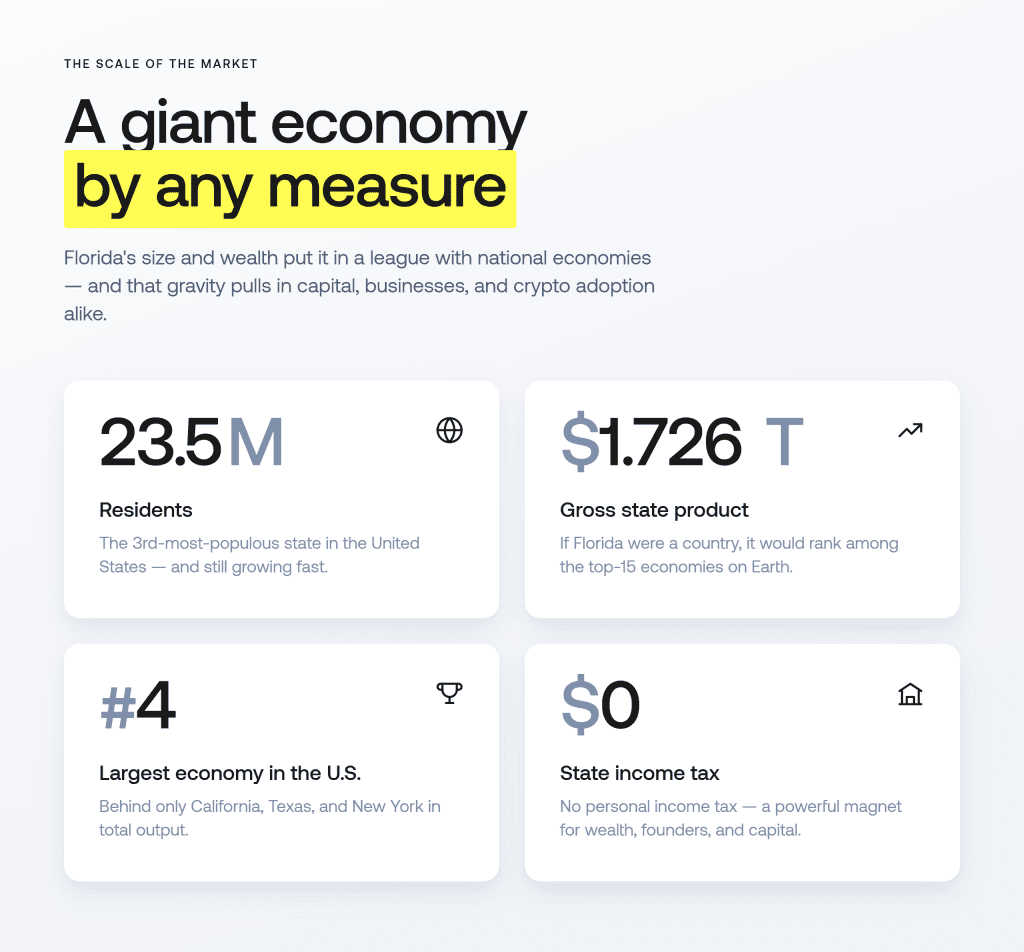
Located in the southeastern United States, Florida has an estimated population of approximately 23.5 million, making it the third-most populous state in the country and accounting for approximately 6.9% of the US population. Its 2024 GDP of $1.726Tn makes it the fourth-largest state economy in the US, accounting for approximately 6% of total US GDP: If it were an independent nation, it would rank as the world’s fifteenth-largest economy by nominal GDP, ahead of Spain and behind South Korea. The state has a large, fast-growing population with high retiree and high-net-worth migration. The combined effect is a market with material absolute crypto adoption and disproportionate exposure to age-targeted investment fraud.
Florida Attorney General James Uthmeier, in announcing a Florida Deceptive and Unfair Practices Act investigation into a national crypto and stock trading platform in July 2025, framed the state’s posture directly: Florida wants digital asset businesses, but consumer protection enforcement against misleading promotions will remain active. The Cyber Fraud Enforcement Unit established under his predecessor, Ashley Moody, has continued operating throughout 2025 and 2026, after seizing approximately $2.4M in stolen crypto in 2024 alone.
Crypto regulation in Florida
Florida regulates virtual currency primarily through its money services business framework rather than through a bespoke digital asset license. Chapter 560 of the Florida Statutes, concerning money services businesses, provides the primary legislative guidance, and is administered by the Florida Office of Financial Regulation (OFR).
The framework was substantially modernized by CS/HB 273, signed by Governor Ron DeSantis on May 12, 2022, and effective January 1, 2023. The bill added “virtual currency” to the statutory definition of money transmission and crucially narrowed the licensing trigger: a money transmitter license is required only where a person acts “as an intermediary to transmit virtual currency from one person to another location or person” and has the ability to unilaterally execute or indefinitely prevent a transaction. The Greenberg Traurig analysis of the bill described this as an explicit easing of the licensing burden on non-custodial crypto operators in Florida.
Florida’s posture on central bank digital currency is unique among US states. In May 2023, Governor DeSantis signed SB 7054, the first-in-the-nation legislation explicitly excluding federally adopted CBDC from the definition of “money” under Florida’s Uniform Commercial Code and prohibiting the use of foreign-issued CBDC. The Governor’s office framed the law as consumer protection against government surveillance of personal finances.
Florida does not maintain a bespoke virtual currency license analogous to New York’s BitLicense. The combined effect of HB 273 and SB 7054 is a permissive but bounded framework: licensed money transmission for custodial intermediaries, lighter touch for non-custodial operations, and an explicit policy preference for non-state digital assets over government-issued CBDC.
Live obligations and deadlines
Money transmitter obligations under Chapter 560 are continuous: a custodial intermediary handling virtual currency for Florida residents has needed an OFR-administered money transmitter license since January 1, 2023, when the HB 273 amendments took effect.
The most consequential near-term development is CS/HB 505, the Virtual Currency Kiosk law. It passed both chambers of the Florida Legislature on March 12, 2026, was signed by Governor DeSantis in June 2026, and took effect July 1, 2026, as Chapter 2026-178. The law expands the Chapter 560 definition of money services business to include virtual currency kiosk operators, requiring registration with the Office of Financial Regulation, fraud warnings, daily transaction limits, and 72-hour refunds for fraud victims.
The operational thresholds will likely be $2,000 per day for new customers and $10,000 per day for existing customers (recently amended upwards). Additionally, electronic and printed receipts at the point of sale will be mandatory, along with disclosure of operator contact information and the refund policy. The bill exempts kiosk-only operators from application and renewal fees.
Concurrent federal deadlines apply to Florida-licensed entities. The GENIUS Act requires federal and state regulators to issue final stablecoin implementing regulations by July 18, 2026, which directly affects any Florida money transmitter that issues or handles stablecoins. Meanwhile, the CLARITY Act, passed by the House of Representatives in July 2025 and cleared by the Senate Banking Committee in May 2026, still awaits full Senate approval and the President’s signature, which had been slated for July 2026, but has experienced headwinds.
Applications for new Florida money transmitter authorization are submitted through the Nationwide Multistate Licensing System (NMLS). Application and licensing fees, surety bond requirements, and net worth thresholds are set under Chapter 560.1401, Florida Statutes, and processing varies depending on application complexity.
Crypto adoption rates in Florida
Florida’s reported crypto adoption is high in absolute terms and middle of the pack per household, reflecting the state’s overall demographic profile. 2022 Internal Revenue Service tax data analyzed by SmartAsset recorded 1.97% of Florida households (approximately 219,330 households) submitting returns indicating digital asset involvement, placing Florida as the eighth most crypto-tax-compliant state in the United States, behind Washington (2.43%), Utah (2.36%), California (2.25%), Colorado (2.17%), New Jersey (2.15%), Alaska (2.07%), and ahead of New York (1.94%).
Meanwhile, the National Cryptocurrency Association 2026 Annual State of Crypto Holders report found that 38% of American crypto holders resided in the sixteen-state South region, of which Florida is the second-most populous.
Miami specifically has built a self-sustaining crypto ecosystem anchored by major venues such as the annual Bitcoin Conference and Consensus Miami 2026, which drew over 20,000 senior leaders from crypto, finance, and policy. Institutional anchors, including Citadel Securities, Hut8, and MoonPay, plus active local capital from Borderless Capital, Nyca, Founders Fund, and a wave of South Florida family offices, have moved the city from speculative novelty to a sustained scale-up phase.
Key trading infrastructure available to Floridians
The combined effect of Florida’s permissive licensing posture, its lack of state income tax, and its large, affluent population yields unusually broad market access. Floridians enjoy access to:
- All major US-based crypto exchanges: Coinbase, Kraken, Gemini, Robinhood Crypto, Bitstamp USA, bitFlyer USA, Binance.US, and others. Unlike New York, Florida is not excluded from any major exchange’s service map. The state’s lighter licensing burden under HB 273 means most exchanges that withdrew from New York continue serving Florida residents.
- Peer-to-peer trading marketplaces: LocalCoinSwap, Bisq, and Binance peer-to-peer. Operators facilitating commercial peer-to-peer activity with Florida residents remain subject to the Chapter 560 intermediary analysis. Paxful, previously a dominant US peer-to-peer venue, closed its core service in 2023.
- Over-the-counter (OTC) desks: Galaxy Digital OTC, Cumberland (DRW), Coinbase Prime, Circle Trade, Fidelity Digital Assets, and B2C2 USA, among others, operating under Florida money transmitter authorization or federal trust charter. Miami specifically hosts a concentration of high-net-worth OTC desk activity.
- Crypto ATMs: Florida hosts one of the largest crypto kiosk footprints in the United States. Coin ATM Radar tracks several thousand operating kiosks across the state from operators including Bitcoin Depot, CoinFlip, RockItCoin, Byte Federal (111 Florida locations), Cryptobase (84 locations across eight cities), and Americas Bitcoin ATM, while the nationwide non-profit that advocates on behalf of older adults, the American Association of Retired Persons (AARP), claims there are 3,100 crypto ATMs operating in the state. The pending HB 505 framework would bring all of these under explicit OFR authorization from July 1, 2026, with the per-day transaction caps noted previously.
- Crypto-focused banking services: Florida-chartered institutions have built measurable digital asset capability post the 2023 closure of Signature Bank and wind-down of Silvergate. Custody and banking infrastructure for Florida-based crypto firms is primarily provided by federally chartered trust companies (Paxos Trust, Anchorage Digital, BitGo Trust) alongside Florida community banks that have developed niche capabilities. Florida has not, to date, produced an analog to New York’s NYDFS-chartered limited-purpose trust company regime.
Florida’s crypto-based crime profile
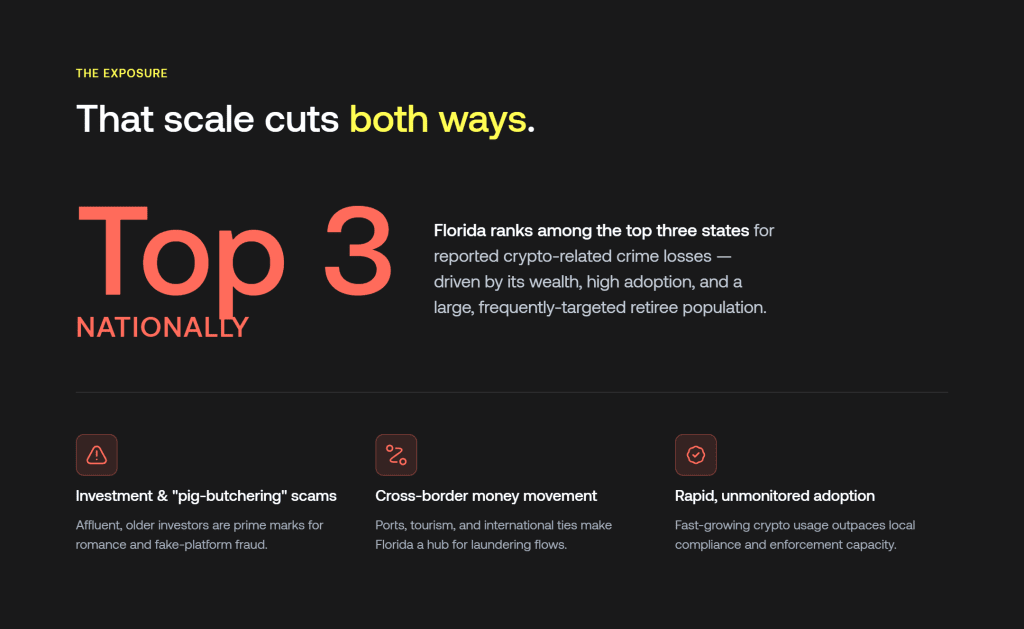
In 2025, Florida ranked third in the United States by reported crypto-linked losses, behind only California and Texas. According to the FBI Internet Crime Report for 2025, Florida residents reported approximately $914.5M in crypto-related losses, a substantial year-over-year increase consistent with the nationwide trend.
The report also recorded 1,213 crypto kiosk-specific complaints and $32.7M in kiosk-linked losses in Florida, placing the state second nationally for crypto ATM and kiosk fraud. With several thousand crypto ATMs, this prompted a combined warning to Floridians from the AARP and the Florida Department of Law Enforcement (FDLE) in February 2026.
Nationally, crypto-linked fraud losses reached a record $11.366B in 2025 across 181,565 complaints, a 21% year-over-year increase. Florida’s share of total US crypto losses is approximately 8%, proportional to its share of US GDP and roughly in line with its population share.
Floridians 60 and older were disproportionately affected, consistent with the national IC3 finding that Americans 60 and older filed 44,555 crypto-related complaints with $4.4B in losses, the largest share of any age cohort. The AARP has separately, and significantly, supported the HB 505’s kiosk transaction caps, which it believes will mitigate Floridians’ losses in this category. Florida’s status as the nation’s largest retirement destination makes this demographic exposure structurally elevated relative to most other states.
Some possible reasons for the elevated absolute loss figures in Florida:
- Investment fraud (pig butchering) targeting wealthy retirees. Florida hosts the largest retiree population in the United States and a high concentration of high-net-worth individuals along the Gulf and Atlantic coasts. The state’s large, affluent senior population is the single best-fit profile for sustained relationship-based investment fraud, which has dominated the IC3 crypto category for three consecutive years.
- The crypto ATM exposure. Florida’s large kiosk footprint is a double-edged sword for consumer protection. The same scale that makes crypto accessible to the unbanked also delivers a delivery channel for scam-directed cash deposits, with Florida posting some of the highest per-capita kiosk losses in the country in 2025. HB 505 is, in part, a direct policy response to this pattern.
- Tourist and short-term resident. Florida’s high seasonal and tourist population creates a transient consumer base that is harder to reach through long-form education campaigns and is more likely to use unfamiliar kiosks, exchanges, or peer-to-peer venues during short stays. This is a structural feature unique among the top-loss states.
Florida’s loss profile is the predictable interaction of three structural factors: a very large and affluent senior population, a permissive market-access regime, and among the largest crypto kiosk footprints in the country.
Frequently asked questions
Does Florida require a license to operate a crypto exchange? Florida does not have a bespoke crypto license. Custodial intermediaries that transmit virtual currency between parties must hold a money transmitter license under Chapter 560 of the Florida Statutes, administered by the Office of Financial Regulation. Non-custodial operators face a lighter licensing burden under the HB 273 amendments, which took effect January 1, 2023.
What is HB 505 and when does it take effect? HB 505 is the Virtual Currency Kiosk bill, passed by the Florida legislature in March 2026. If signed by the Governor, it takes effect July 1, 2026, and brings all crypto ATM and kiosk operators under the Chapter 560 licensing framework, with transaction caps of $2,000 per day for new customers and $10,000 per day for existing customers.
Can CBDC be used in Florida? Federal CBDC is excluded from the legal definition of money under Florida law. SB 7054, signed in May 2023, was the first legislation of its kind in the United States. It also prohibits the use of foreign-issued CBDC in the state.
Why does Florida have such high crypto fraud losses? Florida ranked third nationally in 2025 with $914.5 million in reported crypto losses. Three structural factors drive this: the largest retiree population in the US, one of the largest crypto ATM footprints in the country, and a permissive market-access regime that makes Florida one of the most accessible large crypto markets in the United States.
What federal deadlines apply to Florida-licensed crypto operators? Florida money transmitters that issue or handle stablecoins have been required to comply with the GENIUS Act, which came into effect on July 18, 2026. The CLARITY Act, meanwhile, awaits full Senate approval and the Presidential signature to come into force.
Are all major crypto exchanges available to Florida residents? Yes. Unlike New York, Florida is not excluded from any major exchange’s service map. Coinbase, Kraken, Gemini, Robinhood Crypto, Bitstamp USA, and Binance.US all serve Florida residents. Florida’s lighter licensing burden means exchanges that withdrew from New York have continued operating in the state.
Conclusions for Florida’s crypto industry
Florida occupies an unusual position in U.S. crypto regulation: genuinely open to digital asset business, active on consumer enforcement, and now facing two consequential federal deadlines in a single month. For compliance teams, the July 2026 window requires an honest review of licensing status and stablecoin obligations. For law enforcement and regulators, the state’s crime profile demands ongoing resources focused on its most common fraud schemes. The state is neither failing to enforce nor falling behind: it is bearing the natural consequences of being one of the most accessible large crypto markets in the United States.