

A seasoned financial crime investigator recently made a damning observation about the blockchain analytics industry. After evaluating multiple firms competing for contracts across the Middle East, they found that only one company had actually conducted on-the-ground intelligence collection in the region: Crystal Intelligence.
While other analytics providers pitch expensive licenses based on user interfaces and buzzword-heavy presentations, this investigator noted that Crystal was the only firm that could prove they’d done real-world intelligence gathering. “What are you even selling?” the investigator challenged other providers. “Without ground truth data collection, you’re just selling access to the same on-chain information everyone else has.”
The investigator’s assessment highlights a critical gap in the blockchain analytics space: the difference between analyzing transactions that have already happened and understanding the physical infrastructure that enables them. While most firms focus on post-transaction analysis, Crystal Intelligence has been mapping the hidden economy that operates before digital assets ever touch the blockchain.
Behind unmarked doors across the globe
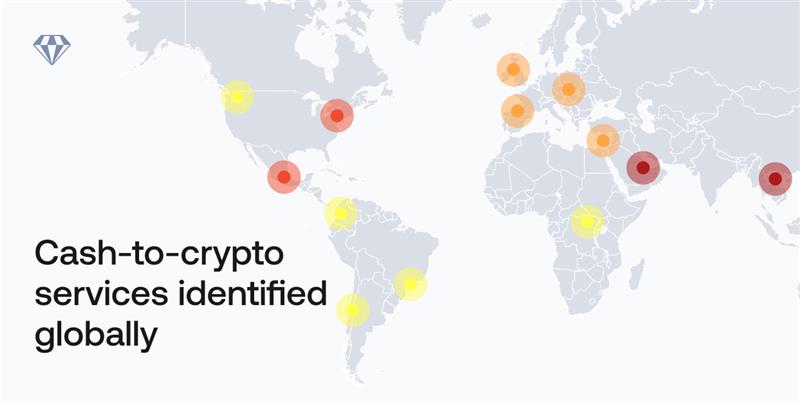
Crystal’s research team has identified hundreds of active cash-for-crypto services operating globally, from Vancouver’s commercial districts to Hong Kong’s financial centers. For example, Hong Kong’s cash desks processed over USD $2.5 billion in cash transactions in 2024 alone. These operations process significant volumes annually, yet remain largely invisible to most blockchain analytics providers.
These aren’t necessarily criminal enterprises. In many cities, they may serve legitimate needs—offering faster and cheaper ways to send money home than traditional remittance services. Small businesses use them to access international markets without costly banking relationships. Individuals in countries with currency restrictions turn to them for financial access.
This makes them particularly popular among Russian speakers; our research team identified several such services operating in resort destinations across the world, including Thailand, Sri Lanka, and Egypt.

Significantly, much of the exposure from cash services is towards international exchange services, accounting for 97% of the total value of these funds. Further, many of these cash desks operate as so-called ‘nested’ services, allowing their clients to bypass anti-money laundering controls such as KYC. This is particularly problematic in jurisdictions where there is a potentially higher risk of exposure to terrorism finance, for example.
The blind spot that’s costing you money
If you’re running an exchange, these services are funneling transactions through your platform right now. Your current analytics provider probably can’t tell you:
- Which of your users are cash-for-crypto intermediaries
- Whether these services have proper licensing in their jurisdictions
- How much volume are they’re processing through your platform
- Whether they’re operating from high-risk locations
Crystal’s intelligence shows the scale of this exposure. Major platforms like Binance, OKX and Bybit receive hundreds of millions annually from these services. This isn’t hypothetical—it’s documented transaction flow.
This isn’t just a compliance headache – it’s a business risk.
When regulators crack down on unlicensed services (and they will), exchanges that enabled these operations become targets for enforcement action. When correspondent banks discover undisclosed crypto exposure through these channels, they terminate relationships.
The speed advantage that makes your exchange attractive to legitimate users also makes it attractive to these gray-market services. Without proper intelligence, you can’t distinguish between them.
Traditional finance faces the same blind spot
For banks and traditional financial institutions, cash-for-crypto services represent a massive gap in due diligence frameworks. Your crypto exposure assessments likely focus on direct relationships with exchanges and custody providers. But significant volumes flow through these unlicensed intermediaries first.
Consider the compliance implications:
- Anti-money laundering programs that don’t account for cash conversion points
- Know Your Customer procedures that miss the actual source of funds
- Sanctions screening that occurs after cash has already entered the crypto ecosystem
- Regulatory reporting that understates actual crypto exposure
Our analysis shows 33% of cash-for-crypto service activity involves unlicensed exchanges, with additional connections to illegal services and sanctioned entities. When a corporate client’s “low-risk” crypto transactions actually originated from these unlicensed services in high-risk jurisdictions.
Why blockchain analytics miss the real story
Traditional blockchain analytics start with on-chain data – transactions that have already been recorded on public ledgers. This approach misses the crucial first step: how fiat currency becomes cryptocurrency in the first place.
Most analytics providers can tell you that funds moved from Address A to Address B. They can identify known exchanges and label wallet clusters. But they cannot tell you:
- Where the original cash came from
- Whether the conversion service was properly licensed
- What due diligence was performed on the cash source
- Whether the physical location matches regulatory requirements
This is why a significant portion of high-risk cryptocurrency transactions appear “clean” in traditional analytics—because the risk occurs before the blockchain transaction is recorded. With billions flowing through these services annually and only Crystal tracking them, traditional analytics are missing the complete picture.
Ground truth intelligence changes everything
Traditional blockchain analytics start with on-chain data—transactions already recorded on public ledgers. This approach misses the crucial first step: how fiat currency becomes cryptocurrency in the first place.
Most analytics providers can tell you that funds moved from Address A to Address B. They can identify known exchanges and label wallet clusters. But they cannot tell you:
- Where the original cash came from
- Whether the conversion service was properly licensed
- What due diligence was performed on the cash source
- Whether the physical location matches regulatory requirements
Billions in annual transaction volume flow through cash-for-crypto services that most analytics platforms cannot identify. These services don’t exist in blockchain data until after the conversion happens. By the time funds appear on-chain, they look identical to any other deposit—the critical risk assessment moment has already passed.
Our analysis shows 33% of these services’ activity involves unlicensed exchanges, with additional connections to illegal services and sanctioned entities. Yet in traditional blockchain analytics, these transactions appear unremarkable. The compliance gap isn’t theoretical—it’s billions of dollars in exposure that standard tools simply cannot detect.
Crystal Intelligence integrates physical-world intelligence with blockchain analysis. This reveals patterns invisible to purely digital approaches: service clusters in specific jurisdictions, volume patterns that correlate with regulatory changes, and cross-border networks operating under different legal frameworks.
The competitive advantage you’re missing
While other analytics firms compete on user interface features and processing speed, they all analyze the same limited dataset. Crystal Intelligence provides intelligence that doesn’t exist elsewhere.
Our cash-for-crypto intelligence gives you:
- Early warning systems for emerging risk corridors
- Enhanced due diligence on counterparties and customers
- Regulatory compliance documentation for examination purposes
- Strategic insights for market expansion and risk assessment
When regulators ask about your crypto risk management, you need more than on-chain analysis. You need intelligence about the entire ecosystem.
Don’t wait for the enforcement action
The regulatory environment is tightening globally. Unlicensed cash-for-crypto services that operate today may be enforcement targets tomorrow. The exchanges and financial institutions that enabled them—unknowingly or otherwise—will face scrutiny.