

From cross-chain bridge tracing to a smarter Risk Score, here’s everything we shipped to help you investigate faster and comply with confidence.
Key takeaways
Crystal Expert now detects and displays cross-chain bridge transactions directly in Visualization.
Risk Score is now fully based on real-time Connections, with no hidden inputs – making scores easier to explain to auditors and regulators.
The RiskCheck API and Monitor now use the same scoring algorithm, eliminating discrepancies in two-layer compliance setups.
EVM clustering in Monitor automatically labels deposit addresses of centralized services, sharpening counterparty attribution and supporting Travel Rule workflows.
Address Connections are available to all users, with automatic path building for address-level Visualizations.
Cross-Graph Links highlight when an address on the current graph also appears in other visualizations across personal or corporate accounts, helping investigators avoid duplicated work and surface hidden links between cases.
Updated Connections diagrams are now consistent across Monitor, Explorer, and Visualization, with interactive in-product guides.
The Crystal interface is now available in 18 additional languages, supporting compliance teams, investigators, analysts, and partners worldwide.
Performance improvements include faster Solana operations, quicker Explorer load times, and corrected token data across several chains.
Blockchain analytics is only as good as the visibility it provides. Over the past quarter, we’ve focused on closing the gaps that slow investigators down and create uncertainty for compliance teams — starting with two of the biggest: cross-chain blind spots and Risk Score transparency.
Here’s what’s new.
Cross-chain bridge detection in Visualization
This is one of our most requested capabilities. Investigators can now identify and follow cross-chain bridge transactions directly within the Visualization graph, bringing full visibility to fund movements that previously disappeared when assets crossed from one blockchain to another.
Before this release, when funds left one network via a bridge, the trail went cold. Investigators had to manually correlate transactions across separate blockchain explorers, piecing together source and destination addresses by hand. That process was slow, error-prone, and easy for bad actors to exploit.
Now, when a transfer is identified as part of a bridge transaction, Crystal flags it with a bridge indicator in the Transfers table. You can expand the details to see the bridge service, protocol, source and destination chains, amounts, timestamps, and transaction hashes — then add the bridge directly to your graph with a single click.
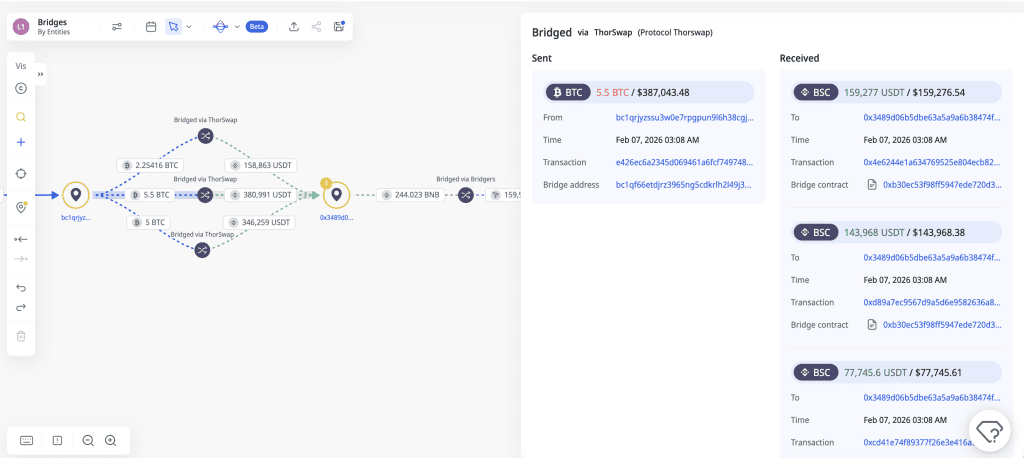
Above: Cross-chain bridge detection in Visualization
What this means in practice: An investigator tracing suspicious activity on Tron sees funds sent to an address with no further on-chain activity. Rather than hitting a dead end, Crystal highlights the transfer as a bridge transaction, reveals that funds moved to Ethereum, and lets the investigator continue analysis seamlessly on the destination chain. One continuous investigation, no tool-switching required.
At launch, we support 80 bridges, including Ethereum, Bitcoin, Tron, Solana, Polygon, Arbitrum, Base, Optimism, Avalanche, Binance Chain, and Injective. The full list includes major protocols like Wormhole, deBridge, LayerZero, Across, Chainflip, Circle CCTP, and many more.
Redesigned Risk Score
We’ve upgraded how Risk Score is calculated to make it more transparent, consistent, and easier to explain to auditors and regulators.
The core change: Risk Score is now calculated entirely from granular, real-time Connections. There are no longer any hidden inputs influencing the final number. Every factor that contributes to a Risk Score can be traced back to a specific, explainable connection.
For compliance teams running a two-layer setup — using the RiskCheck API for fast initial screening and Monitor for detailed review — this update eliminates a longstanding friction point. The API and Monitor now use the same underlying algorithm, so you won’t see discrepancies between what the API flags and what Monitor shows.
For the majority of transfers, the median score change is within 5%, so existing workflows and alert thresholds should remain largely unaffected.
EVM Clustering in Monitor
Crystal Monitor now supports automatic clustering for deposit addresses of centralized services on Ethereum and other EVM-compatible chains. When the option is enabled, Crystal labels each matching address as a service and populates the entity name in the counterparty field, both for withdrawal transfers and for address pre-checks.
This closes a gap that was particularly costly for travel rule workflows. With clustering off, the distance from a deposit address to its parent entity was two or more hops in 99% of cases, so direct interaction rules rarely fired correctly. With clustering on, those rules behave as intended, and financial institutions and VASPs can use Monitor API results inside their own travel rule logic – or in a bring-your-own-key setup with an existing travel rule provider.
The same heuristics now power the suggested-owner display in Explorer, so users see consistent attribution as they move from a transfer check into a deeper investigation.
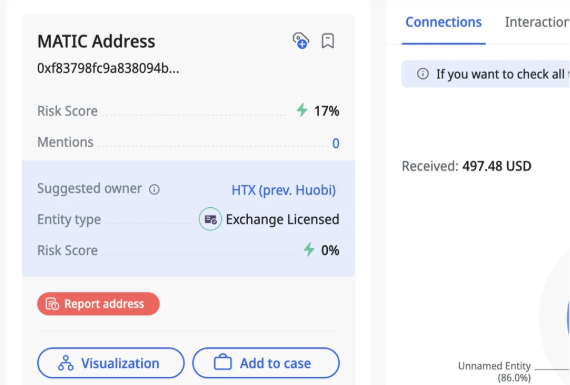
Above: Suggested owner appears in Explorer using the same heuristics as Monitor.
Clustering is opt-in and currently available in Monitor (UI and API). It is not yet available in the Risk Check API or in Explorer when the option is disabled.
Address Connections and Automatic Path Builder
Address Connections are now available to all users. Previously limited to a smaller audience, this capability lets investigators focus analysis on a specific wallet address rather than an entire entity or cluster — reducing noise and making results easier to interpret.
This matters because over 50% of all graphs in Crystal are built by address. To support these workflows, we’ve also introduced Automatic Path Builder for address-level Visualizations. Investigators can now run shortest-path and multi-path analysis with full address-level granularity (currently available on all chains except BTC-like networks), which saves significant time compared to manual graph construction.
The combination is especially powerful for investigating individual deposit addresses on centralized exchanges, focusing analysis on a specific user’s activity, and uncovering nested services that operate within CEX infrastructure.
Cross-Graph Links Across Your Visualizations
Investigators rarely work in isolation. Cases overlap, suspect addresses appear in multiple workstreams, and the same wallet can show up across separate visualizations built by different team members. Cross-Graph Links makes those overlaps visible.
When you open a visualization, Crystal flags any address on the current graph that also exists in other visualizations within your personal account or your organization’s corporate account. You can see who created the other graph, when, and jump straight to it.
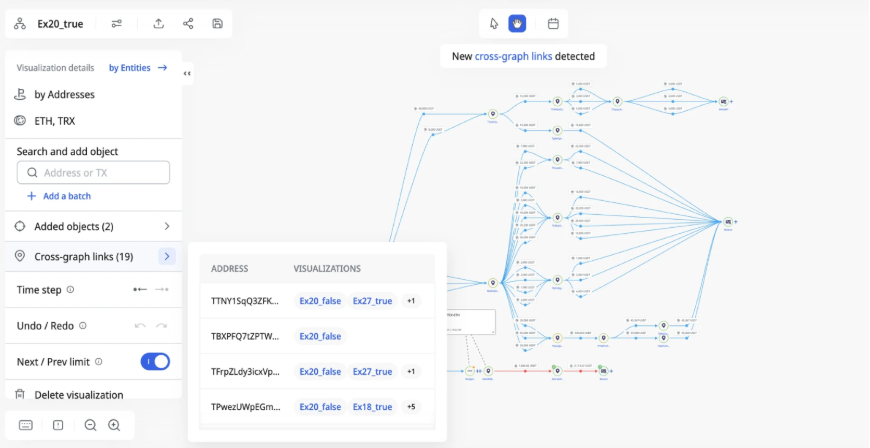 Above: Cross-graph links surface directly inside a visualization, with each shared address linked to the other graphs it appears in.
The same connection runs through Main Search. Search any address and Crystal will tell you whether it already lives in a visualization, who is investigating it, and open the relevant graph in one click.
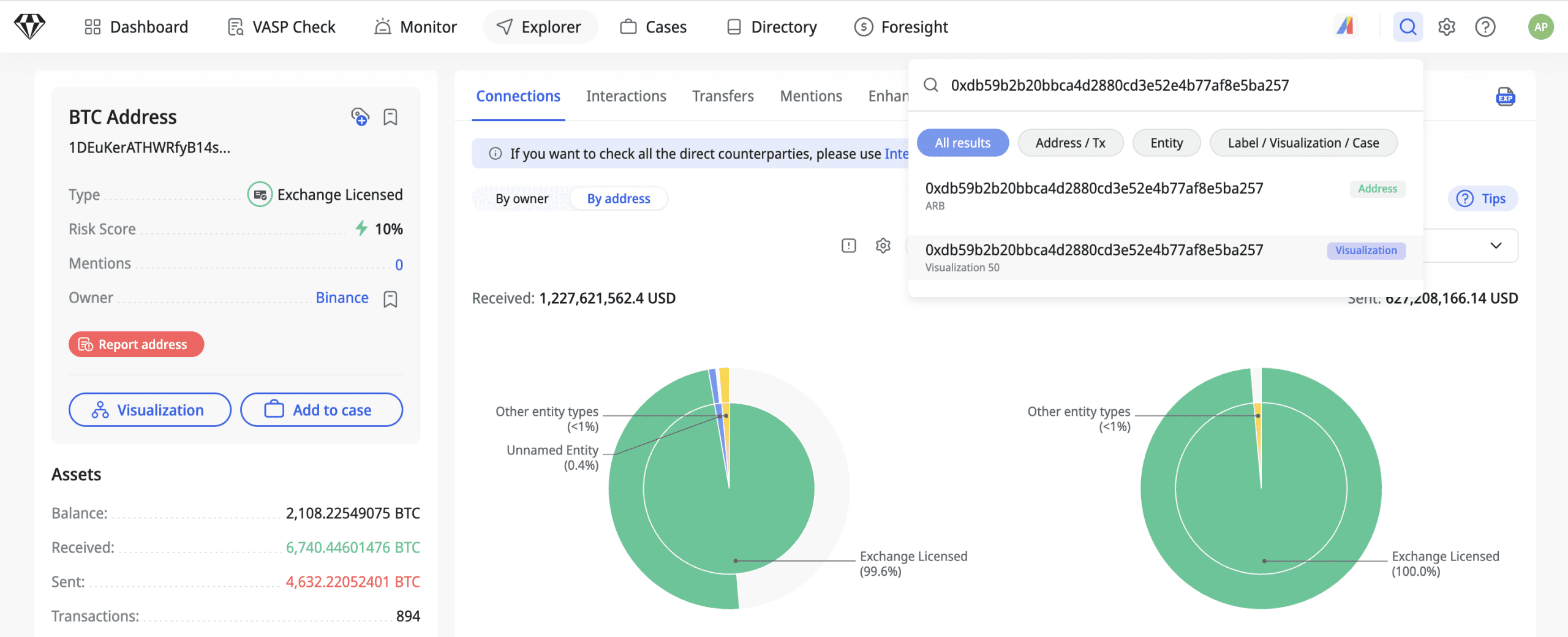
Above: Main Search returns address matches alongside any visualizations and cross-graph links that already include the address.
What this means in practice: Less duplicated work, faster overlap detection between cases, and a higher chance of catching connections that span investigations. The feature is especially valuable for larger compliance and investigation teams handling many cases in parallel – a long-standing ask from partners who run shared corporate accounts.
Updated Connections diagrams across all products
The redesigned Connections view is now consistent across Monitor, Explorer, and Visualization. The new diagrams make it clearer what portion of funds came directly or indirectly from specific entities, and let you filter by type and entity in just a few clicks.
We’ve also launched Userflow, an interactive guide system built directly into the product. The first guide walks you through the updated Connections diagrams, so you can explore the new functionality without leaving the UI.
18 new languages in the Crystal interface
The Crystal interface is now available in 18 additional languages alongside English. Users can switch language directly in their Profile settings.
The new languages are: Mandarin Chinese, French, Modern Standard Arabic, Portuguese, German, Turkish, Korean, Italian, Polish, Ukrainian, Romanian, Russian, Kazakh, Uzbek, Kyrgyz, Malay, Dutch, and Vietnamese.
This expansion makes Crystal more accessible for compliance teams, investigators, analysts, and partners working in regions where English is not the primary working language. It also reflects how our customers actually operate – many financial institutions, law enforcement units, and VASPs run multilingual teams, and a localized interface speeds up onboarding, reduces errors, and improves day-to-day investigation work.
We add new languages on a rolling basis. If your team needs a language we don’t yet support, let your account team know and we’ll factor it into the roadmap.
Performance and quality improvements
Alongside the major features, we shipped a number of fixes and improvements that make the day-to-day experience better:
Solana performance: We switched to a more reliable JSON-RPC provider, improving general performance across Solana operations.
Explorer speed: Page load optimizations and faster main search response times.
Data quality fixes: Corrected TRC10 historical data that was causing TRX transactions to display the wrong asset, fixed Arbitrum asset price history, resolved token metadata issues on Solana, and added price history for recently added TON tokens.
New tokens: Added USDD on Ethereum and BSC, and cNGNon Ethereum, Base, BSC, and Polygon.
Profile page redesign: Improved structure so users can access settings more quickly.
What’s next
We’re continuing to invest in cross-chain visibility, investigation workflows, and platform performance. If you have feedback on any of these updates or want to see a demo, reach out to your account team or visit our changelog for the full release notes.