


Digital assets moved faster than the tools built to watch them. This guide introduces decision intelligence for digital assets: what it is, why the market needs a new category, and how it turns on-chain and off-chain data into decisions you can make quickly and defend completely.
What is decision intelligence for digital assets?
Decision intelligence for digital assets combines data, AI, and verified attribution to support, augment, and automate the decisions that digital-asset businesses, investigators, and supervisors are accountable for. Unlike blockchain analytics, which answers queries about past transactions, it puts verified evidence and context in front of the decision itself; before funds move, in a form that stands up in court, audit, or challenge.
As payments move to stablecoins and autonomous agents, decisions happen at machine speed. Evidence has to arrive first.
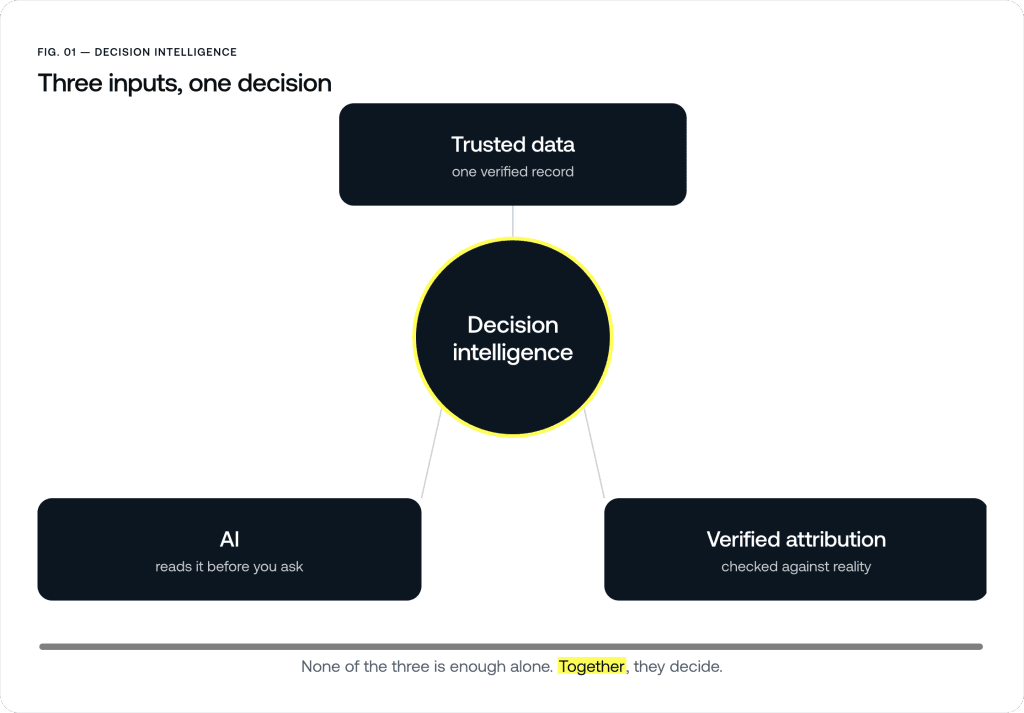
Getting there takes three things that most tools keep apart, and none of the three is sufficient on its own. Verified data on its own is slow to act on. AI on its own, without verified attribution behind it, is a confident guess. Attribution without AI to surface and read it arrives too late to change the decision. Decision intelligence is all three working together: a trusted data foundation, AI that surfaces and reads that data before anyone thinks to ask, and attribution checked against the real world, all placed in front of the decision itself rather than filed in a report after it.
Crystal built its reputation on blockchain analytics and cryptocurrency intelligence, attributing data behind who is who on-chain. Decision intelligence for digital assets is the next step: it takes that same verified intelligence and puts it in front of the decision itself, before funds move, in a form that stands up in court, audit, or challenge.
The result is not another dashboard of alerts. It is a foundation for faster, clearer, more defensible decisions across compliance, investigations, onboarding, markets, and oversight. Because in digital assets, a decision you cannot evidence is a liability waiting to surface, and a decision you cannot make in time is an opportunity or a risk you have already missed.
330+ blockchains. 10,000+ digital assets. 118,000+ attributed entities. The question is no longer whether you can see the data. It is whether you can decide on it, fast enough and with proof.
Why digital assets need their own decision intelligence
Decision intelligence as a general discipline already exists in banking, insurance, and government. But digital assets break the assumptions those tools were built on. In traditional finance, an entity has a legal identity, an address, and a paper trail. On-chain, an entity is a wallet, then a cluster of wallets, then a bridge to another chain, then a mixer, then a peer-to-peer trade that never touched an exchange. Identity is not given. It has to be established from behavior, and then verified against the physical world.
Generic decision intelligence platforms were not built for this. They assume clean, structured, single-jurisdiction data. Blockchain analytics tools were built for the opposite problem, tracing transactions, but most stop at the score. They will tell you a wallet is high-risk. They rarely tell you who is behind it, whether that attribution is evidenced or inferred, or what you should do next, and they almost never do it fast enough for a decision that has to be made in seconds.
Decision intelligence for digital assets closes that gap. It treats attribution as evidence rather than a guess, connects on-chain flows to off-chain reality, and is built for a world where the data crosses chains, borders, and legal systems by default, and where the decisions increasingly have to be made at machine speed.
Why it matters now
Several forces have converged, and together they make this the moment the category has to exist. Digital assets went institutional: stablecoins now settle real volume, and the banks, asset managers, and payment firms entering the market bring traditional-finance expectations that every decision can be explained, audited, and defended to a regulator or a board. Intuition and a risk score do not meet that bar.
Regulation caught up and kept moving. Compliance obligations across major markets now assume you can trace funds across chains, attribute entities, and produce evidence on demand. The cost of getting a decision wrong is no longer reputational alone; it is financial and legal. At the same time, the tooling market converged. The established blockchain analytics providers have landed on nearly identical language: intelligence, plus AI bolted onto compliance and crime detection. When everyone claims the same lane, buyers cannot tell the difference, and the tools stop short of the decision.
Blockchain analytics | Decision intelligence | |
Where it stops | At the risk score | At the decision, and the action |
Attribution | Often inferred | Evidenced, traceable to source |
Posture | Reactive: you query it | Anticipatory: it surfaces first |
Speed | Human-paced | Machine speed, agentic-ready |
Output | A flag to investigate | A decision you can defend |
And a new force is arriving faster than any of them. Payments are beginning to move autonomously, with AI agents initiating and settling transactions without a human in the loop. When money moves at machine speed, the decision behind each movement has to keep pace, and the evidence has to arrive with it. The market does not need another scoring engine. It needs a way to decide quickly, and to prove the decision afterward.
The decision lifecycle for digital assets
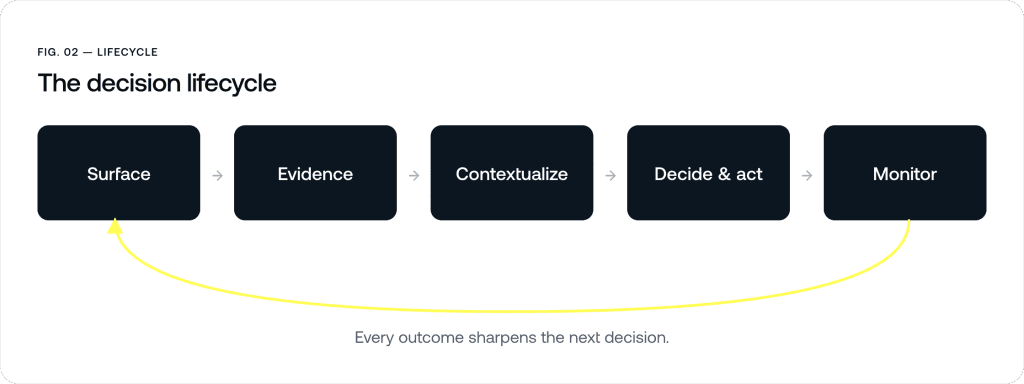
Deciding well is not a single moment; it is a lifecycle, and a decision intelligence platform is built to support every phase of it. It begins by surfacing the right signal, ideally before anyone goes looking for it. Rather than waiting for an analyst to run a query, the platform brings what matters into view: a sanctioned counterparty two hops away, an unusual stablecoin flow, an entity whose behavior just changed. This is where AI earns its place, reading the connected data continuously so the decision starts sooner.
A surfaced signal is only useful if it holds up, so the next phase is evidence: connecting on-chain activity to verified, off-chain ground truth about the real-world entity, with every claim traceable to its source. From there the platform contextualizes, using entity resolution and connection analysis to reveal the cluster, the counterparties, the corporate structure, and the path across chains, so the decision reflects the full picture rather than a fragment of it.
Then the decision is made and acted on, automatically for high-volume, lower-risk cases, or by a person for anything complex or consequential, with the platform connecting that decision to real systems so it actually happens: onboarding approved, a case escalated, a report filed, a position adjusted. Finally, monitoring tracks whether the decision held up, feeding the result back so the next one is sharper. No phase stands alone. A tool that only scores transactions can help you surface; a decision intelligence platform carries you all the way through to an action you can defend, and learns from what happened next.
What is a decision intelligence platform for digital assets?
A decision intelligence platform for digital assets is software that turns raw blockchain and real-world data into decisions organizations can make quickly and defend. It combines entity resolution, evidence-based attribution, connection analysis, and AI into a single foundation rather than a stack of disconnected point tools. What sets it apart from a blockchain analytics tool is where it stops: an analytics tool stops at the score, while a decision intelligence platform carries the work through to the decision itself and makes that decision explainable.
Three pillars define the category, and they are where Crystal draws the line against a converged market.
The first is that it is Verified: everything Crystal shows you is checked against the physical world, not guessed from the chain alone, so when you act you can show why, down to the source.
The second is that it is Timely: the platform surfaces what you need before you search for it, and its AI reads the connected data so the answer is waiting when the question arrives, turning reactive lookup into proactive intelligence and, in practice, turning decisions that took days into decisions made in seconds.
The third is that it is Defensible: every answer can stand up later, in court, audit, or challenge, because it carries its proof, with the source open to inspection and no proprietary-methods wall between your case and the evidence behind it.
Underneath all three sits the trinity that delivers them — Data, AI, and Attribution — and a principle about the role of the machine. The platform surfaces, contextualizes, evidences, and, where a decision is routine, executes it at speed against the customer’s own risk policy. But the consequential call stays with a person. Crystal surfaces; humans decide.
What decision intelligence is used for
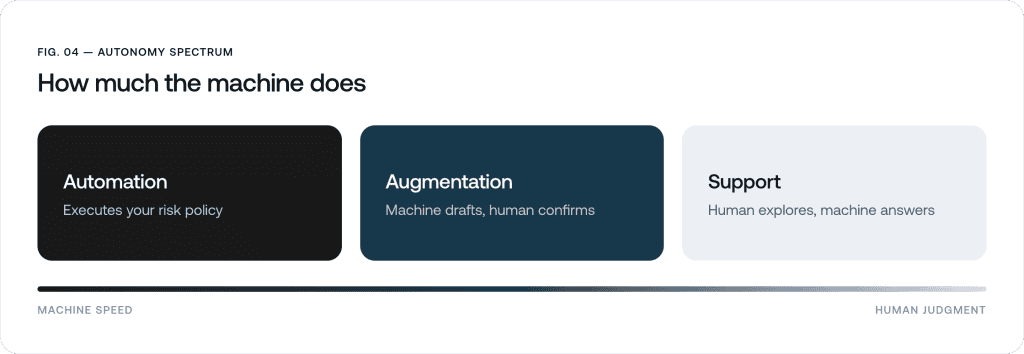
Not every decision needs the same treatment. Decision intelligence for digital assets meets three levels of decision, matched to how much a machine should do versus a person.
Decision type | Best fit | Examples |
|---|---|---|
Automation | High-volume, lower-risk, repeatable | Real-time transaction monitoring, address screening, first-pass onboarding, autonomous payment approvals |
Augmentation | Complex, case-by-case, human-owned | Fraud and financial crime investigations, escalations, suspicious activity review |
Support | Strategic, exploratory, judgment-led | Market entry, stablecoin exposure decisions, portfolio and oversight strategy |
For high-volume, lower-risk decisions, the platform executes the customer’s own risk policy at machine speed, monitoring transactions against their configured rules and thresholds and clearing the routine so people can focus on what is genuinely hard. This is where AI speed matters most: the policy is applied in the moment the signal appears, not hours later in a queue.
For complex cases, the platform surfaces, evidences, and recommends, and a human makes the call, seeing the full connected picture with attribution evidenced before deciding how to proceed. And for strategic decisions, it gives decision-makers a connected, real-time view to explore, so a team can weigh a stablecoin market shift, an exposure, or a new-market entry with evidence in front of them. These map onto the domains Crystal serves, from compliance and investigations to onboarding, stablecoin markets, and oversight, all drawing on the same evidenced foundation, which is what makes it a platform rather than a point tool.
Who uses decision intelligence for digital assets
Decision intelligence supports people making very different decisions, all from the same evidenced foundation. Compliance and AML teams use it to monitor activity, screen entities, and decide, with evidence, when to act, escalate, or file, often in real time. Financial crime and fraud investigators use the connected, cross-chain picture to trace funds and attribute entities, turning weeks of manual tracing into a decision they can prove in court. Onboarding and risk teams use evidenced attribution to decide who to accept and where to set limits, and to defend that decision later.
Further out, market and stablecoin analysts use real-time intelligence to spot unusual flows and liquidity shifts and act before the market moves, while regulators and oversight bodies use it to achieve transparency and explainability across the digital asset economy.
Leadership and strategy teams use the same connected view to make market and exposure decisions with evidence rather than instinct. What unites them is not a job title but a shared need: to decide fast, and to stand behind the decision afterward.
The old way | Decision intelligence | |
Data | Siloed; on-chain and off-chain apart | One connected, verified record |
Attribution | A score with no evidence | Evidenced, traceable to source |
Investigations | Reactive, query by query | Anticipatory, surfaced first |
Speed | Human-paced, days | Machine speed, seconds |
The decision | Asserted, hard to defend | Explainable, court-ready |
Anticipating agentic payments
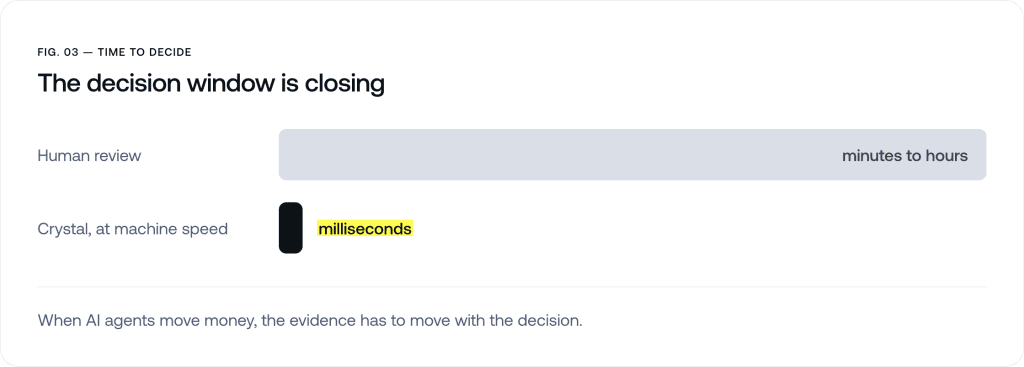
The next shift in digital assets is already visible: payments are starting to move autonomously, with AI agents initiating, approving, and settling transactions on behalf of people and businesses. When agents move money, decisions happen in milliseconds, and the evidence behind each one has to move just as fast. A compliance process built for human review, measured in minutes or hours, simply cannot sit in that loop.
Decision intelligence for digital assets is built for this before it becomes the norm. The same evidenced foundation that lets a human investigator prove who is behind an address lets an autonomous flow make a risk decision at transaction speed, with the same verified attribution and judgment a person would apply, only faster. Policy guardrails define what an agent may and may not do, every automated decision leaves a verifiable trail, and the consequential exceptions still route to a human. This is the clearest expression of the principle that runs through the whole platform: the machine executes the routine at speed, against the customer’s own policy, and people stay accountable for the calls that carry weight.
Anticipating agentic payments is not a feature to be added later. It is the logical endpoint of a platform designed around fast, evidenced decisions, and it is why decision intelligence, rather than transaction scoring, is the category that will matter as money learns to move on its own.
The benefits
Adopting decision intelligence for digital assets changes not just what an organization can see, but what it can decide, how fast, and how well it can defend the decision afterward. Decisions rest on verified, traceable ground truth rather than inference, so they stand up with an auditor, a regulator, or a court. Anticipatory surfacing brings the signal to you, so you catch what a query-based tool would only find if you already knew to ask, and Crystal’s AI reads the connected data continuously, so decisions that once took days are made in seconds.
Connected data and evidenced attribution cut the manual tracing that slows investigations and reduce the low-quality alerts that bury analysts, while one connected view spanning chains, entities, and off-chain reality means decisions reflect the whole context rather than a fragment. Automating execution of the high-volume, lower-risk decisions your policies define frees people for the calls that need judgment. And because the platform is ISO 27001 certified, SOC 2 Type II certified, GDPR compliant, and built on EU-based data governance, the foundation underneath your decisions is as defensible as the decisions themselves.
How this change the old way of working
Before decision intelligence, working with digital asset data meant stitching together fragments. On-chain data lived in one tool, off-chain intelligence in another, and the connection between them lived in an analyst’s head. Attribution was often a score with no visible evidence, investigations were reactive and query by query, and a decision was only as defensible as someone’s memory of how they reached it. That approach could tell you a transaction looked risky. It struggled to tell you who was behind it, whether the evidence would hold, what to do next, or how to do any of it in time.
Decision intelligence changes the starting point. Instead of chasing transactions, teams work from decisions, supported by a connected, evidenced view. Attribution now comes with verifiable ground truth, so a decision can be defended rather than merely asserted. The platform surfaces what matters before a search rather than waiting to be asked. On-chain and off-chain data resolve into a single view of the real-world entity. The work no longer stops at a score; it carries through to an action you can stand behind. And where decisions used to move at human speed, AI now lets the routine ones move at machine speed, while the consequential ones still belong to a person. Through all of it, one principle holds: Crystal surfaces; humans decide.
The Crystal approach
Crystal Intelligence brings decision intelligence for digital assets together in one platform, built on evidenced data and designed to carry organizations all the way from data to a decision they can defend. It starts by evidencing the data, ingesting on-chain activity across 330+ blockchains and 10,000+ digital assets and connecting it to verified, field-sourced intelligence about real-world entities, so attribution rests on evidence rather than inference across 118,000+ attributed entities. It then contextualizes that data, resolving entities and revealing the connections between wallets, clusters, counterparties, and corporate structures, and surfacing what matters before anyone searches for it.
Finally it helps you decide and act: executing your risk policy for high-volume, lower-risk decisions at machine speed, evidencing entities as high-risk or sanctioned where the data, on-chain, off-chain, market, and scam intelligence, supports it, and giving people the evidenced, connected view they need for the consequential ones, with every decision explainable and audit-ready and every consequential call kept with a human.
The platform spans the products organizations already rely on, from Crystal Expert for compliance and investigations to Crystal Foresight for stablecoin market intelligence with 99% market coverage and Scam Alert for fraud prevention. Crystal’s AI runs through all of it: Ask Crystal, the on-demand AI analyst inside Crystal Expert, reads the full on-chain picture behind any transfer and returns one clear, evidence-backed narrative in seconds, so teams decide in seconds rather than minutes while the judgment stays with a person. It is ISO 27001 certified, SOC 2 Type II certified, GDPR compliant, and built on EU-based data governance, so the foundation is as defensible as the decisions it supports.
The future outlook
The digital asset economy is not slowing down, and neither is the volume or the speed of the decisions it demands. As stablecoins settle more value, as institutions enter, as regulation deepens, and as payments begin to move autonomously, the organizations that win will be the ones that can decide fastest and defend those decisions best. Decision intelligence will not replace human judgment; the opposite is true. As more of the routine is automated, the consequential decisions that remain carry more weight, and the people making them will need better evidence, clearer context, and faster surfacing to make them well.
The category is still forming. The term “decision intelligence for digital assets” describes where the industry is heading: away from a market of near-identical scoring tools, toward platforms that turn data into fast, defensible decisions, and that are ready for a world where money moves on its own. Crystal intends to define that category, and to lead it.
FAQs
What is the difference between decision intelligence and blockchain analytics?
Crystal built its reputation on blockchain analytics and cryptocurrency intelligence, the attributed data behind who is who on-chain. Decision intelligence is the next step beyond it. Where blockchain analytics answers questions about past transactions, decision intelligence takes that same verified data and carries it through to the decision itself, connecting it to off-chain evidence, revealing the context, and producing an action you can defend, fast enough for the answer to matter.
How does AI make decisions faster without making them riskier?
The AI does not decide in a vacuum. It reads a foundation of verified data and evidenced attribution, so the speed comes from surfacing and connecting the right evidence the instant it appears, not from guessing. Routine, lower-risk decisions can then be made in the moment, while anything complex or consequential is routed to a person. Speed and defensibility come from the same source: evidence that is ready before the question is asked. Crystal’s Ask Crystal, the AI analyst inside Crystal Expert, already works this way: it turns any transfer into one evidence-backed narrative in seconds, doing the reading and correlating so the analyst’s judgment starts from the full picture. See how Crystal’s own AI moved from risk scores to evidence-backed narratives in AI in crypto compliance: from scoring to deciding
What are agentic payments, and why do they matter here?
Agentic payments are transactions initiated and settled by autonomous AI agents rather than people. They matter because they compress the decision window to milliseconds, which a human-paced compliance process cannot meet. Decision intelligence is built for this: an autonomous flow can make a risk decision at transaction speed using the same verified attribution a human would rely on, within policy guardrails, and leave a verifiable trail behind every call.
Do we still need human analysts?
Yes, and their work becomes more valuable. Automation handles the high-volume, lower-risk decisions, which frees analysts and investigators to focus on the complex, consequential calls, now supported by evidenced attribution and a fully connected view. The platform does the surfacing and evidencing; people make the decisions that matter.
How is this different from decision intelligence in banking?
General decision intelligence assumes clean, structured, single-jurisdiction data and known legal identities. Digital assets break those assumptions: identity has to be established from wallet behavior and verified against the physical world, data crosses chains and borders by default, and decisions increasingly happen at machine speed. Decision intelligence for digital assets is built for that reality.