Stablecoin settlement, crypto card programmes, and digital asset custody create exposure that traditional, fiat-era AML systems cannot see.
Beware of scammers impersonating Crystal Intelligence
Crypto transaction monitoring for banks and payment providers. Screen wallets, monitor stablecoin settlement, and investigate payment flows across any chain — with the audit trail your compliance team needs.
Verified transfers
Entities checked
Transfers flagged
Crypto payments are growing fast — but most compliance stacks were built for fiat. Three structural gaps stop institutional teams from meeting supervisory expectations.
Stablecoin settlement, crypto card programmes, and digital asset custody create exposure that traditional, fiat-era AML systems cannot see.
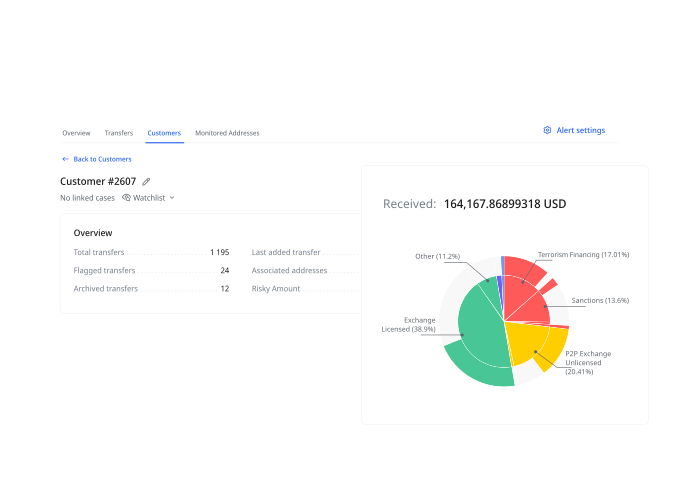
Processors handling $75M+ in monthly crypto volume cannot manually approve every counterparty wallet, and regulators expect real-time monitoring.
Supervisory bodies like BaFin, FCA, and VARA require verifiable data attribution and full evidential chains for enforcement.
Crystal Intelligence gives banks and payment providers blockchain analytics, transaction monitoring, and investigation tools in one platform — with hyperlocal data, multi-asset tracing, and configurable risk scoring to screen wallets at scale, detect sanctions exposure, and build court-admissible evidence.
AML compliance
Transaction monitoring
Wallet screening
Sanctions screening
Stablecoin monitoring
Fraud investigation
VASP due diligence
Regulatory reporting
From the CCO defending a regulatory filing to the analyst clearing an alert queue — Crystal fits the daily work of each role.
Configurable risk profiles that match your risk appetite. Court-admissible audit trail accepted by BaFin, FCA, and VARA.
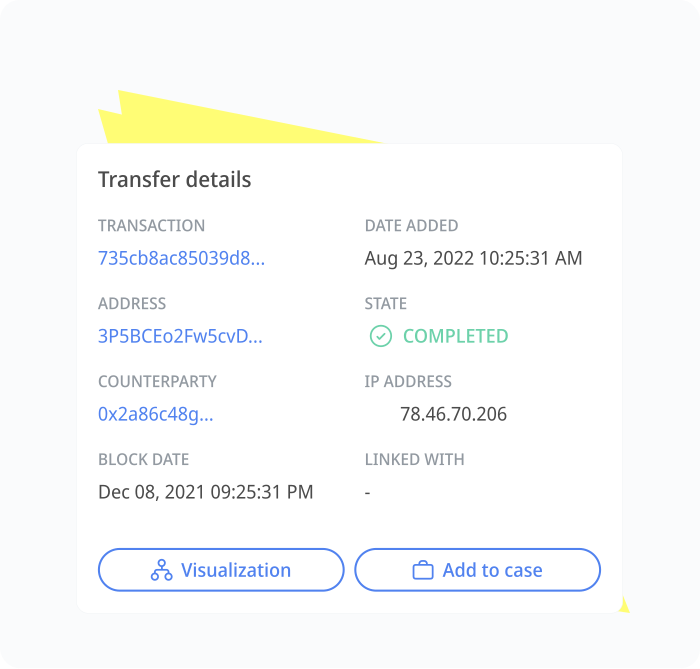
Screen counterparty wallets in seconds. 0–100% risk scoring across 26 risk categories reduces false positives and accelerates triage.
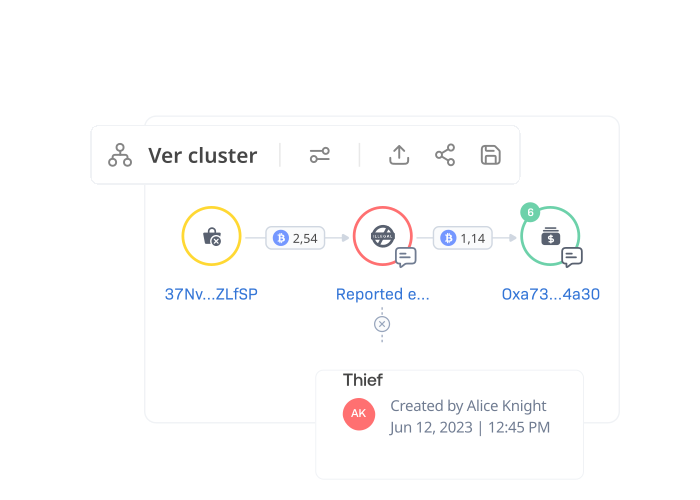
Trace funds across 330+ blockchains with unlimited hop depth. Build visual evidence graphs and export court-ready reports.
Three institutional workflows, each built from the same platform.
A payment processor onboards merchants accepting USDT. Crystal’s Monitor API screens each merchant wallet in real time, returning a risk score and counterparty breakdown. Wallets linked to sanctioned entities or darknet markets are automatically flagged, replacing the manual approval bottleneck.
A customer reports a scam. The investigation team traces funds from the Bitcoin ATM deposit through Crystal’s Explorer, mapping the path across multiple wallets to off-ramp exchanges. The complete evidence graph is exported for law enforcement.
A bank begins settling client payments in USDC. Every counterparty is screened before funds move, and Crystal's Case module compiles risk scores, entity attribution, and screening timestamps into a single record. .
When BaFin asks how a payment was approved, the evidence chain is already assembled.
A payment processor onboards merchants accepting USDT. Crystal’s Monitor API screens each merchant wallet in real time, returning a risk score and counterparty breakdown. Wallets linked to sanctioned entities or darknet markets are automatically flagged, replacing the manual approval bottleneck.
A customer reports a scam. The investigation team traces funds from the Bitcoin ATM deposit through Crystal’s Explorer, mapping the path across multiple wallets to off-ramp exchanges. The complete evidence graph is exported for law enforcement.
We support businesses, law enforcement, and legal teams by tracing and recovering stolen cryptocurrencies.
Our blockchain forensics experts unravel complex transactions, identify suspicious addresses, and deliver actionable insights to support recovery efforts.
Counterparty screening is the main event — VASP checks, entity due diligence — five more capabilities, built for compliance under FATF, MiCA, and BSA/AML.
The core check for every institutional relationship: screen any counterparty wallet or VASP before you transact. Entity identification, licensing and registration status, ownership, and sanctions proximity.
Extensive sanctions coverage plus unhosted wallet detection. Timestamp verification demonstrates a counterparty was not sanctioned at transaction time.
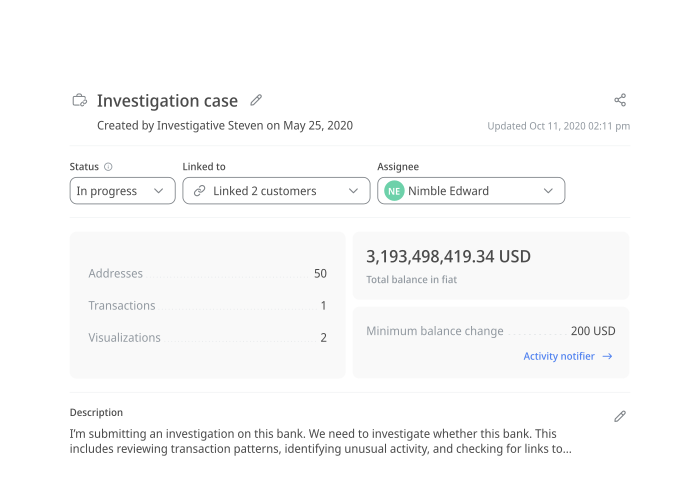
Create cases from flagged transactions, assign, collaborate, attach evidence graphs, and track resolution. Export court-ready packages.
Crypto transaction monitoring is the continuous screening of blockchain addresses and transfers for exposure to sanctions, fraud, darknet markets, ransomware, and other illicit activity. Traditional AML monitoring reads your own payment records. Crypto transaction monitoring reads a public ledger, so you can see where funds came from and where they go next, including counterparties you never onboarded.
Crystal gives your compliance team that view in one platform and one API, with a risk score from 0 to 100% and the evidence behind it.
Yes. Crystal supports pre-transaction screening, so you can check a sending address and its risk exposure before funds are credited or released.
The same API screens deposits and withdrawals as they occur, so pre-credit decisioning and ongoing monitoring run on one set of risk data. Screening is available in the Crystal Expert interface or through the REST API, depending on how your team works.
Crystal Expert traces funds across more than 330 blockchains and 10,000+ digital assets, including Bitcoin, Ethereum, Tron, Solana, BNB Chain, Polygon, and Arbitrum.
Stablecoin activity is covered in depth by Crystal Foresight, which monitors USDT, USDC, and the other major stablecoins across seven chains, including Ethereum, Tron, Solana, BNB Chain, Polygon, Arbitrum, and Optimism, with 99% stablecoin market coverage. If your customers settle in USDT on Tron, both the asset and the chain are in scope.
Crystal screens against major global sanctions regimes, including OFAC in the United States, the UN Security Council Consolidated List, EU sanctions and the EU crypto ban, UK sanctions, SECO in Switzerland, and lists issued in Canada, Australia, Japan, South Korea, and Israel, across more than 20 issuing authorities in total.
Designations are ingested and applied on an ongoing basis, so a newly listed address is flagged without your team rebuilding a list. You can also configure custom lists of restricted jurisdictions and counterparties to match your own risk appetite.
Yes. Crystal connects on-chain risk to the systems you already run through a documented REST API, rather than asking your team to work in a second platform.
Crystal also works alongside KYC and Travel Rule providers, including Notabene, 21 Analytics, Sumsub, Ospree, and Onicore. Integration scope is agreed up front in a working session with your team, so you know what is involved before you commit.
Crystal monitors addresses continuously and alerts you when their risk changes, not only at onboarding.
You can set alerts on a risk score increase, on a move between the low, medium, and high risk bands, and on balance changes, and you can group monitored addresses by customer. Alerts appear in the platform and can be delivered as scheduled reports to the people who act on them.
Crystal shows you the evidence, not only the score. Every attribution in a directory of 118,000+ field-verified entities is open to inspection, with no proprietary-methods wall, which matters when you have to defend a decision to a supervisor.
Crystal is EU-based, with data in its own German data centers and both ISO 27001 and SOC 2 Type II certification. It is built to sit behind your existing AML stack through an API rather than replace it.