



Bridge minted $717M of Open USD (OUSD) in its first week and placed most of it with founding partners, Coinbase, and market makers before demand arrived. On-chain data shows where each tranche went, and how little of it has moved since.
Open USD (OUSD) went live on September 30 on Tempo, the payments blockchain incubated by Stripe and Paradigm, as well as Base, Ethereum, and Solana. It is issued by Bridge, Stripe’s stablecoin subsidiary, and run by Open Standard, a company founded by Coinbase, Mastercard, Shopify, Stripe, and Visa. Open Standard’s model rewards partners for the OUSD supply they help create and the activity they drive, and its founders have committed $1B in launch liquidity, according to CoinDesk. One week in, the chain shows the first half of that model at work. Most supply has been placed and held. Very little of it is in use yet.
Key findings (as of October 5, 2026)
Supply is $666.3M, and 71% of it sits on Tempo.Bridge minted about $717M and burned $51M. Most of the minting, $640M, came in two bursts on September 29 and October 1.
Ten wallets hold 74% of supply. Sixty-four wallets of $1M or more hold 99.5%, and 218 of 355 holders hold under $100.
Coinbase took $200M as four identical $50M legs, one per chain. Every dollar of it is still held in Coinbase custody, $80M of it split across 40 custody addresses of exactly $2M each.
Trading on decentralized exchanges (DEXs) totals about $4.1M in six days, or 0.6% of supply. Tempo’s own exchange has handled roughly $17K.
Fee payments make up 73% of OUSD transfers on Tempo, because Tempo lets users pay transaction fees in stablecoins. Raw transfer counts overstate activity therenearly fourfold.
Headline supply overstates use. Most of the $666M sits in wallets that have not moved since they were funded, so supply figures alone say little about adoption yet.
How much OUSD is in circulation, and on which chains?
Chain | Supply | Share | Minted | Burned | DEX volume (6 days) |
Tempo | $472.8M | 71.0% | $523.6M | $50.9M | ~$17K |
Solana | $68.0M | 10.2% | $68.0M | <$0.1M | $3.4M |
Base | $65.0M | 9.8% | $65.0M | $0 | $0.7M |
Ethereum | $60.4M | 9.1% | $60.5M | <$0.1M | $0 |
Total | $666.3M | ~$717M | ~$51M | ~$4.1M |
Source: Crystal Foresight. Balances as of October 5, 04:00 UTC. Mints and burns through October 4. DEX volume September 30 to October 5.
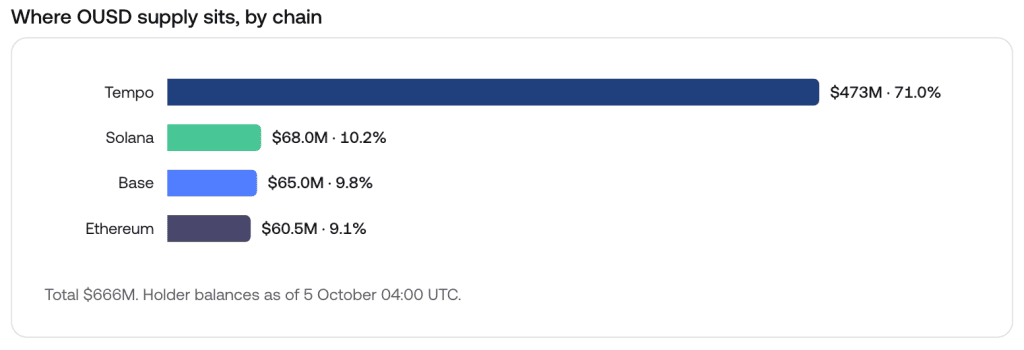 Above: Where OUSD supply sits, by chain
How did Bridge issue OUSD?
Bridge issued OUSD in stages, starting with test mints of $1 to $200 on Ethereum in late May, then on Base, Solana, and Tempo through September. On September 23 it minted $9.99M on each of the four chains, a week before launch. That pre-positioned about $40M where the first customers would need it.
The bulk followed in two moves. On September 29, the day before launch, Bridge minted $439.5M on Tempo alone. On October 1, the day Coinbase support went live, it minted $50M on each of the four chains. After that, issuance all but stopped. Between October 2 and 4, Bridge minted about $1.2M and burned $3.4M, so supply shrank by about $2.2M.
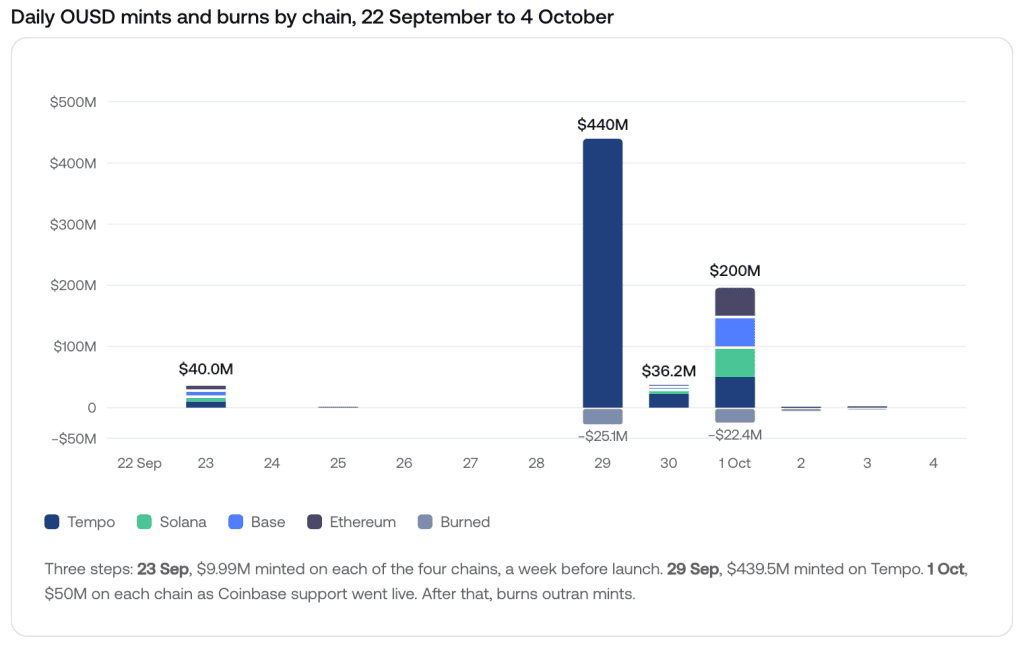
Above: Daily OUSD mints and burns by chain, September 22 to October 4
Every new token on Ethereum, Base, and Tempo was minted to a single Bridge wallet, 0x4c2c…00b8, and a second Bridge wallet does the same job on Solana. From there, supply has moved out to the rest of the network.
Where did the minted OUSD go?
Most minted OUSD went to a handful of wallets that have not moved it since. A second share went to Coinbase and market makers, which put OUSD in front of users and traders. A third came back to Bridge, and part of it was burned. Bridge holds the remainder in its own treasury.
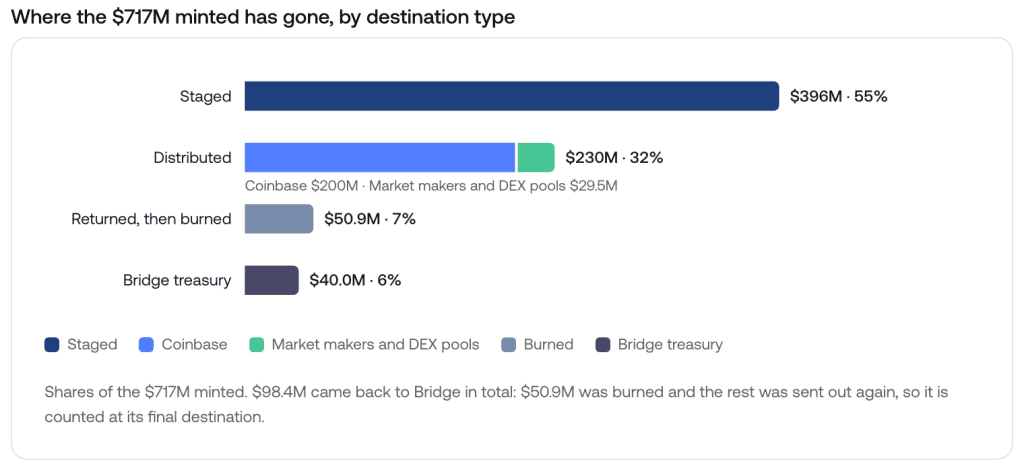
Above: Where the $717M minted has gone, by destination type
Staged: $396M. Eight wallets on Tempo received between $10M and $200M each directly from Bridge and have not moved it since. The largest holds $200M, delivered in four tranches on September 29, and the second $85M, which appears to be held in Coinbase custody. These are positions, not customers. They have no exchange or DEX activity, which fits CoinDesk’s report that founding partners would hold OUSD on their balance sheets or on-chain, or help make markets.
Distributed: $230M.Coinbase received $200M, as four identical $50M legs on 1 October, one per chain. Each leg was then divided the same way: ten transfers of exactly $2M and one larger transfer of about $30M. All 40 of the $2M addresses are Coinbase custody addresses and deal only with Coinbase, so the $200M is staged inside Coinbase rather than released to the market. On Ethereum, $25M of it went into Coinbase Prime, the firm’s institutional platform.
The rest of this group, about $30M, went to market makers and DEX pools. Wintermute received $4M on the EVM chains ($2.5M on Base and $1.5M on Tempo) and another $4M on Solana. On Base it put its $2.5M into the Uniswap v4 OUSD/USDC pool as liquidity. A second, unlabelled wallet received exactly the same amounts on the same day, added the same $2.5M to the same Uniswap pool, and sent its Tempo and Solana balances on to the same wallets as Wintermute’s. That is market-making behaviour, and it may be Wintermute itself. Tempo’s built-in exchange was seeded with about $5M.
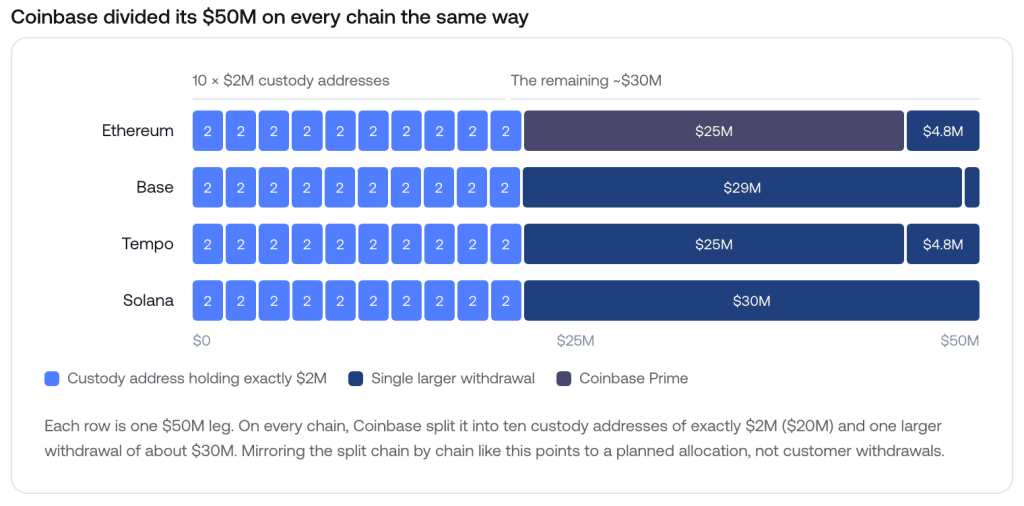
Above: Coinbase divided its $50M on every chain the same way
Bridge treasury: $40M. Bridge holds $30M in its EVM wallet and $10M on Solana, ready for the next customer.
That accounts for the $666M outstanding. The other $51M was redeemed and burned. In total, $98M came back to Bridge in the first week. Most of it, $95M, came from a single wallet that received the funds on September 29 and sent them all back through Bridge’s redemption address over the next two days. The wallet has no other activity, so the chain does not show why. Bridge burned $50.9M of the returned supply on Tempo, through the same redemption route it uses for its other stablecoins such as USDB, and sent the rest back out. That re-issued amount is counted in the groups above.
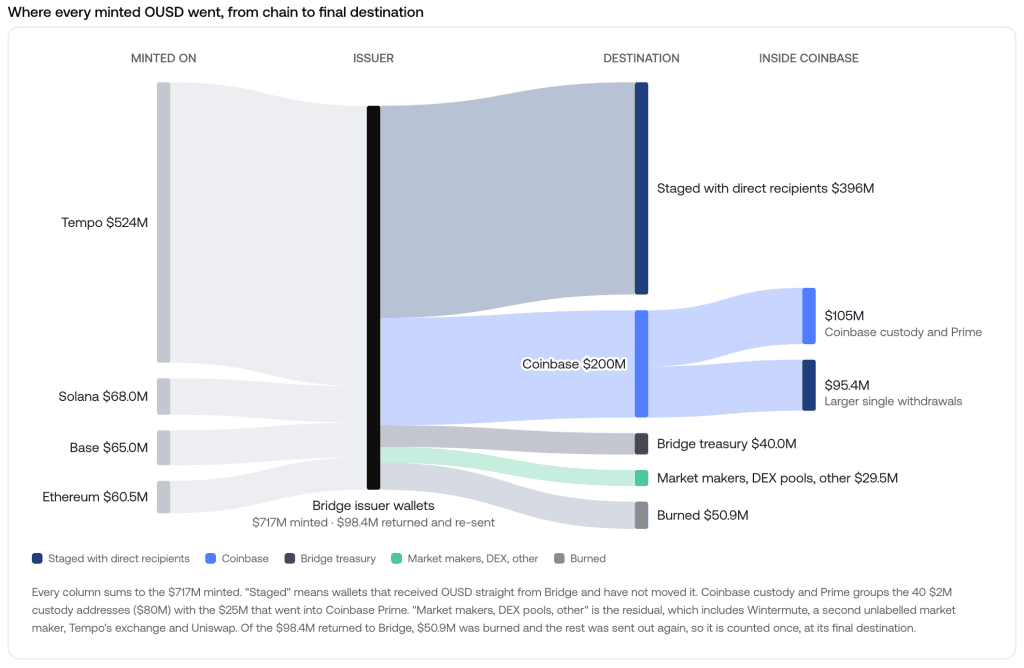
Above: Where the £717M went to, by destination type
Who holds OUSD?
A few large wallets hold almost all OUSD, and the 355-wallet holder count overstates how many parties are involved. Of these, 218 hold under $100, worth $3,197 in total. On Ethereum, Base, and Tempo, the largest group (73 wallets) holds Bridge’s own $1 to $15 test transfers, sent to wallets as they were set up. Another 32 bought small amounts through a DEX or a cross-chain aggregator. One Base address bought about $19K of OUSD on Uniswap and sent small amounts to 20 wallets, the closest thing to an airdrop in the data.
At the top, ten wallets hold 74% of supply. At that level of concentration, one partner moving or redeeming its balance would change OUSD’s supply picture on its own.
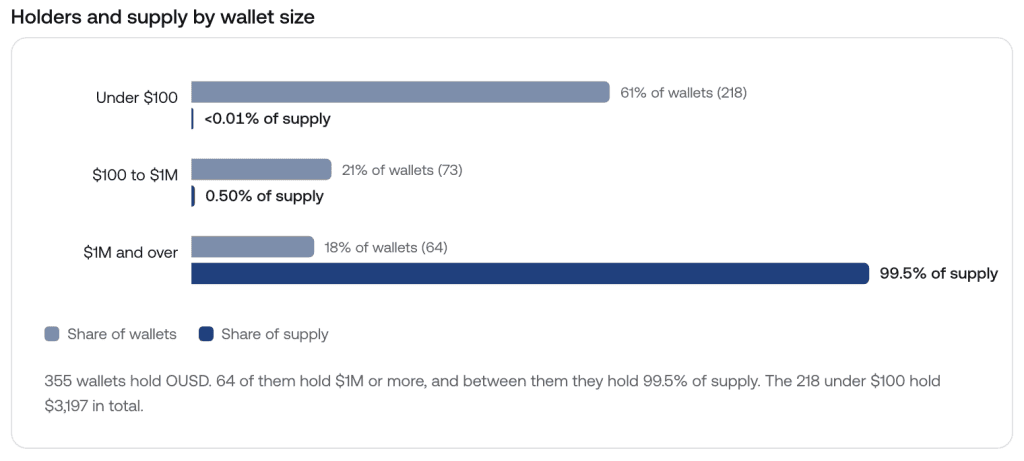
Above: Holders and supply by wallet size
How much is OUSD trading on DEXs?
Secondary trading is small next to supply. Across all four chains, DEX volume was about $4.1M in six days:
Solana:an Orca Whirlpool OUSD/USDC pool led with $3.4M.
Base: Uniswap v4’s OUSD/USDC pool did $0.7M across 676 traders.
Tempo: about $17K on its own exchange, despite holding 71% of supply.
Base also shows a familiar launch artifact. Within hours, unpriced copycat and meme tokens (OHUSD, OCTO, FIRSTOUSD, and others) were paired against OUSD. Those pools account for much of Base’s 7,300 transfers.
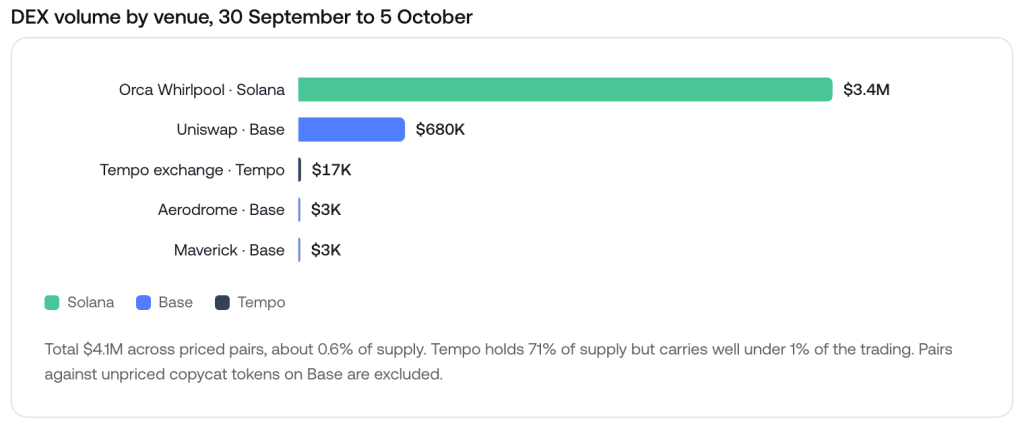 DEX volume by venue, September 30 to October 5
Why do Tempo transfer counts overstate OUSD activity?
Tempo lets users pay transaction fees in stablecoins, and each fee paid in OUSD is recorded as a transfer to the chain’s fee manager. Of 11,544 OUSD transfers on Tempo, 8,377 were fee payments worth $3.33 in total. Value needs the same care: 60% of Tempo’s $1.19B in non-fee transfer volume involves Bridge’s own wallet. At this stage, any headline figure for OUSD activity is mostly issuance and positioning.
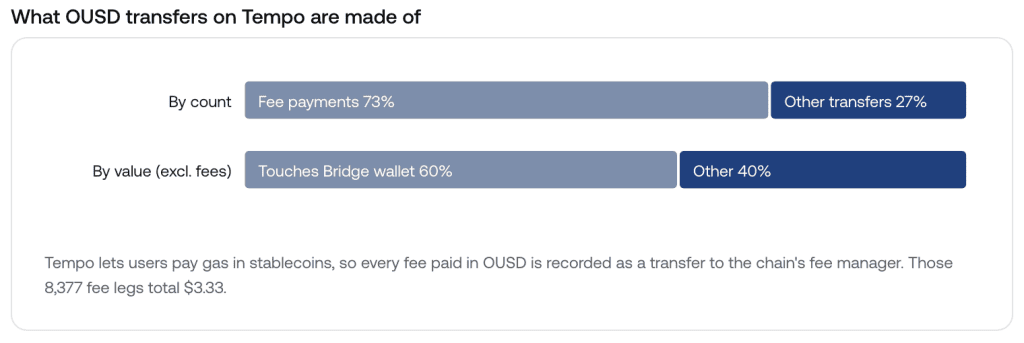
Above: What OUSD transfers on Tempo are made of
What to watch
The first week shows partners holding OUSD. These signals will show whether use follows:
Net issuance after October 1. It has been slightly negative so far. New mints that are not founder or partner placements are the clearest sign of organic demand.
When staging turns into circulation. The eight staged Tempo wallets and Coinbase’s 40 custody addresses hold most of the supply. Their first transfers to outside addresses will show what they are for.
Redemptions. Redemptions running ahead of mints would signal that early balances are flowing back to Bridge.
DEX depth on Tempo.Trading on Tempo’s own exchange will show whether the chain’s supply is starting to circulate.
Frequently asked questions
What is OUSD?
Open USD (OUSD) is a US dollar stablecoin issued by Bridge, Stripe’s stablecoin subsidiary, and run by Open Standard, a company founded by Coinbase, Mastercard, Shopify, Stripe, and Visa. It went live on September 30, 2026, on Tempo, Base, Ethereum, and Solana.
How much OUSD is in circulation?
As of October 5, 2026, OUSD supply was $666.3M. Bridge had minted about $717M and burned about $51M. Tempo held 71% of supply.
Who holds OUSD?
A small number of wallets hold almost all OUSD. Ten wallets hold 74% of supply, and 64 wallets with $1M or more hold 99.5%. Most of the largest balances sit in partner wallets, Coinbase custody addresses, and Bridge’s own treasury, and have not moved since they were funded.
Is OUSD trading on decentralized exchanges?
Yes, but volume is small. DEX trading totaled about $4.1M from September 30 to October 5, equal to 0.6% of supply. Most of it ran through an Orca pool on Solana ($3.4M) and a Uniswap v4 pool on Base ($0.7M).
Why do Tempo transfer counts overstate OUSD activity?
Tempo lets users pay transaction fees in stablecoins, and each fee paid in OUSD is recorded as a transfer. Of 11,544 OUSD transfers on Tempo, 8,377 were fee payments worth $3.33 in total. Excluding them cuts the transfer count by nearly three-quarters.
Data: address-level balances and transfers on Tempo, Base, Ethereum, and Solana, as of October 5, 2026.