


Stablecoin supply grew less than 1% in the third quarter of 2026, but the largest holders were busy underneath. RLUSD grew 59%. Exchanges cut billions of dollars of USDT and added other stablecoins, many of them backed by rewards programs and revenue-sharing deals.
Key takeaways
Supply barely moved. The stablecoins we track rose $2.2B (+0.7%) to $297.6B, leaving the market about 0.2% below the $298.2B it started the year at.
Exchanges used USDT to fund their moves. Between them, 19 named exchanges and lenders cut $4.6B of USDT and added about $1.9B of other stablecoins, often ones that carry rewards, such as RLUSD at Bybit and USDGO at Bitget and MEXC.
RLUSD grew the most. Its supply rose $929M (+59%) to $2.5B, the largest dollar gain of any stablecoin we track.
USDC’s derivatives growth came with revenue sharing. Hyperliquid’s USDC deposits grew $1.5B, about three-quarters of it from one cluster of linked wallets. Coinbase, which holds the reserve, passes most of the income on those deposits to the venue.
Lending growth was sponsored. Most of Morpho’s $404M gain came from a single $250M RLUSD deposit that Spark placed in a vault it co-runs.
How much did stablecoin supply grow in Q3 2026?
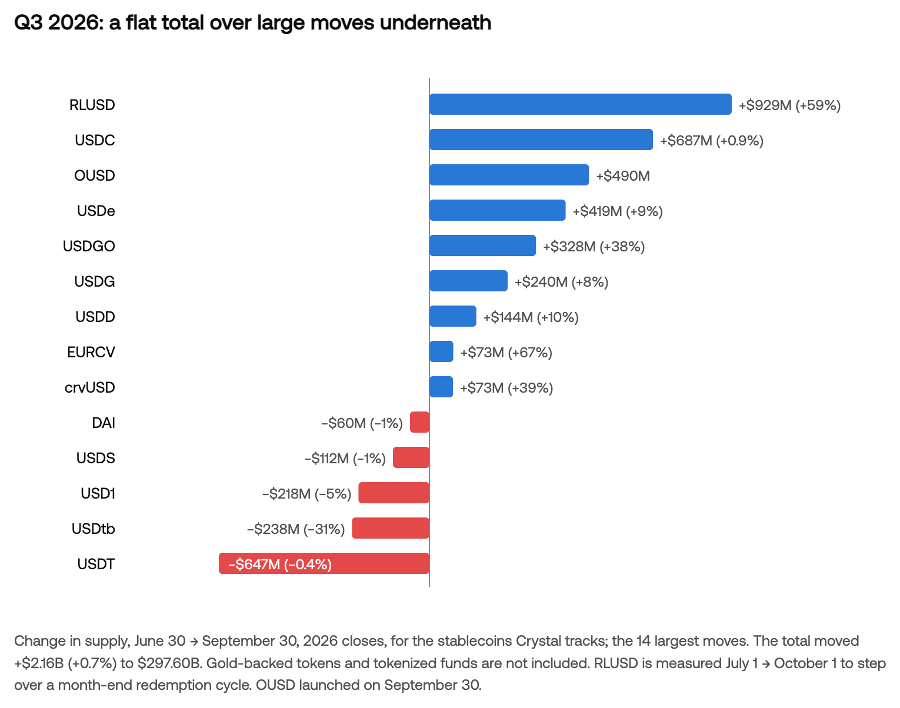
Figure 1. Change in supply by stablecoin, June 30 to September 30, 2026 (RLUSD measured July 1 to October 1). Source: Crystal Intelligence market-cap data.
Supply of the stablecoins we track rose from $295.4B on June 30 to $297.6B on September 30, a gain of $2.2B. RLUSD gained the most, at $929M (+59%). USDC (+$687M), USDe (+$419M), USDGO (+$328M), and USDG (+$240M) followed. Open USD (OUSD), which launched on September 30, closed its first day at $490M.
USDT fell $647M, a 0.4% move on a $184B base. USDtb lost nearly a third of its supply (−$238M), and USD1 fell $218M. Our Q2 stablecoin review covers the quarter before.
The flat total hides how much moved between holders. The largest holders moved about $32B in gross terms, and most of it netted out. The useful signal is who moved, and into which coins.
Five ways the largest holders moved
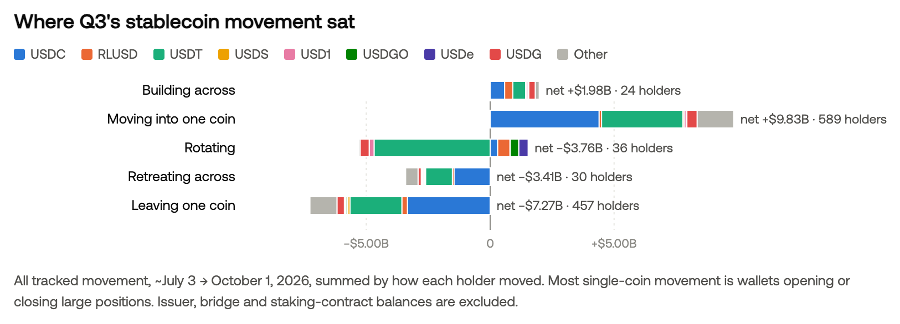
Figure 2. Q3 2026 holder movement summed by pattern, early July to October 1, 2026. Issuer, bridge, and staking-contract balances are excluded. Source: Crystal Intelligence holder and entity data.
We sorted each large holder into one of five patterns, based on how its balances changed across the stablecoins we track:
Building across: added several stablecoins and cut almost nothing
Moving into one coin: one large addition, little elsewhere
Rotating: added some stablecoins while cutting others
Retreating across: cut several stablecoins and added almost nothing
Leaving one coin: one large cut, little elsewhere
The single-coin groups are the largest by volume, at +$9.8B in and −$7.3B out. Most of that is wallets opening or closing large positions, such as new storage wallets, over-the-counter settlements, and withdrawals to self-custody.
The multi-coin groups are smaller but more revealing. They show which holders chose between stablecoins, and nearly all of them are named exchanges, lenders, and protocols. Because issuer, bridge, and staking-contract wallets are excluded, and the figures cover only the largest holders of each coin, the five groups net to about −$2.6B even though supply rose $2.2B.
The charts show change during Q3 only. At quarter-end, named exchanges in our data held about $85B of these stablecoins, roughly two-thirds of it USDT. Binance alone held $41B of USDT. The quarter’s rotation moved a few billion dollars against that base.
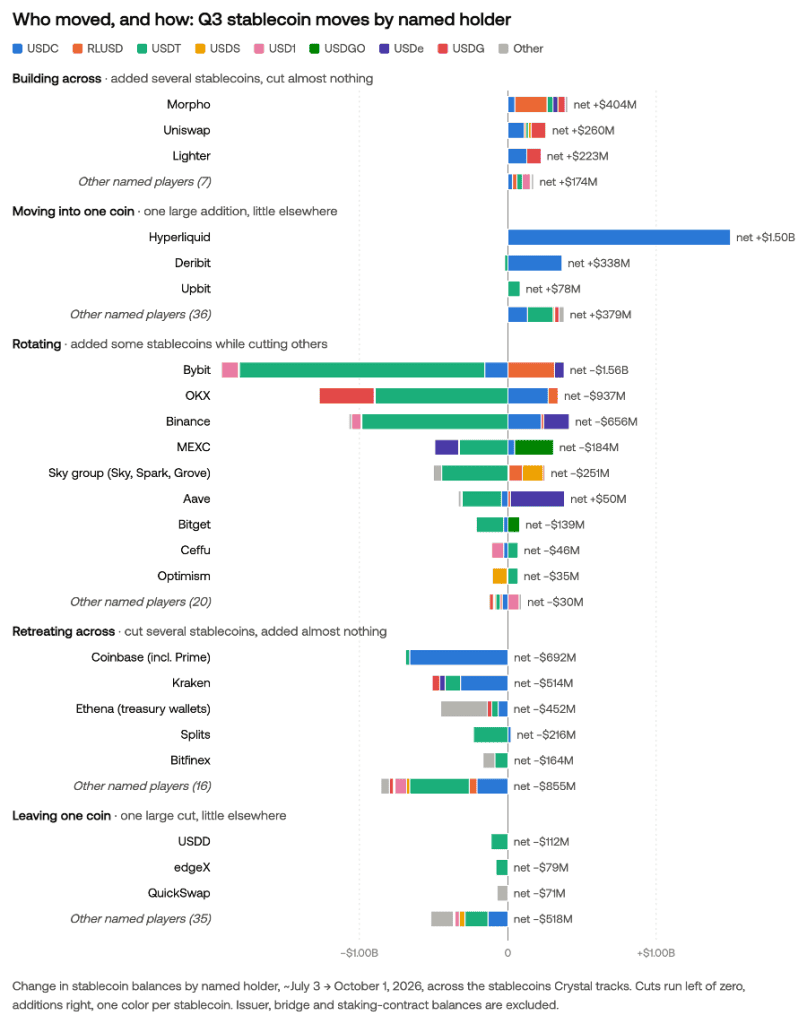
Figure 3. Change in stablecoin balances by named holder, early July to October 1, 2026. Cuts run left of zero, additions right. Source: Crystal Intelligence holder and entity data.
Lending vaults and trading venues added several stablecoins
Three venues added several stablecoins at once and cut almost nothing. Morpho, a lending protocol, rose $404M across six stablecoins, led by RLUSD (+$218M) and including $49M of USDG on Robinhood Chain. Uniswap, a decentralized exchange whose pools grow when liquidity providers deposit more of each coin, added $260M, mostly USDC (+$111M) and USDG (+$101M).
Lighter, a perpetual futures exchange, added $223M. It uses USDC as base collateral on its main exchange, where it added $127M. Its newer deployment on Robinhood Chain uses USDG as the settlement dollar and added $96M of USDG.
Morpho’s gain was built deal by deal. About $247M of it came from one deposit: Spark placed its own RLUSD, under a $250M cap, into a new Sentora x Spark vault, approved in Spark’s September 10 governance update (spell code). Morpho’s other RLUSD vaults shrank by about $29M, so its net RLUSD gain was $218M. At quarter-end, almost all of the Spark deposit was still waiting for borrowers.
The other Morpho vaults that grew were also built around partners. Sentora’s main RLUSD vault pays about half of its 5.4% headline rate as weekly RLUSD rewards. Steakhouse’s EURCV vault pays a flat 3% set by its curator, while most of its deposits sit unlent. Part of Morpho’s growth came from borrowers: its extra USDe is collateral posted to borrow RLUSD.
At Morpho, the partners behind the vaults decided where balances grew. A sponsor, a curator, or a rewards budget arranged most of the quarter’s increase.
Why USDC grew on derivatives exchanges
The largest single addition of the quarter went to one coin. Traders’ deposits on Hyperliquid, a perpetual futures exchange, rose $1.5B to about $7.2B, all of it USDC. Deribit added $365M of USDC. Both venues earn income tied to USDC.
Hyperliquid
Hyperliquid adopted new rules for USDC on August 26. Coinbase holds the reserve behind traders’ USDC and shares most of the reserve yield with the protocol, which reportedly funds buybacks of its HYPE token. The deposits belong to traders, but most of the income on them goes to the venue.
The growth was also narrow. About three-quarters of the quarter’s net increase came from one cluster of wallets that bridged USDC in and deposited it, most likely a single trading firm. Across all deposits, transfers of $100,000 or more were about 2% of the count but 80% of the value.
Deribit
Coinbase owns Deribit and funds USDC rewards on Deribit balances. It extended those rewards to about 70 more countries on August 1. Deribit also launched more than 100 USDC-settled contracts. Coinbase International’s perpetuals moved onto Deribit on October 1, the last day of our data, so that move will show in Q4.
USDC’s derivatives growth therefore reflects venue economics as much as trader preference. Circle and Coinbase’s revenue-sharing agreement renewed in August on the same terms, and Coinbase describes it as perpetually renewable. Coinbase passes part of its share to the venues holding USDC.
Quarter-end balances give a more mixed picture. On-chain perpetuals venues in our data hold almost entirely USDC. Aster, which holds mostly USDT and USD1, is the main exception. Most derivatives trading still happens on large centralized exchanges, and their balances remain mostly USDT.
Why exchanges cut USDT in Q3 2026
The rotating group shows Q3’s choices most clearly. Among its named players, the 19 that ended the quarter with smaller balances cut $4.6B of USDT between them. They added about $1.9B of other stablecoins, led by USDC ($569M), RLUSD ($493M), USDGO ($341M), USDe ($236M), and USDS ($139M). These are gross additions. Figure 2 nets each coin within the group, so its additions look smaller.
Table 1. The largest USDT cuts by named holder, and what each added, Q3 2026
Holder | USDT | Added | Also cut |
|---|---|---|---|
Bybit | −$1.66B | RLUSD +$315M, USDe +$64M | USDC −$155M, USD1 −$118M |
Binance | −$987M | USDC +$223M, USDe +$172M | USD1 −$63M |
OKX | −$899M | USDC +$273M, RLUSD +$67M | USDG −$375M |
Sky group (Sky, Spark, Grove) | −$444M | USDS +$139M, RLUSD +$92M | PYUSD −$42M |
MEXC | −$326M | USDGO +$262M, USDC +$46M | USDe −$161M |
Aave* | −$266M | USDe +$363M | USDC −$42M |
Bitget | −$189M | USDGO +$79M | USDC −$28M |
*Aave is shown for its lending rotation. It ended the quarter with a larger balance, so it is not one of the 19. Source: Crystal Intelligence holder and entity data, early July to October 1, 2026.
Several exchanges added a coin they run a rewards program for. Bybit’s RLUSD gain followed its RLUSD Hold & Earn campaign with Ripple, launched July 20. Bitget’s USDGO gain followed holding-reward and conversion campaigns that ran from March to July. The Sky group cut USDT and added USDS, which Sky issues.
Lenders rotated too. Aave’s pools held $266M less USDT and $363M more USDe, reflecting borrower demand for USDe as collateral. OKX made a two-way trade, cutting $375M of USDG alongside its USDT. USDG’s supply still grew $240M, because Lighter, Uniswap, and Morpho added about $246M of it on Robinhood Chain.
Regulation may also have played a part. MiCA’s transitional period for crypto service providers ended on July 1, and USDT is not authorized under MiCA. The rotation is consistent with venues reducing exposure to USDT while adding coins that carry rewards.
Not all of the USDT left for other stablecoins. Wallets we could not attach to a named holder added about $1.5B of USDT over the quarter, some of it exchange clients withdrawing to their own wallets. Part of the USDT that exchanges cut moved to self-custody rather than out of USDT.
Who cut stablecoin balances in Q3 2026
Holders in the retreating groups shrank their balances. Coinbase and Coinbase Prime together held $692M less, nearly all of it USDC. Some of that may have moved within the Coinbase group, since Deribit added $365M of USDC over the same period.
Kraken cut $514M, mostly USDC (−$317M) and USDT (−$105M). Galaxy Digital, Gate, and Crypto.com each cut $95M to $116M across two or more coins.
Taken with the building and derivatives groups, balances moved toward venues with active lending, derivatives trading, or partner rewards. Coinbase is the exception: it pays USDC rewards but still cut balances.
Ethena drew down USDtb as USDe spread
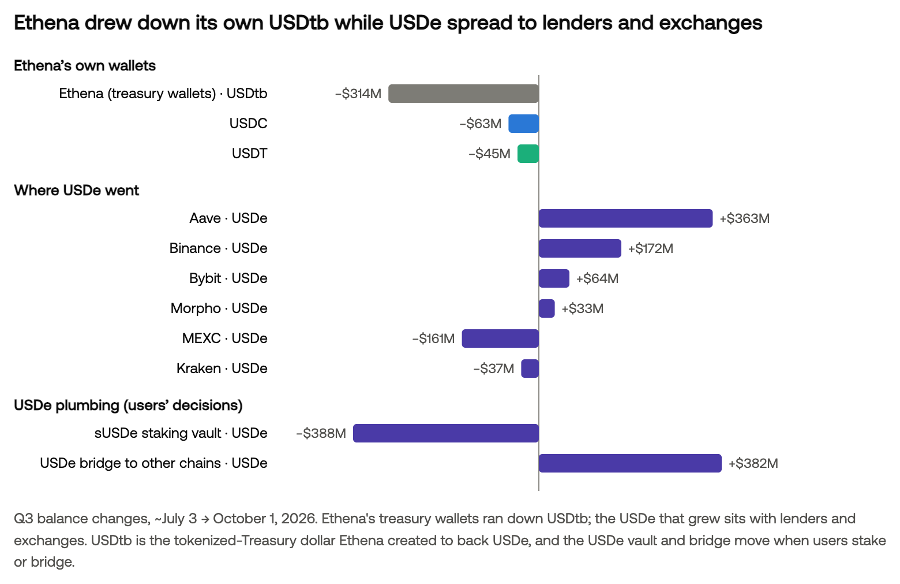
Figure 4. Ethena treasury wallets and where USDe went, early July to October 1, 2026. Source: Crystal Intelligence holder and entity data.
Ethena’s treasury wallets ran down $314M of USDtb, the Treasury-backed dollar Ethena created to help back USDe. USDtb’s total supply fell $238M, so other holders added about $76M. Over the quarter, USDe supply grew $419M. The new USDe went mainly to Aave (+$363M), Binance (+$172M), and Bybit (+$64M), where it is used as collateral and margin.
USDe reached Tron through Stargate on September 11, and much of the quarter’s new USDe moved to other chains in a few large transfers. Who is behind those transfers needs further research.
Who pays for stablecoin distribution
Rotations like these cost money, and issuers fund much of it. Circle paid $410M in distribution and transaction costs in Q2, 58.5% of its $701M revenue, according to its Q2 2026 results. Coinbase alone received $325M under its revenue-sharing agreements with Circle, according to Circle’s Q2 2026 Form 10-Q.
Tether reported $1.5B of net operating profit for Q2 in its press release. Its reserve buffer, the amount by which its assets exceed the USDT in circulation, roughly halved to $4.1B in the quarter, according to its BDO-assured reserve report.
PayPal is paying too. USD.AI, which lends to borrowers buying computing hardware, holds PYUSD as the reserve behind its own USDai token. The two offer a 4.5% incentive on up to $1B of deposits. USD.AI’s PYUSD reserve rose $51M in Q3 as new USDai was minted.
New entrants are bidding for the same venues. Open USDlaunched on September 30, issued by Stripe’s Bridge with Coinbase, Visa, and Mastercard among its partners (Stripe announcement). Most of its reserve yield is designed to flow back to partners.
Budgets for these deals grew late in the quarter. The Federal Reserve raised its target range by 25 basis points to 3.75% to 4.00% on September 16, so every reserve-backed issuer now earns more on its Treasuries. The effect will show in Q4.
What to watch in Q4 2026
Q3 was a quarter of competition for where stablecoins sit. Venues that pay rewards, lend, or settle derivatives drew balances in, and USDT was the coin most often cut to fund those moves. Three questions will show whether the pattern holds:
Do rewards-led balances stay once programs end? Bybit’s RLUSD Hold & Earn phase closes on October 18.
Does revenue sharing keep drawing derivatives deposits to USDC, or do rival issuers match the terms?
Do newer dollars that share reserve yield, such as Open USD, take share from the incumbents?
Frequently asked questions
How much did stablecoin supply grow in Q3 2026?
Supply of the stablecoins Crystal tracks rose $2.2B (+0.7%) to $297.6B between June 30 and September 30, 2026. That left the market about 0.2% below the $298.2B it started the year at. Underneath the flat total, the largest holders moved about $32B in gross terms.
Which stablecoin grew most in Q3 2026?
RLUSD. Its supply rose $929M (+59%) to $2.5B, the largest dollar gain of any stablecoin Crystal tracks. Bybit, which ran an RLUSD rewards campaign with Ripple, added $315M, and a single Spark deposit put about $247M into a Morpho lending vault.
Why did exchanges cut USDT in Q3 2026?
Between them, 19 named exchanges and lenders cut $4.6B of USDT and added about $1.9B of other stablecoins, often ones with rewards programs, such as RLUSD at Bybit and USDGO at Bitget and MEXC. Part of the USDT moved to self-custody rather than to other stablecoins. The end of MiCA’s transitional period on July 1 may also have played a part.
Why did USDC grow on Hyperliquid?
Traders’ USDC deposits on Hyperliquid rose $1.5B to about $7.2B in Q3 2026. Under rules adopted on August 26, Coinbase shares most of the reserve yield on that USDC with Hyperliquid. About three-quarters of the net increase came from one cluster of linked wallets.