

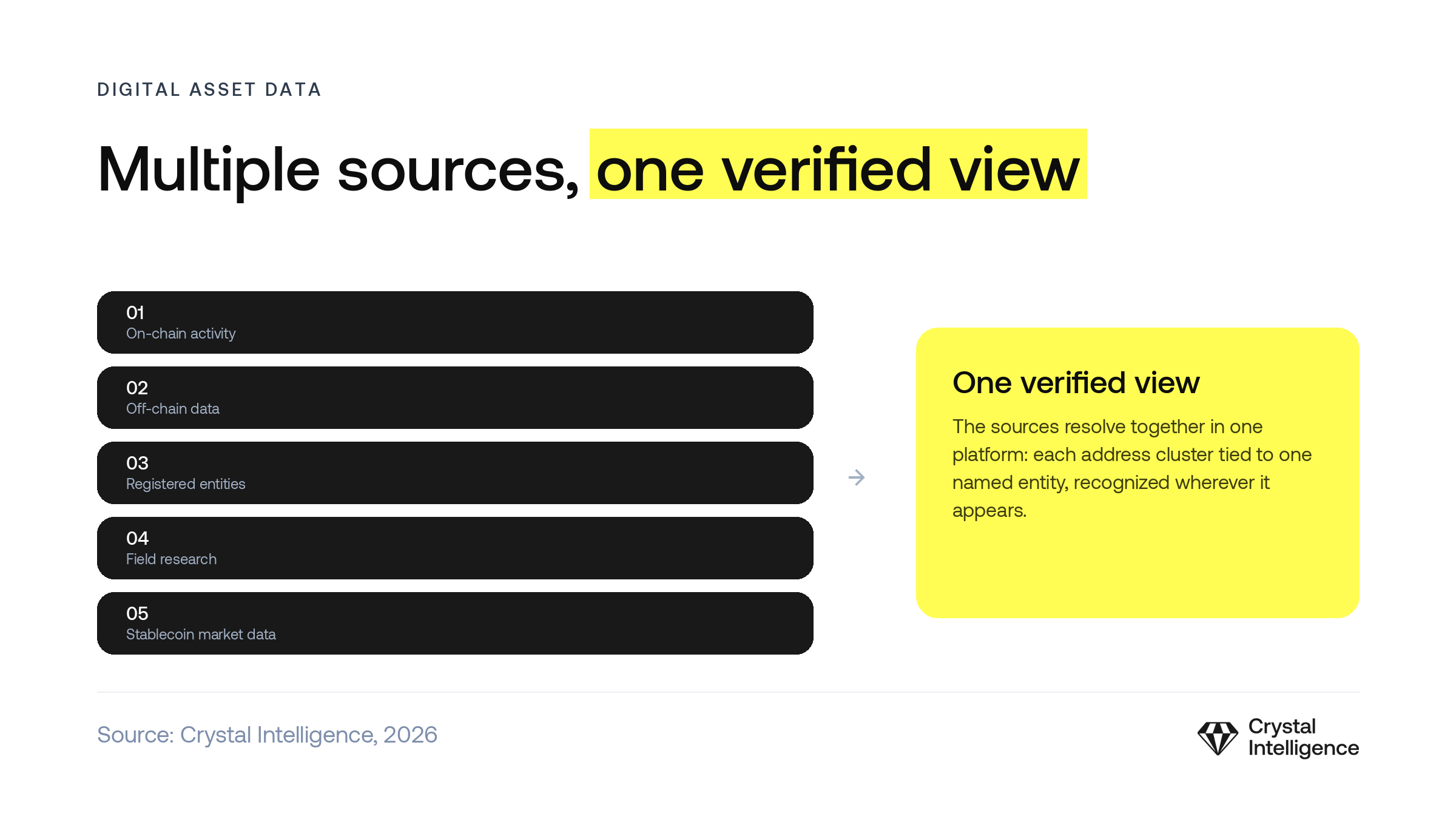
Digital asset data is the picture every decision-maker – including AI agents acting on their behalf – reads before making a call about digital assets in compliance, investigations, or markets. It includes on-chain activity, off-chain data, registered entities, field research, and stablecoin market data. The data forms the evidence a decision is made on: a clearance, a case, or a market call is only as reliable as the data it reads.
Decision intelligence for digital assets is the discipline of putting verified evidence in front of every decision an organization makes about digital assets. This article makes the case for its foundation layer: data as evidence – for compliance teams, investigators, regulators, and business teams in exchanges who must make quick decisions based on data they can trust. The stakes are rarely abstract. When an examiner, a court, or a board asks how you knew, the answer traces back to the data – which is why assurance matters: the ability to check the data yourself, before the decision is made.
Key takeaways
Digital asset data is the full picture a decision-maker reads: on-chain activity, off-chain data, registered entities, field research, and stablecoin market data.
Typically, as with most organisations, data is fragmented across many tools – the challenge is getting it into one consolidated view.
Three properties make data decision-grade: attribution over clustering, checked against the physical world, and consistent – the facts hold no matter when or who checks.
One verified view means multiple sources are resolved together in one platform.
AI searches that view and narrates only what the data supports – explaining its reasoning, never deciding, for the human analyst and the AI agent alike.
What is digital asset data?
Digital asset data is the full picture a decision-maker reads: on-chain activity, off-chain data, registered entities, field research, and stablecoin market data. It is broader than on-chain data. On-chain analysis can trace the full transaction graph and cluster addresses into probable wallets. What clustering can’t do on its own is confirm who is actually behind an address, whether they’re licensed to operate, what a counterparty’s corporate structure looks like, or how a stablecoin’s supply is moving against the market. Those answers come from attribution and off-chain sources: registries, field research, and market data.
Stakeholders need all of it at once – this is exactly the data behind quick decisions that have impact. Clearing a transfer means knowing the activity and the counterparty behind it. Building a case means connecting wallet behavior to a real-world entity that can be named in a filing. Reading a stablecoin position means seeing mint and burn activity next to market data. Every one of those questions draws on multiple sources at once.
One verified view means these sources belong together: a single, factual dataset drawn from on-chain activity, off-chain ground truth, registered entities, field research, and stablecoin market data, in one platform. Not multiple sources stitched together at query time, and not a probabilistic guess about how fragments relate. In Crystal Expert that resolution is the attribution dataset: each address cluster is tied to one named entity, and the same entity is recognized wherever it appears.
On-chain data alone | Digital asset data | |
|---|---|---|
What it covers | The full transaction graph – transfers, contract calls, protocol and bridge activity – plus addresses clustered into probable wallets by heuristic | On-chain activity + off-chain ground truth, registered entities, field research, stablecoin market data |
What it answers | What moved, through which addresses, clustered into probable groupings | Who’s actually behind it, whether they’re licensed, what the market is doing |
Where it stops | Clustering gets you a probable grouping, not a confirmed identity – it’s a pattern, not a claim you can defend | Attribution carries that grouping into evidence: identity confirmed, ready to be shown |
Who reads it | Analysts building a case that still needs confirming | Compliance, investigations, and market teams – and the AI agents acting on their behalf |
For professional operators – asset managers, custodians, brokers, payment firms, and exchanges – this data is working infrastructure: it is what pricing, custody, compliance, and audit decisions actually readю
Why do data silos slow down digital-asset decisions?
Data silos are the norm. Typically, as with most organisations, digital asset data is fragmented across many tools: an on-chain analytics feed in one tool, sanctions and licensing data in another, entity research in spreadsheets, market data in a terminal. Competent teams make this work. Analysts reconcile the fragments by hand, case by case, and the reconciliation is often careful and correct.
The honest cost is what the reconciliation takes and what it cannot give back. It takes time, which agentic payments and threat detection at machine speed do not have. It produces answers that differ between tools, because each fragment names entities its own way. None of that is a failure of the people involved. It is what fragmented data makes work look like.
Fragmented data layer | One verified view | |
|---|---|---|
Time to reconcile one case | Hours, pulling from separate tools and cross-checking names by hand | Minutes – the entities are already resolved |
What gets missed | A counterparty named differently across sources, so the link isn’t caught | Nothing – one entity has one identity, wherever it shows up |
What happens under time pressure | Reconciliation gets skipped or rushed | Nothing to skip – it’s already done |
Source: Comparison by Crystal Intelligence, 2026. For informational purposes only. Download as CSV.
What makes digital asset data verified?
Verified data is not data that someone feels more certain about. It has three properties, and each one can be tested: attribution over clustering, a check against the physical world, and consistency.
Attribution, not just clustering. Clustering groups addresses into a single wallet using heuristics – patterns that hold most of the time, not certainties. Attribution is the harder claim: tying that wallet to a real-world identity. At Crystal, this happens through direct engagement, verification against social media and websites, and testing the address itself – and analysts can always produce that evidence on request.
Checked against the physical world. Attribution is not given on-chain; it has to be established, and then confirmed outside the chain. More than 130,000 entities in Crystal’s dataset have been verified in the field (Crystal Intelligence, 2026), connecting clusters of on-chain behavior to organizations that exist in the world, with registered names and jurisdictions. Field verification is its own discipline, and it is what separates a name you can file from a cluster you can only group.
Consistent. Check the same wallet or entity twice, on different days, and the answer holds. That sounds modest until a technical evaluator runs due diligence, or a regulator re-runs a check from a filing, or two analysts compare case notes. Data that shifts between checks cannot anchor any of those. Consistency is the property that lets a decision be re-examined instead of re-argued.
Where do AI and attribution fit?
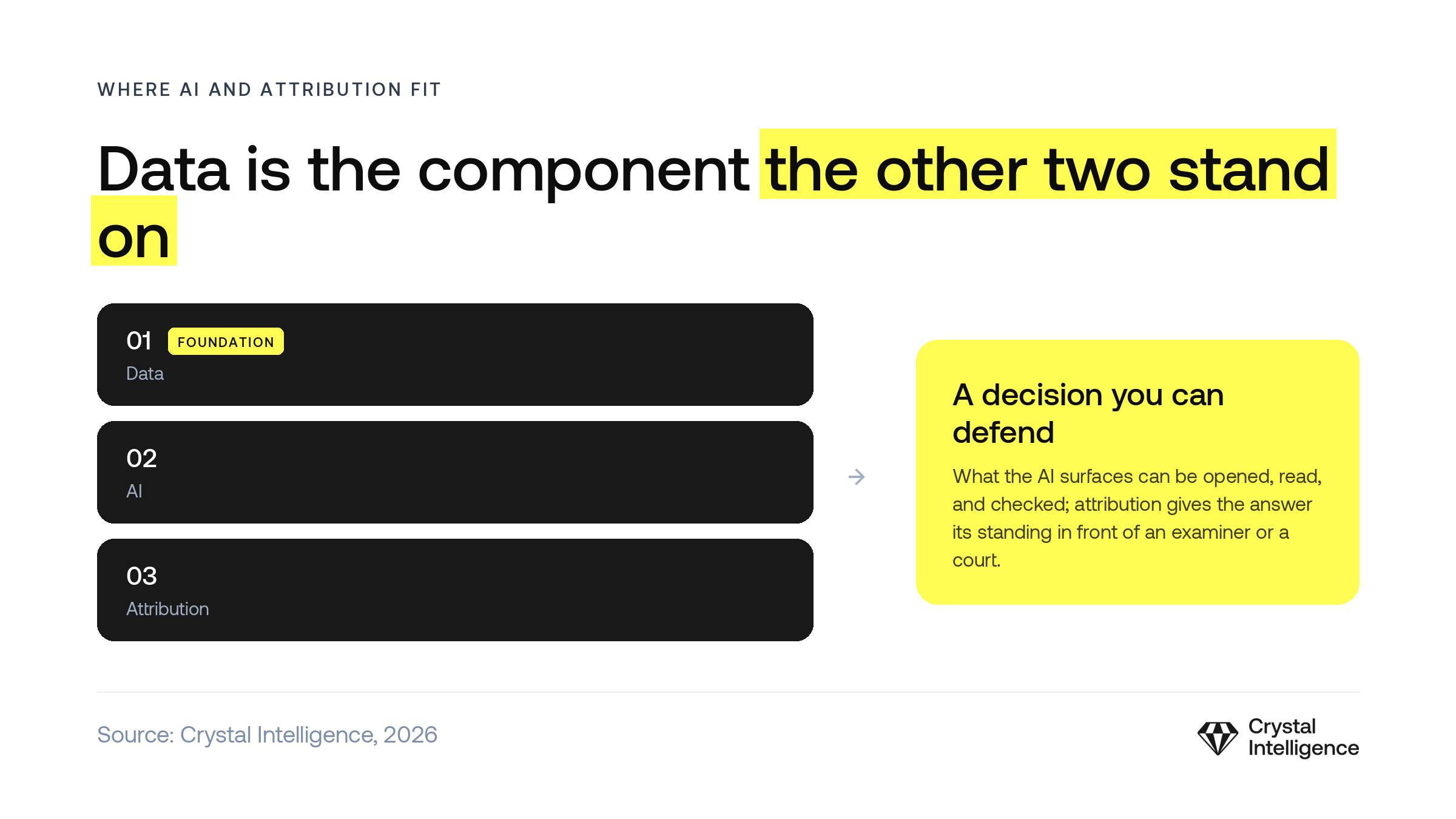
Data is one of three components that make decision intelligence work, and it is the one the other two stand on. Data without AI is slow. AI without attribution is a guess. All three together is decision intelligence.
The AI searches across both clustering and attribution – on-chain, off-chain, entities, research, market data – and surfaces evidence with its sources, for the human analyst and the AI agent alike: what it surfaces can be opened, read, and checked. It’s attribution, not clustering, that gives an answer the standing to be defended in front of an examiner or a court.
Frequently asked questions
What is digital asset data?
Digital asset data is the complete picture a stakeholder – or sometimes an AI agent – reads before making a digital-asset decision: on-chain activity, off-chain ground truth, registered entities, field research, and stablecoin market data. On-chain data alone is a subset; decisions about people, entities, and markets need the rest.
Why isn’t on-chain data enough for compliance decisions?
Because on-chain data shows activity, not identity or standing. Clustering can group addresses into a probable wallet, but who controls it, whether that entity is licensed, and how it connects to a corporate structure are off-chain facts established by attribution and registry research. A compliance decision that names a counterparty needs both halves, resolved together.
What makes digital asset data verified?
Three properties: attribution is evidence-based rather than heuristic like clustering, entities are checked against the physical world, and the underlying data holds steady – check the same wallet or entity twice and the facts don’t change, even if an AI-generated summary is phrased differently each time.
Why does consistency matter in blockchain data?
Because decisions get re-examined. A due-diligence test, a regulator re-running a check, or two analysts comparing notes all depend on the underlying facts holding steady. Data that drifts cannot support a decision that has to be defended later.
How does data quality change what AI can safely do?
An AI summary reads the data and narrates only what it supports: every figure is computed first, the model writes the sentences around those figures, and it explains rather than decides. Its output can be checked line by line, because every figure it cites was computed from that data first.
Build on data you can stand behind
Anyone making a digital-asset decision is quietly answering one question first: what does the data say, and can we stand behind it? If the data is fragmented, they inherit the stitching. If it is one verified view, they inherit evidence: named entities, sources attached, answers that repeat. Crystal Expert is built on that data across 330+ blockchains, so the question an examiner asks last is the one already answered first.