

Key takeaways
Blockchain intelligence contains two different things: consistent on-chain facts and probabilistic inferences from clustering heuristics, and only corroborated findings meet the bar of court-level evidence.
A hypothesis is not a conviction. Legal responsibility for acting on a finding sits with the investigating or judicial authority, not the vendor that produced it.
Clustering confidence isn’t uniform across networks: researchers have tested it most thoroughly on Bitcoin, less so on account-based chains like Ethereum and Tron.
The industry hasn’t set an accepted international standard yet for validating blockchain analytics, which is why independent benchmarking, not source code disclosure, is its biggest gap.
Vendors and courts share the job of raising the bar: vendors must disclose methodology and limitations, while courts, prosecutors, and defense counsel need the technical literacy to assess it critically – the shared bar behind decision intelligence for digital assets.
Why does blockchain analytics need an evidence standard?
Critics of blockchain analytics have a point. An algorithm producing a risk score that cannot be explained, audited, or reproduced fails the evidentiary standard a finding must meet before reaching a courtroom. Left unchecked, that kind of score risks frozen accounts and wrongful cases. The concern is legitimate.
But critics often blur two different things together: intelligence that is consistent and defensible in court, and intelligence that is probabilistic – a useful hypothesis, dangerous as a conclusion. Most criticism really objects to the second being presented as the first.
Decision intelligence for digital assets is the discipline of putting verified evidence in front of every decision an organization makes about digital assets. That discipline matters most in a courtroom, where the gap between a hypothesis and proof decides who gets prosecuted and who walks free. What follows is what that standard requires in practice, and who answers for it when a finding turns out to be wrong.
What do blockchain analytics critics object to?
Critics call blockchain analytics a “black box”: if you cannot see how a tool reached a conclusion, you cannot challenge it. When that’s true, it’s a real problem: a risk score with no explanation of how it was produced is not evidence – it is an assertion, and no investigator or judge should treat it as more than that.
But “black box” overstates how blockchain analytics actually works. Clustering, the technique behind most of these risk scores, groups wallet addresses that behave as though they share an owner – for example, addresses that repeatedly get spent together in the same transaction. Researchers have published and taught that technique in academic papers for years; anyone can read how it works. What a vendor keeps proprietary is its own software and how well that specific software performs, not the underlying method. In most cases, the results are consistent and are likely reproducible between vendors – with nuances around optimization and efficiency.
That is an ordinary trade secret, not a cover-up: Coca-Cola does not publish its recipe and Microsoft does not publish its source code. Courts still evaluate what both companies produce by testing the result, not by inspecting what is inside.
The sharper version of the criticism is this: banks, exchanges, and law enforcement pick a vendor largely on how accurate its clustering seems. Nobody outside the vendor checks whether that claim holds up before a finding freezes an account or feeds a criminal case. The fix is straightforward: the industry needs independent benchmarking to set and maintain standards – testing, validating, and publishing how well a tool’s clustering actually performs against known wallet activity, rather than taking a vendor’s word for it. More on what that would take below.
How are clustering and attribution different?
Blockchain analytics doesn’t solve investigations by itself – it helps trace flows and surface connections through two distinct steps of blockchain analysis. The method varies between types of blockchain: account-based and unspent transaction output (UTXO) chains are very different technically.
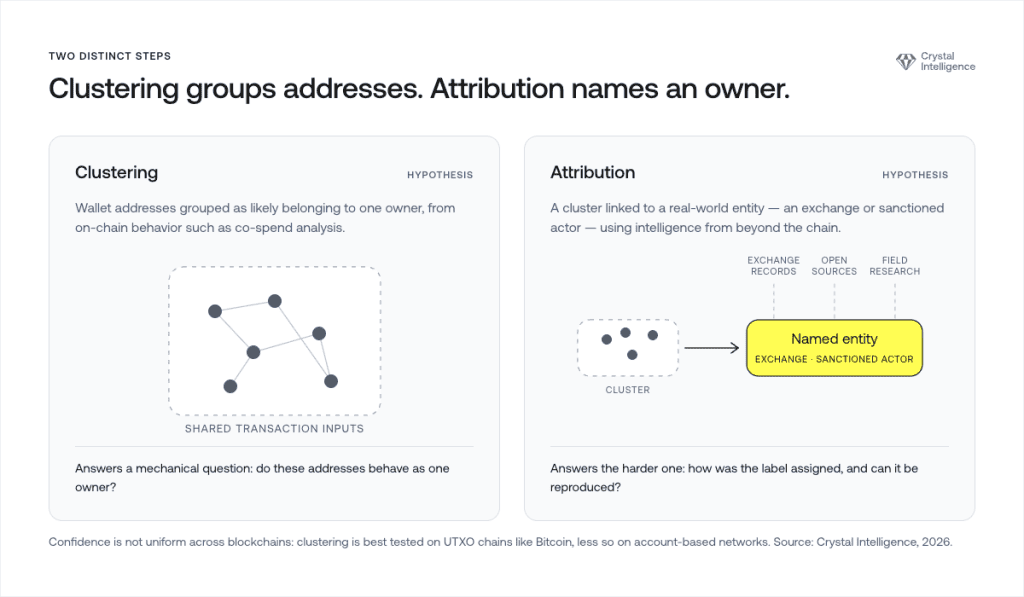
Clustering groups addresses based on a shared on-chain behavior, like common transaction inputs or spending; at a more basic level, it associates a seed phrase with its public child addresses. Attribution links a cluster to a real entity – an exchange or sanctioned actor – using external intelligence.
Clustering answers a mechanical question; attribution answers a harder one – how was the label assigned, and how replicable is that evidence? Tracing shows where funds moved. Attribution says who most likely controlled them. Neither step convicts anyone: a group of addresses is a hypothesis about ownership, and a court still needs corroborating evidence before it treats that hypothesis as proof.
Confidence is not uniform across blockchains. Researchers have tested clustering most thoroughly on UTXO systems like Bitcoin, where co-spend logic is generally easy to verify – with one large exception: CoinJoin transactions, which remain problematic for clustering algorithms (CoinJoin transactions are specifically designed to defeat clustering algorithms). Other implementations, such as the Lightning Network, Bitcoin’s layer-two network, are similarly difficult to trace and are designed to obfuscate and frustrate clustering and tracing. However, there is settled agreement in the industry that under most normal conditions, UTXO clustering is reliable.
How do CoinJoin transactions work
A CoinJoin transaction requires a third party to operate, known as a coordinator. Even when it’s clear which coordinator service was used – Wasabi Wallet, for instance – that coordinator relies on an external process to determine the transaction’s actual inputs and outputs, and reconstructing that mapping after the fact takes specialist training to do reliably. Tracing funds through a CoinJoin is correspondingly difficult to do with certainty. If you suspect you’re looking at one, it’s worth checking the raw transaction data: a CoinJoin typically has an unusually large number of inputs and outputs for a single transaction, with many of those outputs sitting at the same fixed denomination – the structural signature the mixing process leaves behind, even though it hides which output belongs to which participant. A public coordinator explorer takes that a step further, checking the transaction ID directly against known coordination rounds to confirm it came from that coordinator. Neither approach will tell you which output belongs to which participant, but both will confirm whether the transaction is a CoinJoin at all.
Account-based networks like Ethereum or Tron, which now represent a significantly larger share of on-chain activity, pose harder challenges, with less established heuristics. Presenting these findings honestly means saying plainly when confidence is lower, not just when it’s high.
Finding type | What it is | How it is produced | Evidence status | What courts need before relying on it |
|---|---|---|---|---|
On-chain transaction record | The ledger entry itself: amounts, addresses, timestamps | Read directly from the public blockchain | Consistent fact – anyone can verify it independently | Authenticated records and a clear chain of custody |
Cluster (grouped addresses) | Wallet addresses grouped as likely belonging to one owner | Heuristics such as co-spend analysis on shared transaction inputs | Hypothesis – probabilistic, confidence varies by blockchain | A documented method with known error modes, tested against known activity |
Attribution (named entity) | A cluster linked to a real-world entity, such as an exchange or sanctioned actor | External intelligence: exchange records, open sources, field research | Hypothesis – only as strong as the evidence behind the label | Disclosed seed data and the sources behind the attribution |
Corroborated finding | A hypothesis tested against independent records and context | Exchange, banking, corporate, and tax records plus investigative work | Court-level evidence when the method is auditable and reproducible | Independent corroboration and expert testimony open to challenge |
For informational purposes only. Not legal or compliance advice.
What does the blockchain intelligence evidence standard actually require?
Clustering has known limits: false positives happen when heuristic assumptions break down, for example with privacy tools or stale data. That’s a normal property of a probabilistic method, and it calls for judgment, not blind trust.
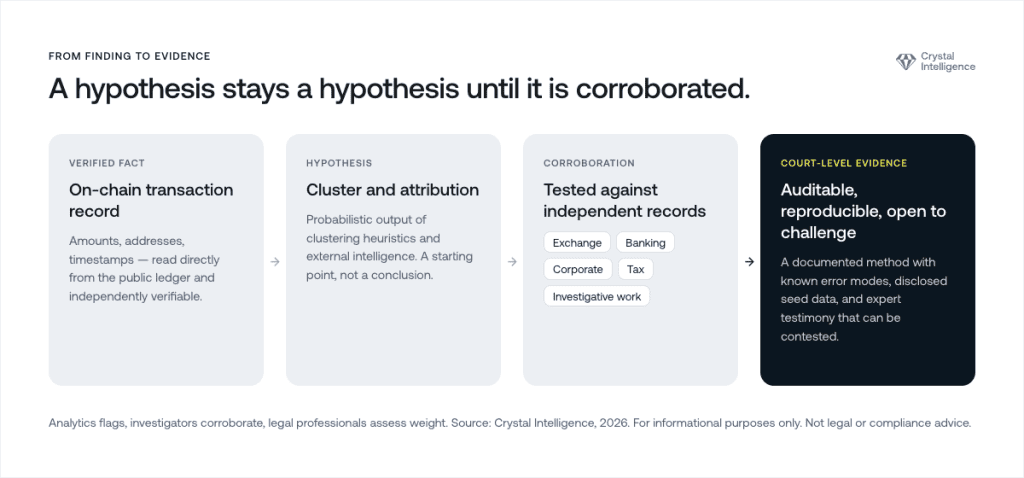
No legal action should rely on blockchain analytics alone. Investigators must test any finding against exchange, banking, corporate, and tax records, and against other contextual indicators. Analytics flags, investigators corroborate, and legal professionals assess weight – informing investigations, not replacing them.
That corroboration requirement is what the evidence standard actually asks for: a method vendors explain, and that others can independently audit and reproduce. That standard applies to forensic evidence generally – DNA, phone data, crypto forensics alike – not just blockchain intelligence.
This isn’t theoretical. In United States v. Sterlingov, the 2024 federal prosecution over the Bitcoin Fog mixing service, a Washington, D.C. court held a pretrial hearing specifically to test whether the blockchain clustering methodology behind the government’s evidence was reliable enough to reach a jury. The court ruled the blockchain analysis admissible – but only after establishing two things. Prosecutors had tested the method against real-world data: subpoenaed exchange records, manual tracing, and an independent cooperator’s review. And the method matched recognized academic technique. The clustering tool was not the sole basis for the case; witness testimony, documents, and other evidence carried weight too. That is what corroboration looks like in practice, and it is why the jury’s guilty verdict on March 12, 2024 rested on more than a risk score.
Who carries legal responsibility when a finding turns out to be wrong?
Critics ask: if a false positive results in an improper freeze or a wrongful conviction, is the blockchain analytics vendor legally responsible, or does the risk lie with the authority that used it?
Responsibility sits with whoever acts on a finding, not the tool that produced it. Forensic software that extracts phone data isn’t liable for how prosecutors use it, and a lab isn’t liable for how a prosecutor weighs its results. These tools feed a legal process; they do not decide to freeze assets or bring charges.
This is why the evidentiary standard matters in practice, not just in principle. Any authority must corroborate a finding against records and investigation before acting on it. One flawed inference should not alone cause a wrongful freeze. Treat a probabilistic finding as proof, and the failure is in that decision, not in the finding.
None of this excuses vendor carelessness. Any vendor must be accurate and disclose the basis for an attribution. But investigative and judicial authorities decide what action to take, and they carry that responsibility – the same as with any technical or expert evidence.
What responsibility does the legal system carry?
Vendors must honestly disclose their tools’ limitations, but rigor isn’t their burden alone. An analytics report is an input into a legal process, not a substitute for one. That only works if someone uses that agency: defense counsel who challenge a finding instead of accepting it, and judges who test whether a method meets the evidentiary bar instead of assuming it does because a vendor says so. Prosecutors, investigators, judges, and defense counsel all need the technical literacy to assess evidence critically, and that training matters as much as vendor disclosure.
Is industry engagement with courts and regulators a form of lobbying?
Critics point to event sponsorships, presentations to judges and prosecutors, and public-sector partnerships, asking whether this is lobbying meant to curry favor with courts and regulators before they settle these tools’ legal validity.
This engagement is advocacy: companies that sell a product have a commercial interest in explaining it to potential users, and that’s true of any vendor in a new field.
What that leaves out is why the private sector does most of the talking. No government has built its own blockchain analytics platform – it requires investment that public budgets have not made, in technology moving faster than procurement allows. Without an independent, publicly funded body, most explanations keep coming from the vendors who built the tools.
That’s a real gap, and the room needs more independent, non-vendor voices. But it’s a different claim to say vendors maneuver judges, prosecutors, and defense counsel into accepting these tools uncritically. Courts are not passive recipients of vendor materials – defense counsel retain experts to challenge findings, and prosecutors and judges can read multiple vendors’ materials. Judges and defense counsel have agency here. Assuming they don’t overstates the case – just as assuming analytics output is infallible does.
How should the industry raise its own standard?
No one has set an accepted international standard for validating blockchain analytics or blockchain forensics software. That’s a real gap. Clustering and attribution are different questions: clustering can be tested against known transaction activity, while attribution – linking a cluster to a real entity – depends on evidence beyond the blockchain, where the stronger criticism sits.
The industry should move toward clearer benchmarking, better confidence communication, and less hype. Independent benchmarking – testing known wallet activity against a tool’s clustering and publishing the results internationally – lets outsiders judge performance without requiring source code.
Where you look also matters. Local expertise in a specific fraud typology or jurisdiction – how crypto scams move through a particular region’s exchanges, say – is often more useful than a generic “crypto crime is rising” narrative that treats every case the same way. If evaluating a provider, ask: How is attribution verified? Can the method be audited and reproduced? Who is accountable if a finding is wrong? Is the data defensible in court? These are not hostile questions – they separate tools built for compliance theatre from tools built for real investigations. This is the same bar behind what we call decision intelligence for digital assets: not a bigger platform, but verified evidence in front of every decision, including the decision a court makes about whether to trust it. The same standard runs through our work on agentic payments, where software agents make those decisions in milliseconds.
Frequently asked questions
Does blockchain analytics hold up in court?
Yes, when it meets the evidence standard. The clustering methods behind blockchain analytics are published, taught, and independently testable, and a federal court examined them in United States v. Sterlingov and admitted them as evidence. What deserves scrutiny is any probabilistic finding presented as certainty – that is exactly what the evidence standard exists to prevent. Verifiable, evidence-backed attribution holds up in court, and auditable, reproducible methods hold up in practice.
What is the difference between a hypothesis and proof in a crypto investigation?
A hypothesis suggests a wallet may belong to an entity – a starting point, not a conclusion. Proof combines verified on-chain data, corroborating records, and reviewable methodology.
Can blockchain clustering methods be independently tested?
Yes, and confidence varies by network. Testing known clusters works well for UTXO chains like Bitcoin; account-based chains are harder. Academic literature describes the mechanisms; only the implementation is proprietary.
Does Crystal Intelligence disclose how its methods work?
The general mechanisms rest on established academic foundations, and anyone can learn them. Crystal can describe the methodology behind any investigation run in Crystal Expert – the heuristic applied, the seed data used, the sources behind an attribution. What stays undisclosed is the underlying algorithm code, the same way no software company publishes its source code.
How should investigators present blockchain analytics findings in court?
With a clear separation between what is verified and what is inferred. Transaction records are facts; cluster and attribution outputs are hypotheses with documented confidence levels. Investigators should document the method, source data, and reasoning behind any finding used in a proceeding, so it holds up as court-level evidence rather than an unverified guess.
Who is liable if a Crystal Intelligence finding turns out to be wrong?
Legal responsibility rests with the authority that acts on a finding, not with the software that produced it, the same principle applied to other forensic and investigative tools. Crystal Intelligence is responsible for the accuracy of what it discloses and for being clear about confidence levels. Investigators and courts are responsible for corroborating a finding before acting on it.
Should law enforcement use more than one blockchain analytics tool?
For major investigations, yes. Different providers have different strengths – geographic coverage, attribution depth, typology expertise. Using more than one tool and checking for agreement increases confidence, and no case should rest on the output of a single tool or provider.
How does the evidence standard relate to decision intelligence for digital assets?
Decision intelligence for digital assets is the discipline of putting verified evidence in front of every decision an organization makes about digital assets. The evidence standard is that discipline applied in court: a finding supports a decision – to freeze, to charge, to convict – only when it can be explained, audited, reproduced, and corroborated.
A serious tool deserves a serious standard
The objective here is simple: punish the guilty, protect the innocent, and treat blockchain analytics as a serious tool that deserves serious standards. Misuse and overreliance are real risks in this field. So is the question of who answers for it when a finding is wrong. Naming those risks plainly isn’t a concession that weakens the standard – it’s part of holding it.
That means transparency about limitations, not source code. Independent validation, not marketing claims. Clear lines of responsibility, so investigators corroborate a finding instead of treating it as a verdict. Disciplined courtroom use, where a hypothesis stays a hypothesis until investigators corroborate it. And honest collaboration between vendors, investigators, and the legal system, each holding up its part of the standard.
That is what decision intelligence for digital assets means when the stakes are a courtroom: evidence you can defend, not just an assumption.