




Crypto card services are openly marketing cards for paying Western AI subscriptions. DogPay, headquartered in Hong Kong, lists AI subscription payments as a use case for cards funded with USDT. Zarub, a card service aimed at Russian users, says its cards have been used for more than 48,000 ChatGPT and 37,000 Claude payments (see Figure 3). The figures are its own, and rounded.
Neither OpenAI nor Anthropic offers its services in Russia or China. For the VASPs that issue crypto cards, and the BIN sponsors behind them, that makes this a crypto card compliance question. EU sanctions ban crypto wallet, account, and custody services for Russian nationals and residents, and China’s central bank has declared crypto trading illegal on the mainland.
The Economist reported on this market on September 29, 2026, in The AI boom meets a new kind of crypto scam. It cites Crystal Intelligence’s April report on crypto cards, which found that nearly seven in 10 crypto card providers had weak know-your-customer (KYC) checks or none at all.
This post covers what these services say publicly, where the sanctions exposure sits, and what on-chain evidence can show about who funds these cards.
Key points
Card services advertise Western AI subscriptions as a use case, including on cards funded with USDT.
A program marketed for services that aren’t available in a customer’s country is a sanctions question, especially where Russian customers are involved.
Not every service is a crypto card. Some take local currency, such as rubles.
The AI provider sees an ordinary foreign-issued card payment, so the checks that matter sit with the issuer.
On-chain analysis can show where a card program’s crypto comes from, but not what the card bought.
How do virtual cards get around AI access restrictions?
A virtual card issued in another country lets a user in Russia or China pay a Western AI provider. It doesn’t, on its own, get them an account.
There are two hurdles. The first is the account. Providers block unsupported locations and check identity. Anthropic says it bans accounts from unsupported regions, including China and Russia, when identity verification fails, as reported by The Hacker News.
The second is payment, which is the hurdle these cards deal with. Cards issued by Russian banks stopped working abroad after the major international card networks suspended operations in Russia in March 2022. A card issued in China tells the provider the card comes from China.
A card from a program in another country gets around this in both countries. Some services fund it with crypto, usually a stablecoin such as USDT. Others take local currency and don’t say how it is converted.
A merchant normally reads a customer’s location from the card’s BIN, issuing bank, and billing address. With these cards, all three point to the issuing country, not to where the user really is.
What are card services advertising for AI access?
At least two services advertise Western AI access openly on their own websites. We describe them below based only on what each says about itself. Crystal isn’t suggesting that either company, or its customers, has broken the law.
DogPay: USDT-funded cards from Hong Kong
DogPay lists “AI Subscription Payments,” naming ChatGPT and Midjourney, as a use case alongside cross-border e-commerce and multi-currency accounts. Itscards page is explicit about funding: customers “use a supported USDT network, then convert and fund your card in the App.” It also says customers must complete KYC.
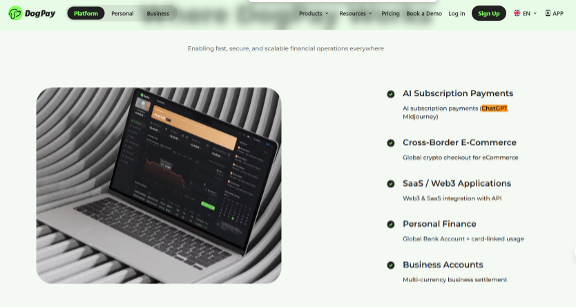
Figure 1. DogPay lists AI subscription payments as a named use case. Source: dogpay.com, accessed September 2026.
Zarub: ruble top-ups for Russian users
Zarub’s Russian-language site describes it as a “payment service for foreign services and foreign purchases” (Zarub quotes translated from Russian). Its landing page invites users to “top up your card with rubles and pay for ChatGPT, Claude Code, the App Store, Google Play, and other international services,” next to example payments marked “successful.”
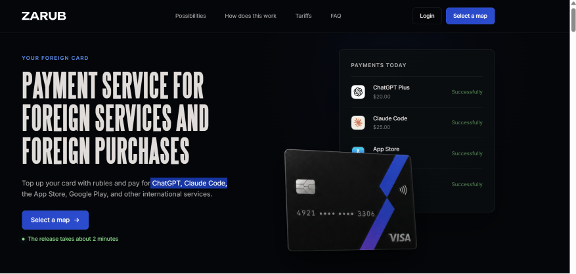
Figure 2. Zarub’s landing page (browser translation) advertises payment for ChatGPT and Claude Code. Source: zarub.io, accessed September 2026.
Zarub’s payment counts are led by Google at 90,000+, ahead of ChatGPT and Claude. The list also includes GPU rental platforms RunPod (15,000+) and Vast.ai (6,000+), which suggests some customers pay for computing power, not just chat access. All the counts are self-reported.
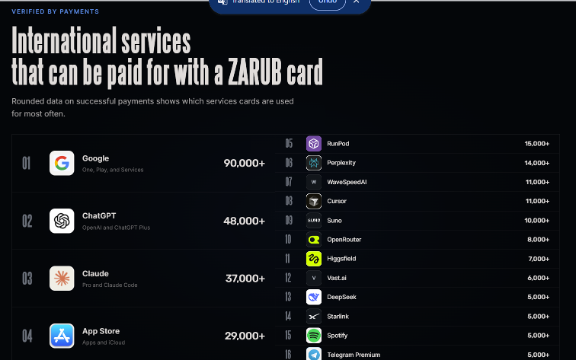
Figure 3. Zarub’s self-reported payment counts by service (browser translation). Source: zarub.io, accessed September 2026.
None of the Zarub pages we reviewed mention crypto. Customers top up in rubles through the Faster Payments System (SBP), run by the Bank of Russia, then pay in foreign currency with a foreign-issued card. Subscriptions renew automatically while there’s a balance, so the relationship is ongoing.
Zarubdoesn’t say how rubles become a foreign card balance, and we haven’testablished whether crypto is involved.
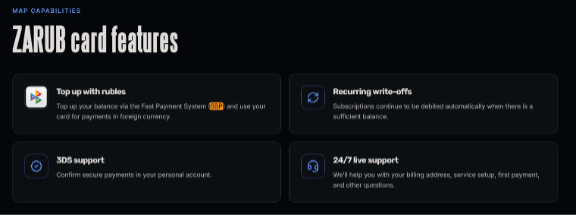
Figure 4. Zarub’s advertised card features, including ruble top-ups through SBP and automatic renewals (browser translation). Source: zarub.io, accessed September 2026.
What customers say
A public Chinese-language Telegram channel for a virtual card service, with more than 11,000 messages when we reviewed it, shows the cards in use. Its pinned message warns members not to link a new card to WeChat Pay or Alipay until it has been funded.
In a post dated September 3, 2026, a member shares a card history with several $0.50 pending charges from Anthropic and Google, plus a $0.20 fee for a declined payment. Another member asks why linking a card cost so much. These look like card-verification attempts, not confirmed subscriptions.
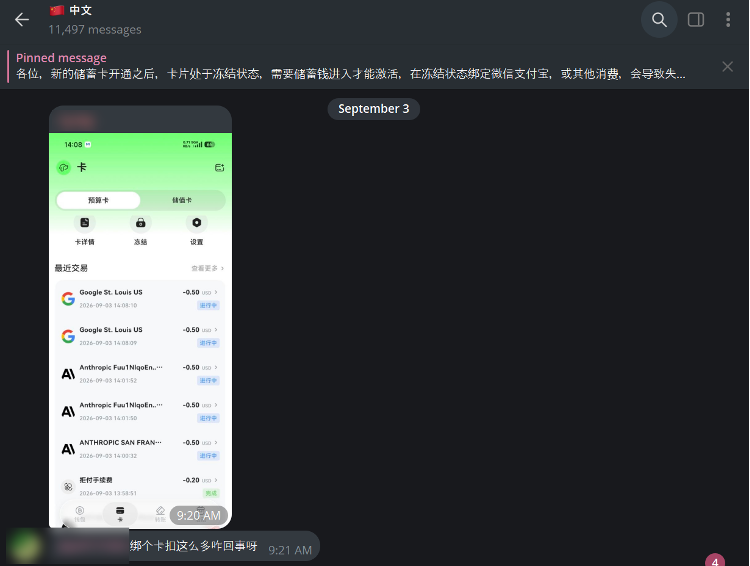
Figure 5. Small pending charges from Anthropic and Google, typical of card-verification attempts, shared in a card service’s Telegram channel. Usernames redacted.
In another post, a member explains that once customers complete KYC in the app, “both GPT and Claude support this card” (Telegram’s automatic translation).
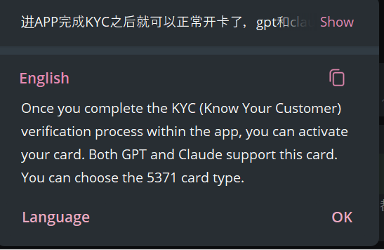
Figure 6. A channel member explains that after in-app KYC, the card works for GPT and Claude (Telegram auto-translation).
At least one of these services runs KYC, so the card service may know who its customer is even when the AI provider doesn’t.
Why is this a crypto card compliance issue for issuers and VASPs?
The risk sits with the program rather than the individual purchase: what it’s marketed as, who it serves, and where its money comes from. Russia and China raise different questions.
Russia: a direct question for EU VASPs
The clearest rule is European. Since October 2022, EU sanctions have banned crypto-asset wallet, account, and custody services for Russian nationals and residents, whatever the amount, with limited exemptions. An EU crypto card program that onboards anyone in scope has to square that with the ban. Our explainer on the EU’s crypto ban on Russia covers the detail.
For issuers and BIN sponsors elsewhere, the question is where the money comes from. SBP is Russia’s domestic payment system, so a ruble top-up passes through a Russian bank somewhere in the chain. Many major Russian banks are under US sanctions. If you sponsor or process for a program marketed to Russian users, you need to know which bank that is.
That doesn’t make every Russian user of a Western app a sanctioned person. The exposure comes from who sits in the payment chain.
China: local law and reputation
China isn’t under a broad US sanctions program. The sharper issue is Chinese law. In September 2021, the People’s Bank of China declared crypto trading illegal on the mainland, including services that offshore platforms provide to mainland residents online. A USDT-funded card program that onboards mainland residents is working against that position, whatever its home license says.
Questions worth asking of any card program you issue, sponsor, or screen:
Is the program marketed as a way to reach services that aren’t available in the user’s home country?
Does it onboard residents of Russia or mainland China, and does its KYC capture where customers live as well as who they are?
Are cardholders screened against sanctions lists, not just their funding sources?
Where are cardholders actually located, compared with where the cards are issued?
What funds the cards: which assets, and which wallets, exchanges, or banks send them?
Are large numbers of cards being opened by the same person or organization?
The answers matter because the person who funds the wallet, the cardholder, and the person using the AI account may not be the same.
Why does large-scale AI access matter to card issuers?
Because payment is where large-scale access leaves a trail, and the issuer may be the only party that can still see it. Anthropic’s recent reports show why. These cases involve AI labs targeting an AI provider, and no VASP or card program has been named in them.
In February 2026, Anthropic said three Chinese AI labs, DeepSeek, Moonshot AI, and MiniMax, used about 24,000 fraudulent accounts to generate more than 16 million exchanges with Claude. An exchange here means one prompt sent to the model and the answer it returns. Anthropic says the labs used those answers to train their own models, a technique called distillation.
Distillation is a standard machine-learning method. Anthropic’s objection is to doing it at scale, through fake accounts, against its terms and regional restrictions. In its September 2026 threat report, it named further China-based labs. The largest campaign, which it attributes to Alibaba, ran to about 151 million exchanges across more than 3,500 accounts, according to TechCrunch.
Anthropic describes how the labs got access and paid for it:
Commercial proxy services resell access to Claude at scale.
These services “create thousands of new accounts under fictitious identities, fake or stolen credit cards, and illegally harvested API keys,” as reported by The Hacker News.
One lab built its own proxy network through a shell company, according to The Hacker News.
In one campaign, the accounts shared payment methods, one of the signals that helped link them.
None of these reports mention crypto cards, and we aren’t suggesting they were used. The lesson for issuers is narrower. If a program gives one customer many card numbers, or funds many cards from the same wallet, the merchant loses the shared-payment signal, but the issuer still has it.
What can on-chain analysis show about crypto card funding?
On-chain analysis shows the funding side of a crypto card program, which is the side an issuer or sponsor is responsible for knowing.
Decision intelligence for digital assets is the discipline of putting verified evidence in front of every decision an organization makes about digital assets. For a card issuer or sponsor, the decision is whether to onboard, keep, or restrict a card program, and on what terms.
For crypto-funded programs, the part before the payment happens on-chain, and that’s where the evidence is.
User wallet → crypto transfer → card service deposit address → [off-chain card balance and payment] → merchant
Crystal Expertlets your team trace funds across 330+ blockchains from a card program’s deposit addresses back to their sources. Using 118,000+ attributed entities, you can see which exchanges and services send funds to the program, whether any have exposure to sanctioned entities such as Garantex, and whether large volumes arrive from the same few sources.
Crystal’s field-sourced intelligence from high-threat jurisdictions helps with the ruble case. For a ruble-funded service like Zarub, the open question is how rubles become a foreign card balance. If crypto sits in the middle, for example through a ruble-to-USDT conversion service, that step is traceable on-chain.
On-chain evidence has a hard limit. Once crypto becomes a card balance, spending moves through the card networks, off-chain, so it won’t show which merchant a card paid. Combined with card transaction data and account information, the funding trail gives a much fuller picture.
Crypto card compliance FAQ
What is a crypto card?
A prepaid or debit card, issued on one of the international card networks, that the customer funds with crypto. The card service converts the crypto into a card balance, and the card then works like any other at merchants. Not every card sold for Western AI access is a crypto card. Some services take local currency, such as rubles, instead.
Can EU crypto firms offer card services to Russian customers?
EU sanctions ban crypto-asset wallet, account, and custody services for Russian nationals and residents, whatever the amount, with limited exemptions. A crypto card program run by an EU firm needs to check whether it onboards anyone in scope.
Is it illegal for people in Russia or China to use Western AI services?
Not in general. OpenAI and Anthropic don’t offer their services in either country, so using them there usually breaks the provider’s terms. The legal questions sit mainly with the businesses in the payment chain, such as card services and the banks behind them.
Can on-chain analysis show what a crypto card was used to buy?
No. Card spending runs through the card networks, off-chain. On-chain analysis shows the funding side: which wallets and services sent crypto to the card program, and whether any have exposure to sanctioned or high-risk entities.
What red flags should a card issuer look for in a crypto card program?
Marketing aimed at users in restricted or unsupported countries. KYC that captures identity but not residence. A gap between where cardholders are and where cards are issued. Funding with sanctions exposure, or large volumes from the same few sources. And one customer holding many card numbers.
Were crypto cards used in the Anthropic distillation cases?
There’s no public evidence that they were. Anthropic says the labs used proxy services, fraudulent accounts, fake or stolen credit cards, and harvested API keys. It also says shared payment methods helped it link one campaign’s accounts.
Conclusion
Cards for paying Western AI from Russia and China are marketed in the open. For card issuers and VASPs, that leaves three points:
The use case is advertised in public, with self-reported usage in the tens of thousands.
The AI provider sees an ordinary foreign card, so the evidence sits with the issuer and the funding trail.
For Russia, the EU crypto ban and sanctioned banks make this a direct compliance question. For China, the central bank’s crypto rules apply to mainland residents.
One question stays open: how do ruble-funded services turn rubles into foreign card balances?