
More than ten years after the launch of the Bitcoin Blockchain, coins that were mined on February 9, 2009 have just started moving. Yesterday, 50 BTC left the address 17XiVVooLcdCUCMf9s4t4jTExacxwFS5uh. They were initially received in block number 3,654, created on February 9, 2009 – exactly one month after bitcoin mining started.
[May 28, 2020 Update]
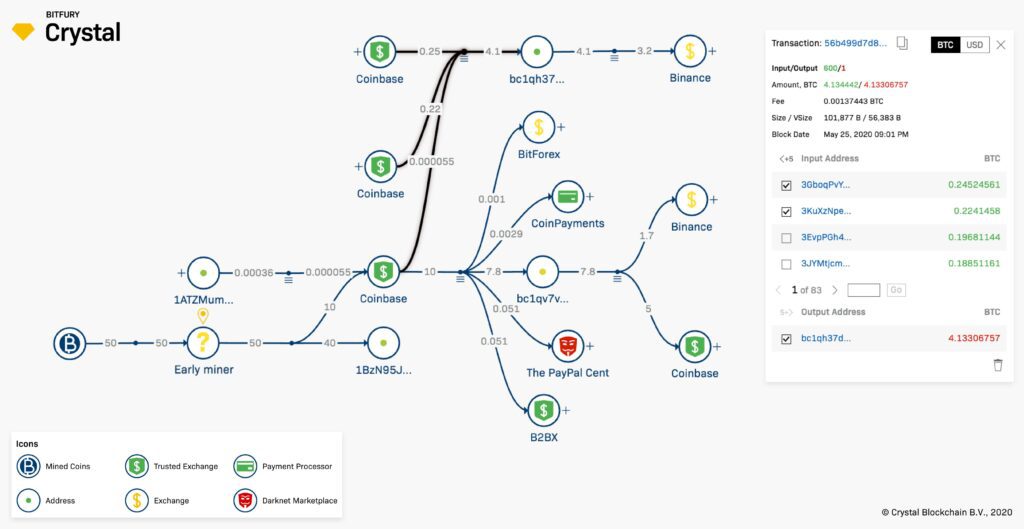
UPDATE: On May 25, 2020, a second outgoing transaction was sent from the same address that received the old coins (3A6AsxxxzgHnGKhiFyW4tYX1Hn2sjNfrQP), after which that address was clustered into an entity. Now, with a degree of certainty, it can be interpreted that 10 BTCs were transferred by the “early miner” directly to the Coinbase exchange address. This happened after someone sent a small transaction to the address, which was probably a test transaction.
Also of note is that to date, the remaining 40 BTCs that were sent to the “change” address are still not spent.
Original Post
From activity at May 22, Crystal Analytics has established that 40 BTC was sent to the wallet 1BzN95J72BLBafwgZiZZvM9s7Wj2bxzA6m and remained there. 10 BTC was moved to the wallet 3A6AsxxxzgHnGKhiFyW4tYX1Hn2sjNfrQP which has then distributed funds within different entities.

The majority of funds were moved to well-known exchanges such as Coinbase and Binance, according to Crystal’s proprietary clustering feature, on May 21, 2020. Furthermore, a relatively small amount of BTC was sent directly to darknet entities.
As we can see in Picture 2, according to Crystal’s Indirect Connections feature, as for May 25, 2020, about 1.718 BTC is still settled in unknown addresses. The Indirect connections feature includes direct connections, but also analyzes incoming and outgoing transactions that occur with unnamed entities and tracks them until the funds reach a known entity.
Despite research published on some social networks that are either based on analysis of the so-called Patoshi pattern, or jokingly referring to as “Satoshi’s accountant”, who incidentally “denies” any transactions from his client’s wallets, it’s hard to prove that this early miner was or was not Satoshi Nakamoto – however, Crystal Analytics will continue to follow this transaction pattern as it unfolds.
To learn more about how Crystal can transform your approach to crypto compliance, contact us for a demo here.