


On 22 May 2010, a Florida programmer named Laszlo Hanyecz posted a message on the Bitcointalk forum. His request was direct: he would pay 10,000 BTC for two large pizzas. Four days later, a forum user arranged delivery. The transaction is completed. Bitcoin had, for the first time, purchased something in the physical world.
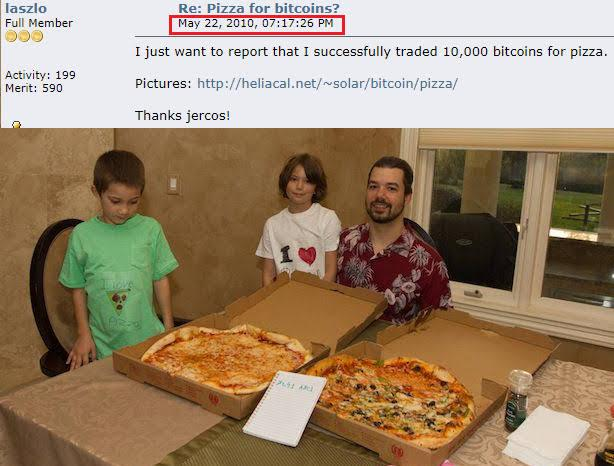
Programmer Laszlo Hanyecz’s photo posted on the forum
Today — 16 years later — those 10,000 BTC are worth over $700 million. The pizzas cost roughly $41 at the time of purchase. The Bitcoin Pizza Index tracks the value in real time.
The numbers are striking. But the more significant data point is what that transaction set in motion.
From proof-of-concept to financial infrastructure
Hanyecz was not buying lunch. He was running an experiment. At the time, Bitcoin had no established market price, no payment processors, and no institutional backing. The exchange was peer-to-peer, informal, and entirely unverified by any central authority. That was the point.
What the transaction demonstrated was not that Bitcoin could buy pizza. It demonstrated that Bitcoin could function as a medium of exchange — that value encoded on a blockchain could transfer between two parties without a bank, a clearinghouse, or a correspondent relationship in between.
Sixteen years on, Bitcoin is listed on major exchanges, held in institutional portfolios, and treated as a reserve asset by sovereign wealth funds. The technology has moved from experimental to structural. And the transaction volume — and the illicit activity embedded within it — has grown accordingly.
What the blockchain now shows
Bitcoin Pizza Day is a moment of reflection for the crypto industry. It is also a useful vantage point for anyone whose job is to understand what blockchain data reveals.
The growth of Bitcoin from a hobbyist network to a global financial system has not been frictionless. It has been accompanied by fraud, sanctions evasion, ransomware, money laundering, and the full spectrum of financial crime. Chain-hopping, mixers, and cross-chain bridges have made tracing more complex. The on-chain record exists — but reading it requires purpose-built analytical capability.
Crystal Intelligence was built for exactly this. Our blockchain analytics platform covers 330+ blockchains, with 110,000+ attributed entities and continuously updated threat intelligence drawn from on-chain data, the Scam Alert database, and field-level intelligence from high-risk jurisdictions. When investigators need to follow funds from a ransomware wallet through a mixing service and across multiple chains to a cash-out point, the platform is designed to make that trace possible — and to produce court-ready evidence along the way.
Sixteen years of adoption — and its consequences
When Hanyecz made his purchase, Bitcoin was used by a small group of cryptographers and cypherpunks. By 2013, it had become a tool for darknet markets. By 2017, it was a speculative asset drawing mainstream attention. By 2024, it had been approved for ETF products in major markets. By 2026, institutional custody, sovereign adoption, and regulatory frameworks have become standard features of the landscape.
Each phase of adoption brought new compliance challenges. Each wave of use cases — legitimate and otherwise — extended the surface area that investigators and compliance teams need to cover. The same open, borderless properties that made Bitcoin’s pizza purchase possible are the properties that make it attractive to illicit actors.
The tools required to manage that risk have had to keep pace. Transaction monitoring, sanctions screening, VASP due diligence, Travel Rule compliance: these are now operational requirements for any institution that touches digital assets. Our compliance solutions are built to meet them.
A milestone worth understanding
Bitcoin Pizza Day is, at its core, a story about adoption. A technology moved from theory to practice. A community formed around it. Infrastructure was built. Value accrued — and, in time, risk followed.
For investigators, compliance teams, and regulators, the anniversary is a reminder of how much ground has been covered — and how much analytical rigour the maturation of this asset class demands.
Crystal exists to provide that rigor. Blockchain intelligence for crime detection: the work is ongoing, and the data does not obscure itself.