



Tokenized real-world assets are sold on three promises: a market-rate yield, faster settlement, and distribution to anyone with a wallet. We read the complete holder list of 17 of the largest funds — around $18B of Treasuries, private credit and gold — to see which of those is actually happening. The yield works, and it is priced sensibly across the risk ladder. Settlement works too, and was never really in question. Distribution has gone somewhere more specific than advertised: nearly every one of these funds is held by a handful of institutions, and increasingly the institution is a DeFi protocol rather than a bank.
Key findings
Ten entities hold just over half of every tokenized RWA we track — 52.7% of the value, across more than 134,000 holder positions.
One exchange ecosystem holds 28.9% of the entire tokenized Treasury layer. The $2.72B USYC position sits in the Binance ecosystem and is a published collateral arrangement, not a distribution failure.
Three lending protocols hold 69.1% of all tokenized private credit.Aave, Spark and Morpho — though only one third of that is the asset being used; the rest is a protocol buying for its own balance sheet.
Every tokenized Treasury fund returned less than the bills it holds — by 38 to 78 basis points, with a 40bp spread across products holding nearly identical exposure. That gap is the cost of the wrapper, measured from the chain rather than read off a fact sheet.
Gold is the exception on distribution. PAXG and XAUt are spread far more broadly across their 123,000 holders, and they are openly available rather than permissioned.
Crystal Foresight research · 3 September 2026 · Holder data as of 2 September 2026
What are tokenized real-world assets supposed to do?
A tokenized real-world asset is supposed to pay a yield close to what the underlying instrument pays, settle in minutes rather than two days, and be held by anyone with a wallet rather than anyone with a prime broker. The mechanism is simple: take a real-world asset — a Treasury bill, a loan book, a bar of gold in a vault — and issue a token that represents a claim on it.
Settlement speed is a property of the rails and is simply true. Yield is a number that can be measured from the chain. Distribution – who actually ends up holding these things – is a claim about behaviour, and behaviour is on a public ledger. So we counted.
What are the three families of tokenized RWAs, and how does each pay you?
Family | Share of value | Examples | Where the return comes from |
Tokenized Treasuries | 56% | BUIDL, USYC, USDY, USTB, JTRSY, OUSG, BENJI, WTGXX | Short-dated US government debt |
Commodities | 30% | PAXG, XAUt | The metal price. No yield |
Private credit | 10% | syrupUSDC, syrupUSDT, PRIME | A lending spread on loan portfolios |
Structured credit | 4% | JAAA, STAC | AAA-rated CLO tranches |
Tokenized Treasuries are on-chain access to low-risk dollar liquidity: the yield passes the T-bill return through, minus a fee. Five of them describe that objective in effectively the same prospectus sentence — current income consistent with liquidity and stability of principal. Who is allowed to buy them is a separate question, and the answer is in the same documents: BUIDL is for qualified investors, JTRSY and TBILL for professional investors only, USTB for accredited investors and qualified purchasers, USDY for non-US investors, CUMIU for institutions. The gating is explicit, and it is not incidental to the product.
Private and structured credit take yield from loan portfolios and distribute it two different ways. Maple’s syrupUSDC and syrupUSDT are permissionless ERC-20s — anyone can hold them, and composability is the stated design goal. Hastra’s PRIME (Figure’s consumer-loan book) and the Janus Henderson Anemoy AAA CLO Fund go to approved institutional counterparties only, and both are marketed substantially as DeFi collateral.
Commodities are the one family with no yield at all. The category is open in principle to anything that can be vaulted; in practice the large tokens today are gold. PAXG and XAUt are each one token per troy ounce of LBMA-certified gold sitting in a vault, openly transferable and redeemable for allocated metal. What they offer is the price of the metal, not an income. Two mechanics matter for everything below.
How the yield reaches you. Either the token’s price rises — Superstate’s USTB trades at $11.19 and climbs — or the price is pinned at $1 and you are simply sent more tokens, as with BlackRock’s BUIDL. Same economics, different on-chain footprint. In the second design a holder being paid looks identical to a holder buying; separating the two is outside the scope of this analysis.
Who is allowed to hold them. Most Treasury and credit tokens are permissioned securities: both sides of a transfer must be KYC-whitelisted, and a transfer to an unapproved address simply fails. The gold tokens and the Syrup tokens are open. This one distinction predicts nearly everything that follows — it is why some of these funds have 20 holders and others have 68,000.
Who actually holds tokenized real-world assets?
Across all 17 funds, the largest single entity holds 19.2% of the market, ten entities hold 52.7%, and 100 hold 84.1%. But that market-wide figure hides the more useful finding, which is that concentration is not a property of “tokenized RWAs” — it is a property of each family, and they differ by an order of magnitude.
 Above: How much of the market the largest holders control. Cumulative share of all tokenized RWA value, top 1 through top 500. Entity-aggregated: an institution’s wallets are summed. Bridge and issuer plumbing contracts are excluded; they move value but hold none.
Tokenized Treasuries: two entities, 44.6%. One exchange ecosystem holds 28.9% of the entire tokenized Treasury layer: the Binance ecosystem holds $2.72B of Circle’s USYC. That is not a failed distribution. Circle and Binance announced in July 2025 that USYC would serve as yield-bearing off-exchange collateral for Binance’s institutional clients, held with Ceffu, Binance’s regulated custody partner. The on-chain concentration is the visible shape of a published commercial arrangement. Second is Grove, the Sky ecosystem’s institutional credit allocation layer, with $1.48B of JTRSY and BUIDL. The two together hold 44.6% of the family; the next eight take it to 77.1%, and 25 entities reach 88.6%.
Above: Concentration ladder, tokenized Treasury. Each ladder represents the cumulative share of that family’s value, aggregated at the entity level. The steeper it is, the fewer entities the family is.
Structured credit — 27 holders in total. Five of them hold 96.2%. The single largest position, 43.0% of the family, belongs to an address nobody has publicly named, and it recorded no transfers at all in the quarter. Grove is second at 38.4% across JAAA and STAC.
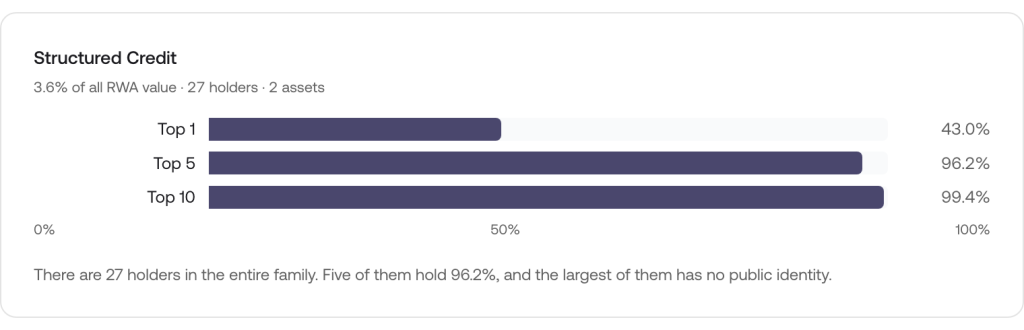
Above: Concentration ladder, structured credit.
Private credit — 69.1% is on three lending protocols.Aave (24.9%), Spark (24.1%) and Morpho (20.2%). This is the family where collateral mobility – tokens being pledged and reused as collateral across DeFi, rather than simply held – is visibly at work, and it is worth being precise about what “on a lending protocol” means, because it means two different things — see below.
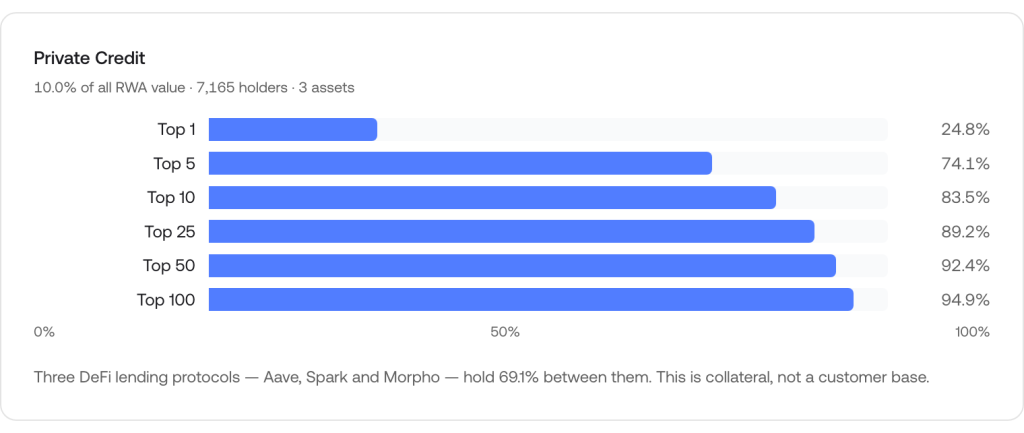
Above: Concentration ladder, private credit.
Commodities — the only family that behaves like a market. The top ten hold 44.3%, and it takes 500 holders to pass 83%. Binance is the largest single holder here too, at 9.9%, this time through its exchange wallets. The two gold tokens are also the only family here with no yield claim and no whitelist, which is unlikely to be a coincidence.
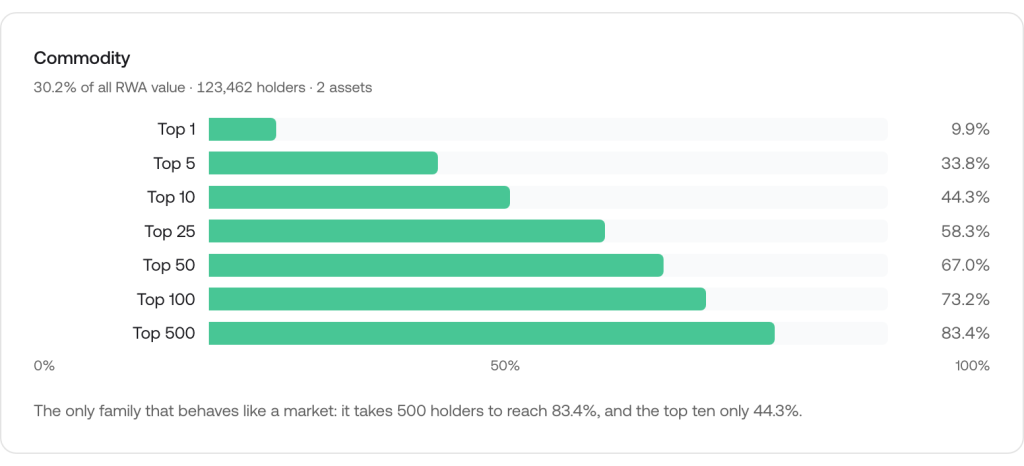
Above: Concentration ladder, the gold tokens.
One entity spans all of this. Grove holds $1.71B in a single address across four different funds — JTRSY, BUIDL, JAAA and STAC — making it the largest holder of three of them and 10.2% of the entire tracked market. Add Spark’s $404M and Sky-ecosystem entities hold $2.11B, more than any bank, asset manager or exchange in the data.
Is the collateral being owned or used?
$3.23B of these assets sits inside DeFi protocol contracts, and the phrase covers two different things:
$2.11B is a protocol investing its own reserves — Grove and Spark, buying for their balance sheets.
$1.12B is the asset actually being used by third parties as posted collateral: Aave ($579M), Morpho ($345M), Ethena, Ether.fi, Flux and Uniswap.
Only the second is “active in DeFi” in the sense the phrase normally carries. Measured that way, BUIDL and USYC are both roughly 0%, matching published estimates under 1%, while the credit tokens are the ones genuinely put to work — PRIME is 63.9% posted as collateral, syrupUSDT 46.9%.
How concentrated is ownership below the top ten holders?
There are plenty of holders, on the face of it: more than 134,000 positions. But only 13,368 of them are worth more than $10,000, and they hold 99.5% of the total value. The remaining 121,080 positions ( 90% of every holder in this market ) hold 0.47% of it, about $82M.
The median position says it twice, in opposite directions.
Asset | Holders | Median position | Value outside the top 10 |
PAXG | 68,348 | $133 | 66.4% |
XAUt | 55,114 | $16 | 45.6% |
syrupUSDC | 4,030 | $3 | 14.6% |
USDY | 3,418 | <$1 | 7.9% |
USTB | 82 | $79,732 | 15.6% |
BUIDL | 79 | $381,840 | 8.6% |
JAAA | 23 | $606,520 | 0.7% |
JTRSY | 20 | $154,005 | 0.1% |
USYC | 27 | $101 | 0.0% |
What did the funds actually return?
We computed the yield on these assets using the realized 90-day net asset value (NAV) accrual, annualized, by family from the chain, not off a fact sheet. The yield automatically sorts the assets by their risk profile. Private credit pays more than structured credit, which pays more than government debt, which is exactly the order in which the risk sits.
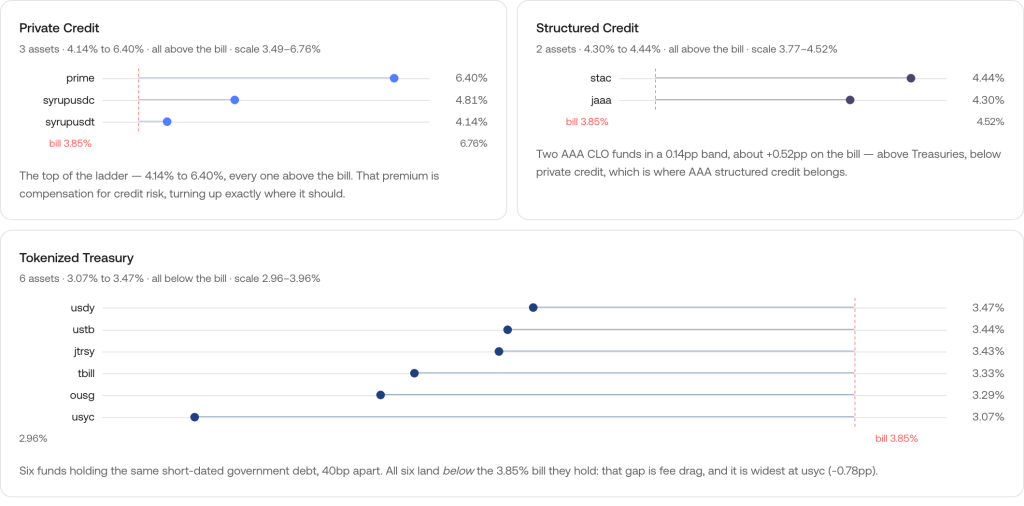
Above: Realized 90-day NAV accrual, annualized, by family. Each panel is scaled to its own family so a 14bp band stays readable — compare each dot against the dashed bill line, not against dots in another panel. The dashed line is the three-month Treasury bill averaged across the same 91-day window.
You will notice the tokenized Treasury funds sit uniformly below the three-month T-bill rate; by 38 to 78 basis points. That gap is the cost of the wrapper,for example, management fees, cash drag, and the distance between what the portfolio earns and what reaches the token. Fee drag is widely discussed in the abstract; this is what it is, measured per fund. The 40-basis-point spread between the cheapest and dearest is wide for products with nearly identical underlying exposures, and an allocator choosing between them on headline yield is really choosing between fee structures.
Two things this method cannot see, stated plainly. Funds that pay in tokens are invisible to it — BUIDL, BENJI, and WTGXX hold NAV at $1 and distribute yield by minting, so their price changesare zero by construction. Their yield is real; calculating it is beyond the scope of this post. And gold is deliberately absent: a 90-day price move is not an accrual, it is endpoint-sensitive enough to change sign inside a week and putting it in the same column invites a comparison that is a category error. The gold tokens did exactly what they advertised, which is to be a price.
Frequently asked questions
What are tokenized real-world assets (RWAs)?
A tokenized real-world asset is a blockchain token that represents a claim on an off-chain asset – a Treasury bill, a loan portfolio, or a bar of vaulted gold. Crystal Foresight tracked 17 of the largest funds, worth around $18B, across four families: tokenized Treasuries, private credit, structured credit and commodities. The token is meant to pay a market-rate yield, settle faster, and distribute more widely than the underlying instrument.
Who holds the most tokenized Treasuries?
Two entities hold 44.6% of the entire tokenized Treasury family. The largest is the Binance ecosystem, which holds $2.72B of Circle’s USYC as part of a published collateral arrangement with its custody partner Ceffu, announced in July 2025. The second-largest is Grove, the Sky ecosystem’s institutional credit allocation layer, with $1.48B across JTRSY and BUIDL.
Is gold more evenly distributed than tokenized Treasuries?
Yes. PAXG and XAUt, the two major tokenized gold products, are spread across more than 123,000 holders, and it takes 500 holders to reach 83% of the commodity family’s value. Tokenized Treasuries are far more concentrated: two entities alone hold 44.6% of that family. Gold tokens are also the only family with no yield claim and no holder whitelist, which likely explains the difference.
Why do tokenized Treasury funds return less than the T-bills they hold?
Every tokenized Treasury fund in the sample returned between 38 and 78 basis points less than the three-month T-bill rate over the same period, measured from realized 90-day NAV accrual rather than a fact sheet. That gap represents the cost of the wrapper – management fees, cash drag, and the distance between what the portfolio earns and what reaches the token. A 40 basis point spread between the cheapest and most expensive products is wide, given the underlying exposure is nearly identical.
What does collateral mobility mean for tokenized RWAs?
Collateral mobility describes how much of a tokenized asset is actually pledged and reused as collateral by third parties, rather than simply held on a protocol’s own balance sheet. Of the $3.23B in these assets sitting inside DeFi protocol contracts, $1.12B is genuinely posted as collateral by borrowers – led by Aave at $579M and Morpho at $345M – while the remaining $2.11B is Grove and Spark investing their own reserves. Private credit shows the most real usage: PRIME is 63.9% posted as collateral and syrupUSDT is 46.9%.
Are tokenized RWAs actually reaching retail investors?
Mostly not directly. Most tokenized Treasury and credit tokens are permissioned securities restricted to qualified, professional or non-US institutional investors, and a wholesale instrument built for institutional balance sheets does not need thousands of holders. The exceptions are the two gold tokens and the permissionless Syrup tokens, which are held broadly at tens and hundreds of dollars a position. Retail access may also be arriving indirectly, through yield-bearing consumer products whose backing includes these tokens.
What does the data add up to?
Two of the three promises are being kept, and the third has landed somewhere other than where it was pointed.
The yield works: money goes into a tokenized Treasury fund and comes back tracking the underlying, minus a fee we can now put a number on. Settlement works too, and was never really in question – it is a property of the rails, not of issuer behaviour.
Distribution is the one that has landed differently. These funds have not failed to find investors; they have found the customer they were built for, which is an on-chain balance sheet that needs somewhere to park reserves that earns a yield and can be redeemed. Most of the issuers say as much in their own terms — qualified investors, professional investors, non-US only. A wholesale instrument does not need thousands of holders, so holder counts in the tens are a product fact rather than a failure. The democratization narrative belongs to the industry, not to the prospectuses.
One behaviour sits underneath that distribution story rather than beside it: collateral mobility. Protocols are buying these assets for their own balance sheets substantially more than borrowers are posting them as collateral – real usage, but concentrated in the same handful of institutional holders the distribution data already points to.
Where broad distribution genuinely is advertised — the two gold tokens and the permissionless Syrup tokens — it has actually happened, at tens and hundreds of dollars a holder. And access may be arriving a layer up: retail does not hold BUIDL, but retail holds yield-bearing products whose backing includes it. The tokenized fund is turning out to be a business input.