


In April 2026, Crystal Intelligence published an investigation into crypto-funded payment cards after identifying close to 100 services operating worldwide. Five months on, that number has changed dramatically.
Crystal has now identified and analyzed roughly 150 additional crypto card services, bringing the total mapped through our research to approximately 250. The growth itself is notable, but one trend inside those numbers matters more: 47 of the newly identified services are connected to non-custodial wallet models, allowing users to hold crypto under their own control while connecting those assets to card payment infrastructure
This update looks at what is driving that shift, why a major payments company just entered the same space, and what one newly identified card service reveals about the risk that can travel from a crypto wallet onto a spendable card balance.
Key points
•Crystal has identified approximately 250 crypto card services, up from close to 100 in April 2026.
•47 of the 150 newly identified services are connected to non-custodial wallet models, where users keep control of their own private keys.
•In August 2026, Western Union and Rain launched Stablecard, a Visa card connected to a non-custodial digital wallet.
•A newly identified Hong Kong-based crypto card service received approximately 355.5M USDT across more than 4,000 transactions since December 2024.
•On-chain analysis linked a customer’s failed transfer to HPay, and customer support then advised the user to fund the card from an exchange instead.
Why are non-custodial crypto cards on the rise?
Non-custodial crypto cards are growing because they let users connect crypto they already control directly to card payment rails, without first depositing it with a centralized exchange or custodian. Opening and using one of these wallets often skips the identity checks tied to a custodial exchange account. Increasingly, these wallets are connecting directly to card payment infrastructure.
That does not mean the card itself is issued without KYC. Card issuers and program managers can still run identity checks and other compliance controls on the card side. What changes is the structure: crypto held under a user’s own control can reach a card without first passing through an exchange’s compliance program.
This shift raises new questions for compliance teams. When funds originate from a self-custodial wallet, understanding who the cardholder is becomes only part of the picture. Source-of-funds analysis, wallet screening, and clarity about where responsibility sits between the wallet provider, card program, issuer, and other intermediaries all become more important.
Is this still limited to crypto-native startups?
No. In August 2026, Western Union and Rain announced Stablecard, a Visa card connected to a non-custodial digital wallet, showing that established payments companies are adopting the same model.
The significance is not that Stablecard carries the same risk profile as the smaller providers identified in Crystal’s research. It shows how quickly the underlying model is becoming part of mainstream payments infrastructure: crypto held in a digital wallet can now connect directly to a traditional card network backed by a household payments brand.
For compliance teams, the message is straightforward. Non-custodial crypto cards are no longer a niche corner of the market to monitor occasionally. They are becoming a standard payment rail that will need the same scrutiny as any other funding source.
What did Crystal find when it investigated one new crypto card service?
One of the newly identified services in Crystal’s research is associated with Hong Kong and appears to primarily serve Chinese-speaking users, based on the structure and activity of its Telegram community. Crystal identified five wallets associated with the service.
As of September 2, 2026, those wallets had received approximately 355.5M USDT since December 2024 and had processed more than 4,000 transactions.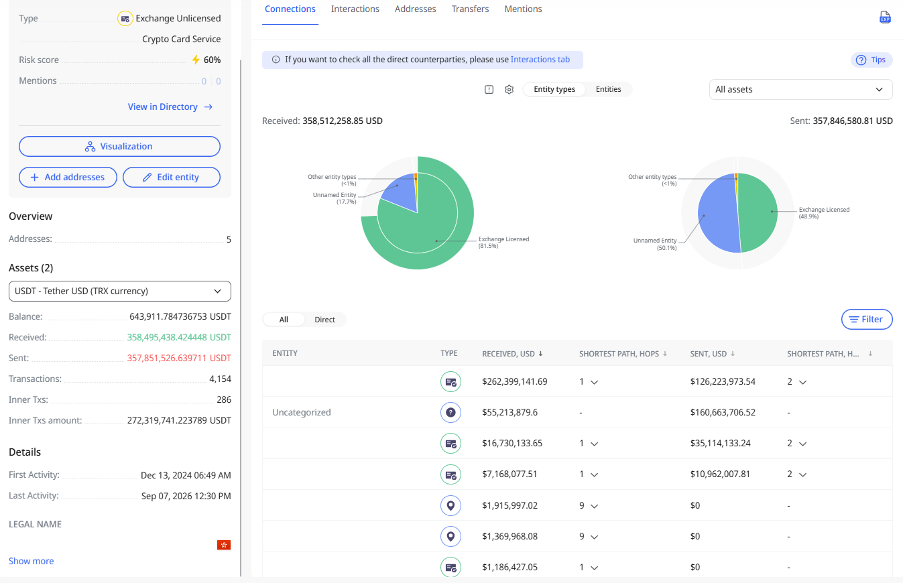 Figure 1. Crystal Intelligence entity profile showing five associated wallets and more than 355M USDT received since December 2024.
Crystal also traced transaction paths between the service and a range of high-risk entities, including HTX, Rapira, Huione Crypto, Stake, several addresses banned through Tether smart contracts, and other reported entities.
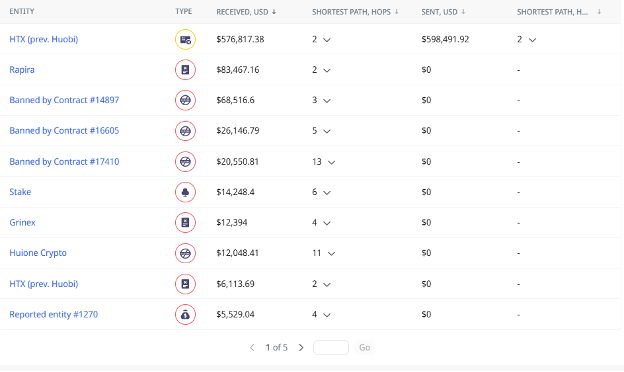
Figure 2. Crystal Intelligence transaction analysis showing high-risk identified entities and their shortest transaction paths to the service.
These relationships vary in distance and should not all be read as direct transactions. Some entities connect through two hops, while others sit considerably further upstream. The value of this analysis is not simply whether the provider transacted directly with a particular entity, but in understanding the broader risk environment surrounding the flow of funds into the service.
What happens when a crypto deposit fails KYT screening?
While reviewing the provider’s Telegram community, Crystal researchers found a user complaining that a transfer had not been credited. On-chain analysis showed that 130 USDT of the 202 USDT flow examined was attributable to HPay, previously known as Huione Pay.
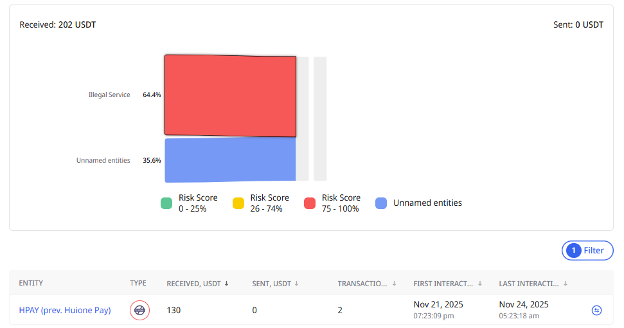
Figure 3. Crystal tracing showing 130 USDT of the examined flow linked to HPay.
The user’s conversation with customer support added further context. Translated from Chinese, the customer-support representative told the user: “This likely hasn’t passed the KYT review. It’s best to transfer it from an [NS1]exchange.” The response could be viewed as alerting the customer that transaction-monitoring controls had been triggered and providing guidance on an alternative funding source.
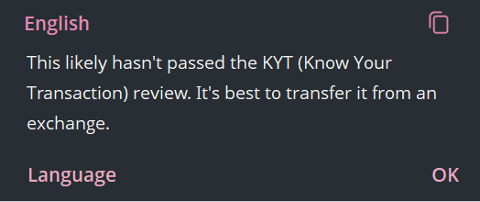
Figure 4. Translated customer-support message indicating that the transfer likely failed KYT review and advising the user to transfer from an exchange.
The exchange points to an important compliance question: what controls apply when a customer’s original source of funds fails KYT screening, but the same customer then tries to fund the service from a different source? A user seeking to convert funds linked to a higher-risk service such as HPay into spendable card value could test whether a provider accepts them, then switch sources if the first attempt is rejected.
The evidence here shows that funds linked to HPay were tied to the failed transaction, that the transfer appears to have triggered KYT controls, and that the customer was then pointed toward an exchange as an alternative source. That combination matters because it shows why compliance teams need to look at a customer’s funding attempts across multiple sources, not just each transaction in isolation.
Why does crypto card monitoring need more than KYC?
A card transaction can appear inside the traditional financial system as an ordinary purchase. The activity that funded it can tell a very different story. Before it reaches the card network, the underlying value may pass through multiple wallets, exchanges, payment services, or higher-risk entities, so effective monitoring needs visibility on both the off-chain and on-chain sides of the transaction.
Crystal’s research on crypto card services combines three capabilities:
•Open-source intelligence to identify providers, customer communities, and operational behaviour
•Blockchain attribution to identify the addresses and services involved in a transaction flow
•On-chain tracing to understand how funds reach a service and what risk exists upstream
The Hong Kong case shows why combining these matters. A Telegram complaint on its own says little, and an on-chain transaction on its own tells only part of the story. Together, they let Crystal researchers connect a customer complaint, an apparent KYT failure, the underlying transaction path, and the provider’s response to the user. Crystal Expert lets compliance teams trace this kind of activity across their own customer base.
Frequently asked questions
What is a non-custodial crypto card?
A non-custodial crypto card lets a user connect crypto held in a wallet they control directly to a payment card, rather than first depositing funds with a centralized exchange or custodian. The user keeps control of their private keys throughout. The card itself may still involve KYC checks from the issuer or program manager.
Does a non-custodial crypto card still require KYC?
It can. Card issuers and program managers may run identity verification and other compliance checks on the card side, even when the underlying wallet is non-custodial. What changes is the compliance picture: teams also need source-of-funds analysis and wallet screening to understand where the crypto came from before it reached the card.
How many crypto card services has Crystal identified?
Crystal has identified approximately 250 crypto card services as of September 2026, up from close to 100 when its original investigation published in April 2026. Around 150 of those were identified in the five months since, and 47 of the new services are connected to non-custodial wallet models.
What is Stablecard and why does it matter for compliance teams?
Stablecard is a Visa card connected to a non-custodial digital wallet, launched in August 2026 by Western Union in partnership with Rain. It matters because it shows a non-custodial crypto card model moving from crypto-native startups into mainstream payments infrastructure, which means compliance teams should expect to see more of these cards, not fewer.
What risk did Crystal find connected to the Hong Kong-based crypto card service?
Crystal traced transaction paths between the service’s wallets and several high-risk entities, including HTX, Rapira, Huione Crypto, Stake, and addresses banned through Tether smart contracts. Crystal also found a transaction where 130 USDT of a 202 USDT flow was linked to HPay, a service previously known as Huione Pay, where the transfer appeared to fail the provider’s KYT screening.
What should compliance teams do to monitor crypto card risk?
Compliance teams should extend monitoring beyond the card transaction itself to the on-chain path that funded it, tracing the wallets and services the crypto interacted with before it reached the card. They should also watch for repeat funding attempts from a single customer across different sources, since a rejected transfer from one source does not mean the customer will stop trying to fund the card.
A market that continues to expand
Five months ago, crypto-funded cards could still be described as a relatively small part of the crypto payments market. That description is harder to justify today. Crystal has identified approximately 250 crypto card services, including around 150 discovered since April 2026, and 47 of those newly identified services are connected to non-custodial wallet models. Western Union and Rain’s launch of Stablecard shows the same model moving into mainstream payments.
For Crystal Intelligence, the goal is not simply to track how many providers exist. It is to understand how these services operate, how funds move through them, and where financial-crime exposure may sit upstream, visibility that will matter more as the line between crypto wallets and card payments continues to narrow.