

New York’s crypto framework sits at the nexus of three converging forces. It operates the most demanding virtual asset governance regime in the US, with tougher state and federal rules set to land through 2026 and into early 2027. Its average crypto crime loss per incident rose 57% from 2024 to 2025, while complaint numbers barely moved, contradicting national averages. Meanwhile, Crystal’s investigation exposed foreign-based, sanctions-exposed, and locally unlicensed cash-to-crypto services operating in New York, using privacy coins to reduce detection risk – unseen by regulators and local law enforcement.
Law enforcement must protect citizens from crypto crimes they cannot see; compliance teams face a tightening environment with tougher consequences for transgressions in the pipeline; and regulators must integrate federal and state laws without compromising New York’s status as a global financial hub.
Crystal set out to discover what all these role-players need to do now.
Key takeaways on crypto regulation and financial crime risk in New York State
- New York’s outsized share of wealth and institutional crypto activity makes it a high-value target.
- New York runs the most demanding state-level crypto framework in the country, and the proposed 2026 CRYPTO Act would criminalize unlicensed operation, with penalties up to a Class C felony.
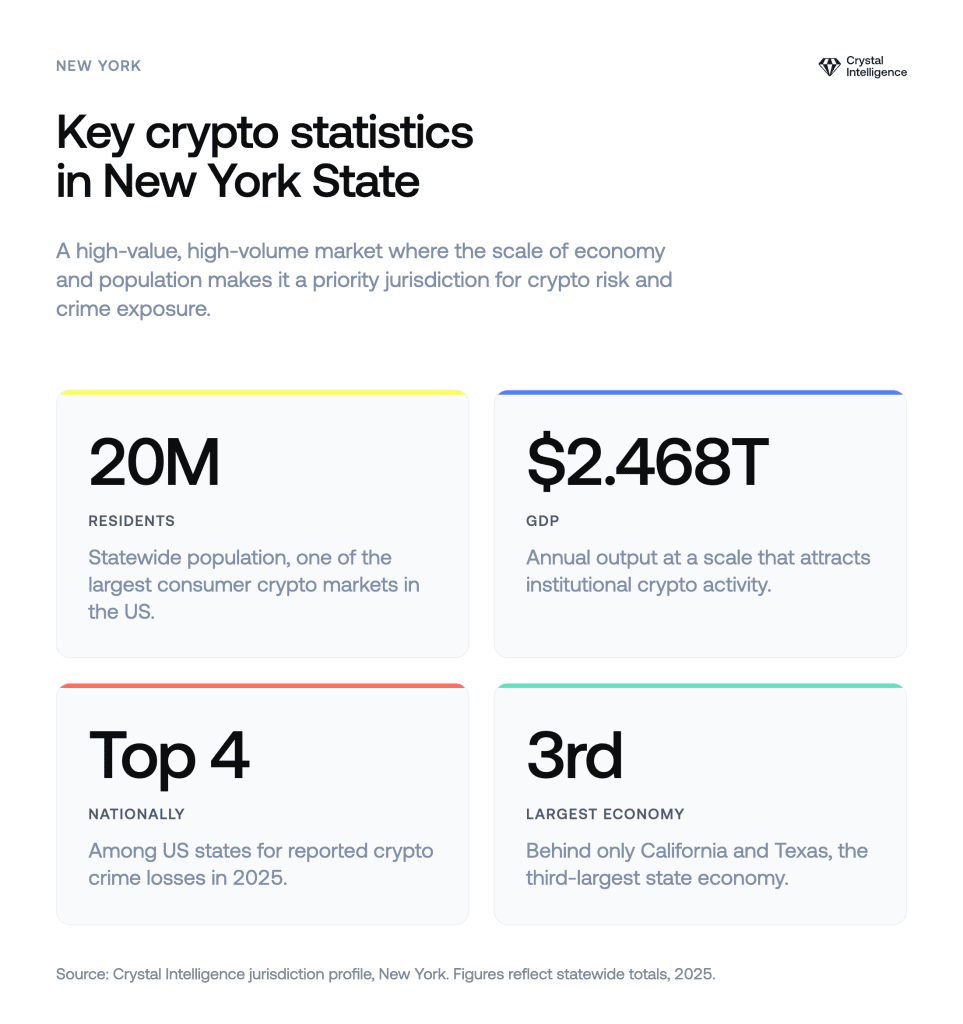
- New York ranked fourth nationally in US crypto crime losses in 2025 at $593M. Complaints rose only 0.4% against a national 21.3% jump, but average loss per complaint surged 57.5% to $73,364.
- Crystal identified 48 cash-for-crypto services with 1,156 New York listings, networked across 443 cities worldwide, and many are not registered locally.
New York State at a glance
New York State: an overview
New York’s estimated population of 20 million (July 2025) makes it the fourth most populous state, and its 2025 nominal GDP of $2.468Tn is the third-largest state economy in the US. As the country’s financial capital, it shapes the financial industry’s engagement with digital assets and hosts a disproportionately large share of high-value crypto holders and institutional activity.
Manhattan District Attorney Alvin Bragg, co-announcing the proposed Cryptocurrency Regulation Yields Protections, Trust, and Oversight (CRYPTO) Act on January 14, 2026, framed the imperative directly, calling for criminal penalties to address the “shadow financial system created by the explosion of crypto.”
Crypto regulation in New York State
The 2015 BitLicense Regulation (23 NYCRR Part 200) established a specialized licensing regime for virtual currency businesses, administered by the New York State Department of Financial Services (NYDFS), which also charters limited-purpose trust companies and runs a dedicated supervision unit under its VOLT program. The New York State Attorney General (NYAG) has pursued multiple actions against unlicensed or fraudulent operators.
Live obligations and deadlines
The BitLicense has been fully in force since August 2015, and the obligation to hold a license is continuous. New BitLicense applications are processed through the Nationwide Multistate Licensing System (NMLS) for a $5,000 fee.
The critical state-level near-term development is the CRYPTO Act (Senate Bill S.8901). If passed, it takes effect immediately, making unlicensed operation a criminal offense – up to a Class C felony carrying five to 15 years, in addition to the stiff civil penalties already in place.
The federal GENIUS Act required final stablecoin rules by July 18, 2026, with implementation expected by January 18, 2027, directly affecting NYDFS-licensed stablecoin issuers. Meanwhile, the crypto-friendly CLARITY Act remains stalled after the Senate blocked it 49-50 on September 15, 2026, well short of the 60 votes needed to end debate.
The result offers respite to New York officials, who had previously raised concerns that it flouted securities and identity disclosure laws and sidelined state enforcement efforts.
Crypto adoption rate in New York State
An August 2023 Coinbase analysis found 19% of New Yorkers surveyed owned crypto. 2022 IRS tax data analyzed by SmartAsset shows 1.94% of households (189,580) reported digital asset involvement, ninth nationally. Meanwhile, the National Cryptocurrency Association’s 2025 report found that 18% of American crypto holders resided in the nine Northeastern states, with New York being the most populous.
Key trading infrastructure available to New Yorkers
With 692 blockchain organizations and over 800 founders headquartered in the state (per Coinbase), New York is a global powerhouse of digital asset uptake. New Yorkers have access to:
- Major US exchanges: Coinbase, Gemini, Robinhood Crypto, Bitstamp USA, bitFlyer USA, and eToro USA. Notably, Kraken chose to discontinue serving New Yorkers over licensing concerns, while others, such as Binance.US, chose not to serve New York for similar reasons.
- Peer-to-peer marketplaces: LocalCoinSwap, Bisq, and others, all subject to the same BitLicense analysis.
- Over-the-counter (OTC) desks: Galaxy Digital OTC, Cumberland (DRW), Coinbase Prime, Circle Trade, Fidelity Digital Assets, and B2C2 USA.
- Crypto ATMs: A constrained footprint of 243 kiosks (per Bytescraper), as operators must hold a BitLicense and run KYC checks at the point of sale.
- Banking and custody: Primarily NYDFS-chartered trust companies – Paxos Trust and Gemini Trust – plus BitLicensed Anchorage Digital NY and BitGo.
New York State’s crypto-based crime profile
In 2025, New York ranked fourth in the US in both the number of criminal complaints with a crypto nexus (8,088, up 0.4% from 2024) and reported losses ($593,370,013, up 58.2%) – both rankings unchanged from 2024.
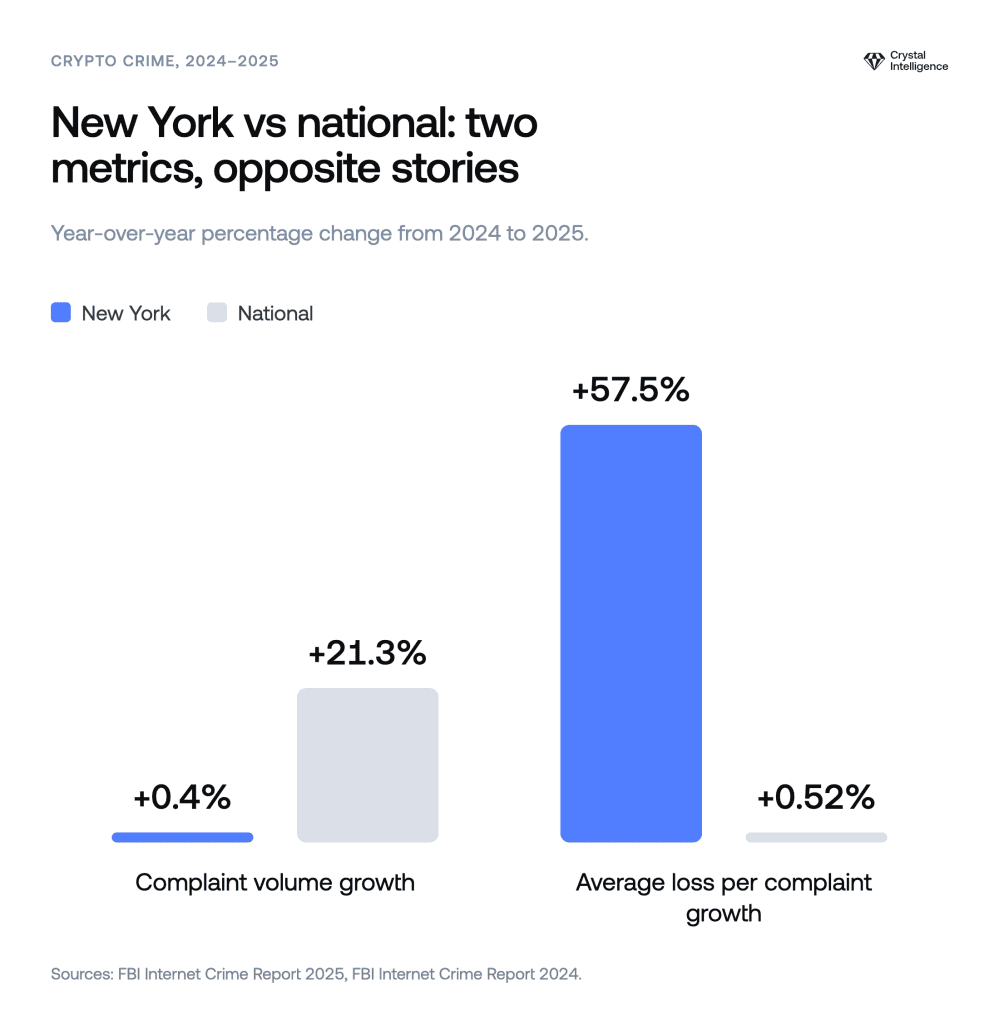
Above: The contrast with national figures is stark. Nationwide complaints rose by 21.3%. Yet New Yorkers lost an average of $73,364 per complaint, up 57.5%, while the national average rose just 0.52% to $62,604.
Sources: FBI Internet Crime Report 2025 (Pages 56 & 57) and Report 2024 (Pages 39 & 40).
Three factors likely drive this anomaly:
- Investment fraud (pig butchering). New York’s concentration of finance professionals, executives, and wealthy retirees makes it a natural hunting ground for long-duration investment scams.
- The BitLicense paradox. Strict licensing means fewer crypto businesses operate in the state, which may push users toward unregulated platforms – precisely where investment fraud flourishes.
- Institutional exposure. A single incident – one family office, one fund – can raise the average loss figure without adding complaint volume.
A flat complaint line with a surging loss line indicates precision targeting rather than mass fraud.
Crystal Intelligence data: the global nature of cash-for-crypto services in New York
BestChange, a cash-for-crypto aggregator popular with Russian speakers, identifies 48 distinct exchange services that list cash-handling options in New York across 1,156 trading pairs, with BaksMan (87 listings), EasySwap (83), 4ange (81), and Monetkins (81) leading the list.
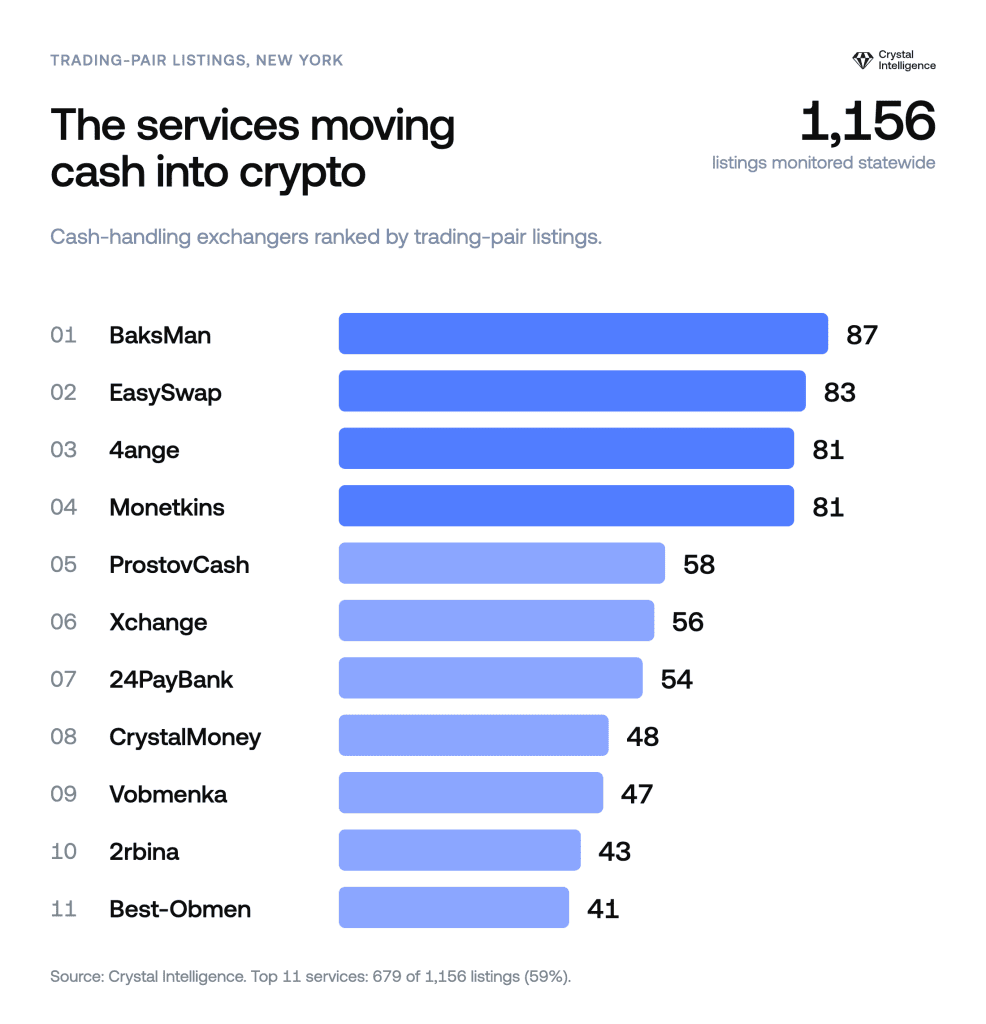
Above: Chart showing the main service operators moving cash into crypto in New York, with just 11 services accounting for 59% of the cash-handling listings monitored statewide. Source: Crystal Intelligence.
For comparison, London shows a higher incidence of BestChange-related listings:
|
Listing type |
New York |
London |
|
Cash services |
48 |
57 |
|
Cash listings |
1,156 |
2,131 |
|
Dominant cash currency |
USD (99.8% of listings) |
EUR (then GBP, USD) |
|
Currency character |
USD monolith |
Multi-currency hub |
|
Leading counter-asset |
USDT TRC20 (45 svc) |
USDT TRC20 (56 svc) |
|
Monero prevalence |
56% of services |
56% of services |
|
Zcash prevalence |
33% |
44% |
|
On-site bank settlement |
None (e-money only) |
Negligible (e-money + token bank cards) |
|
Shared operators |
– |
41 of NY’s 48 (85%) |
Above: Table comparing market types between New York and London. Source: BestChange
Fiat activity is almost entirely USD: 1,154 of the 1,156 listings. Tether on the Tron network (USDT TRC20) leads the counter-assets, offered by 45 of the 48 services, followed by Tether ERC20 (38), Bitcoin and Ethereum (30 each), and Litecoin (28).
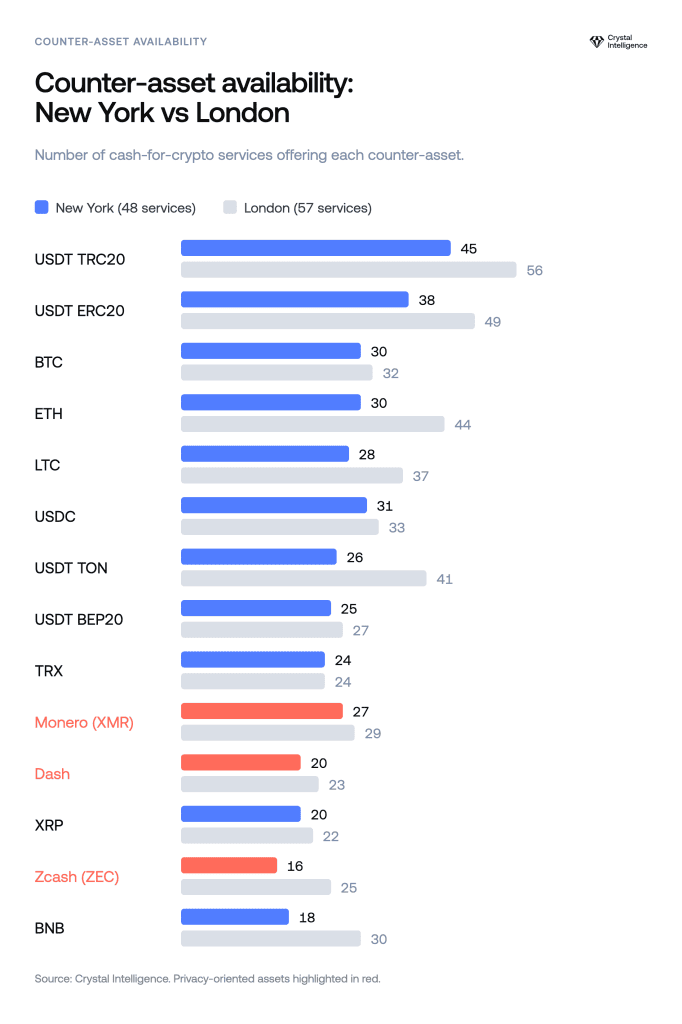
Above: Chart comparing counter-asset availability by number of services in New York and London. Source: Crystal Intelligence.
Privacy-oriented assets feature prominently: Monero (XMR) is offered by 27 of the 48 services (56%), Dash by 20 (42%), and Zcash by 16 (33%).
Above: 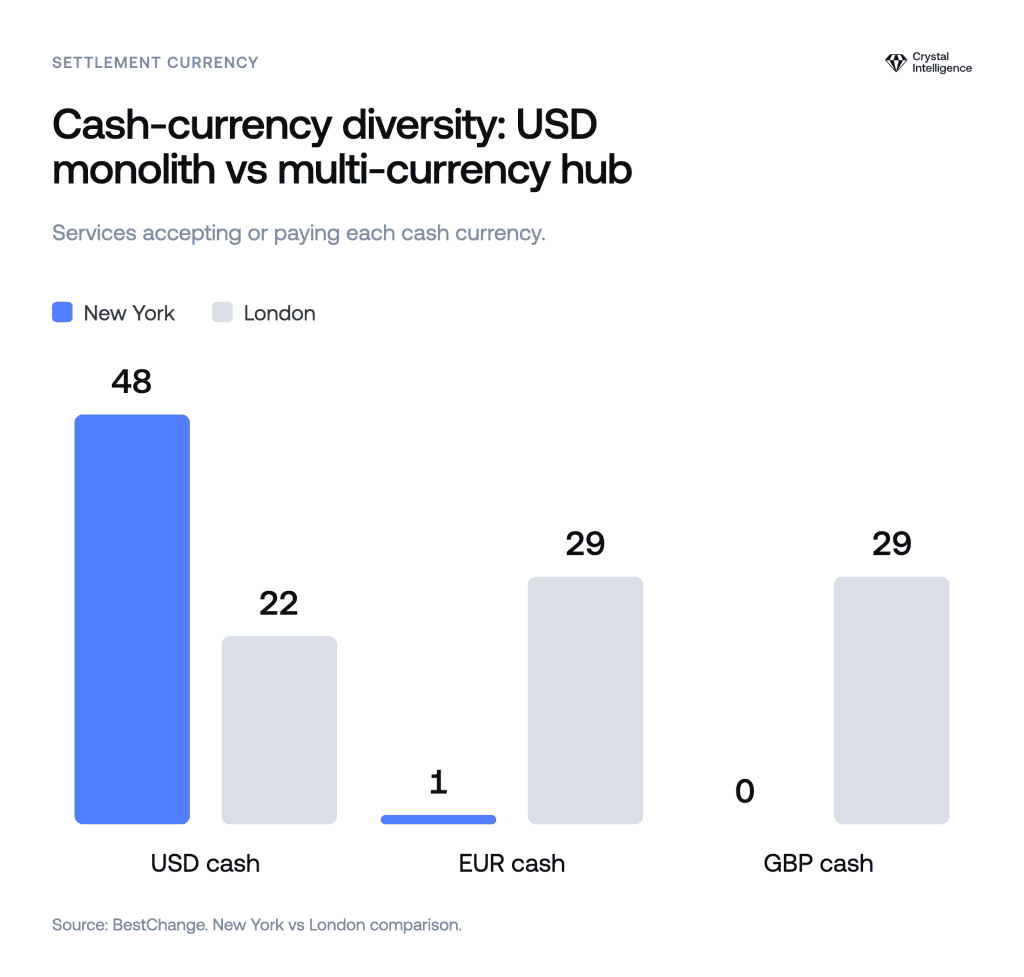
Settlement in New York is overwhelmingly physical cash, with no traditional bank transfers tagged to the state. Where bank rails appear, they are remote/online listings – most frequently Sberbank, T-Bank, Alfa-Bank, and Gazprombank.
These 48 services are not New York-specific: collectively, they appear across 443 cities. Some are sanctions-exposed, support privacy coins, and hold no local registration.
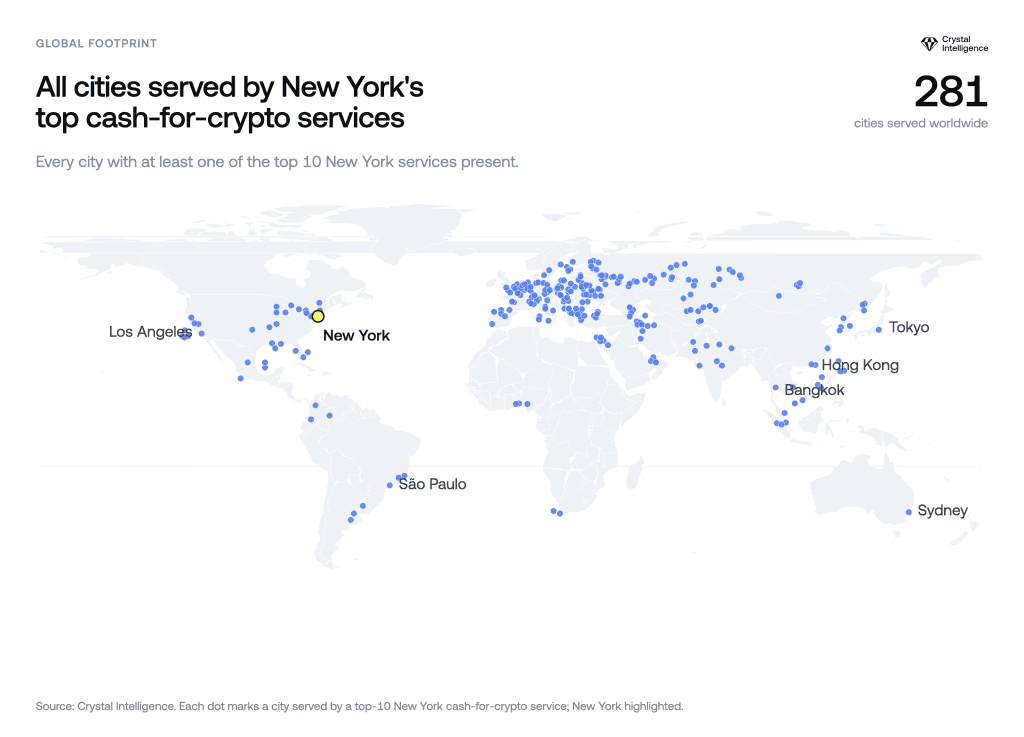
Above: Map showing the 281 cities worldwide where just the top ten cash-for-crypto services available to New Yorkers are also present, or 63% of the total number of cities housing the 48 services in the data set. Source: Crystal Intelligence.
Frequently asked questions
What is the BitLicense, and who has to hold one?
Anyone conducting virtual currency business activities with a New York resident must hold a BitLicense or a NYDFS limited-purpose trust charter.
What will change if the proposed CRYPTO Act passes?
Unlicensed operation would become a criminal offense – up to a Class C felony carrying five to 15 years – effective immediately upon enactment.
Why is New York’s crypto crime loss profile different from the national pattern?
Complaints rose 0.4% compared with a 21.3% national rise, yet the average loss per complaint surged 57.5% to $73,364. Likely drivers are high-net-worth targeting and institutional incidents.
Are many cash-for-crypto services in New York not locally registered?
Yes. The 48 services Crystal identified are present in 443 cities worldwide and share 85% of their operators with London. Most hold no New York registration, and 56% offer Monero.
What should state law enforcement and regulators do now?
Build blockchain investigative capability at the case-officer level, deploy professional-grade analytics to active investigations, and put the NYDFS, NYAG, Manhattan DA, and state law enforcement on a common analytical baseline.
What this means for New York State’s crypto industry
New York’s crypto framework faces three converging pressures: the most demanding state licensing regime in the country, a 2025 crime profile where losses per complaint surged year-on-year, and incoming federal and state rules through 2026 and 2027.
The visibility gap is the practical reality beneath the headlines. Forty-eight cash-for-crypto services move physical USD into stablecoins, Monero, and Bitcoin across 1,156 New York listings, many of which are not registered there. The BitLicense regime cannot reach them on its own.
State law enforcement needs blockchain forensics capability at the case officer level. Compliance teams need exposure controls that match the visibility a sophisticated investigator already has. And the NYDFS needs a common analytical baseline with the NYAG, the Manhattan DA, and federal regulators.