

Verified attribution is evidence tying an address to a real-world identity, checked against the physical world and open to inspection. It is the difference between knowing who is behind an address and guessing who might be behind it.
Most address labels in digital assets are inferred, and the process runs in stages.
Clustering heuristics group wallets by their on-chain behavior.
Scrapers harvest tags for those clusters from forums and block explorers.
A model then weighs the two together and assigns a confidence score, and that score ships as the label.
The method is useful, but the output is a probability, and a probability is a weak place to rest a decision you may have to defend.
Decision intelligence for digital assets is the discipline of putting verified evidence in front of every decision an organization makes about digital assets. Verified attribution is the concept that discipline stands on. Without it, the evidence is not evidence.
This guide defines verified attribution, shows where inferred labels fall short, and explains what verification changes in court, in an audit, and in a platform evaluation. The stakes are rarely abstract. For the person who owns the decision, they are the license, the banking relationship, and their own name on the call.
Key takeaways
An attribution is verified when the entity behind an address has been confirmed in the real world, and the evidence stays attached to the claim.
Most address labels are inferred from on-chain behavior. An inferred label is a probability, not evidence.
Three things separate verification from inference: real-world checks, evidence that travels with the claim, and a method anyone can examine.
Verification is what lets an attribution survive a court challenge, an audit, and technical due diligence.
Verified attribution grounds the AI in decision intelligence, and it underpins Know Your Agent (KYA) checks for agentic payments.
Why isn’t an address label evidence?
On-chain, identity is not given. It has to be established. The industry’s default way to establish it is inference. Co-spend heuristics cluster addresses into wallets. Behavioral patterns suggest an exchange, a mixer, or a service. Tags scraped from forums, block explorers, and known-entity databases fill in names. A model weighs it all and produces a label with a confidence score.
Blockchain analytics built this method, and it answers a real question: what happened on-chain, and what does it look like? What it does not answer is the question a decision turns on: who is actually behind this address, and how do you know?
An inferred label cannot answer that question, for three reasons. Its source is often unknown, so there is nothing to show when someone asks where the name came from. Its method is usually closed, so no one outside the vendor can check how the conclusion was reached. And its output can change as the model changes, so the same query may not return the same answer twice. None of that survives cross-examination, and an examiner, an auditor, and a defense lawyer all ask versions of the same question: prove it.
Inferred labeling | Verified attribution | |
|---|---|---|
Where the label comes from | Clustering heuristics, behavioral patterns, scraped tags | Field research and real-world checks on the entity |
What stands behind it | A confidence score | Evidence, with its source attached |
Can you inspect the method? | Usually not, the model is closed | Yes, no proprietary-methods wall |
Holds up in court or audit? | Contestable as a probabilistic guess | Built to be examined |
Source: Comparison by Crystal Intelligence, 2026. For informational purposes only. Download as CSV.
What makes an attribution verified?
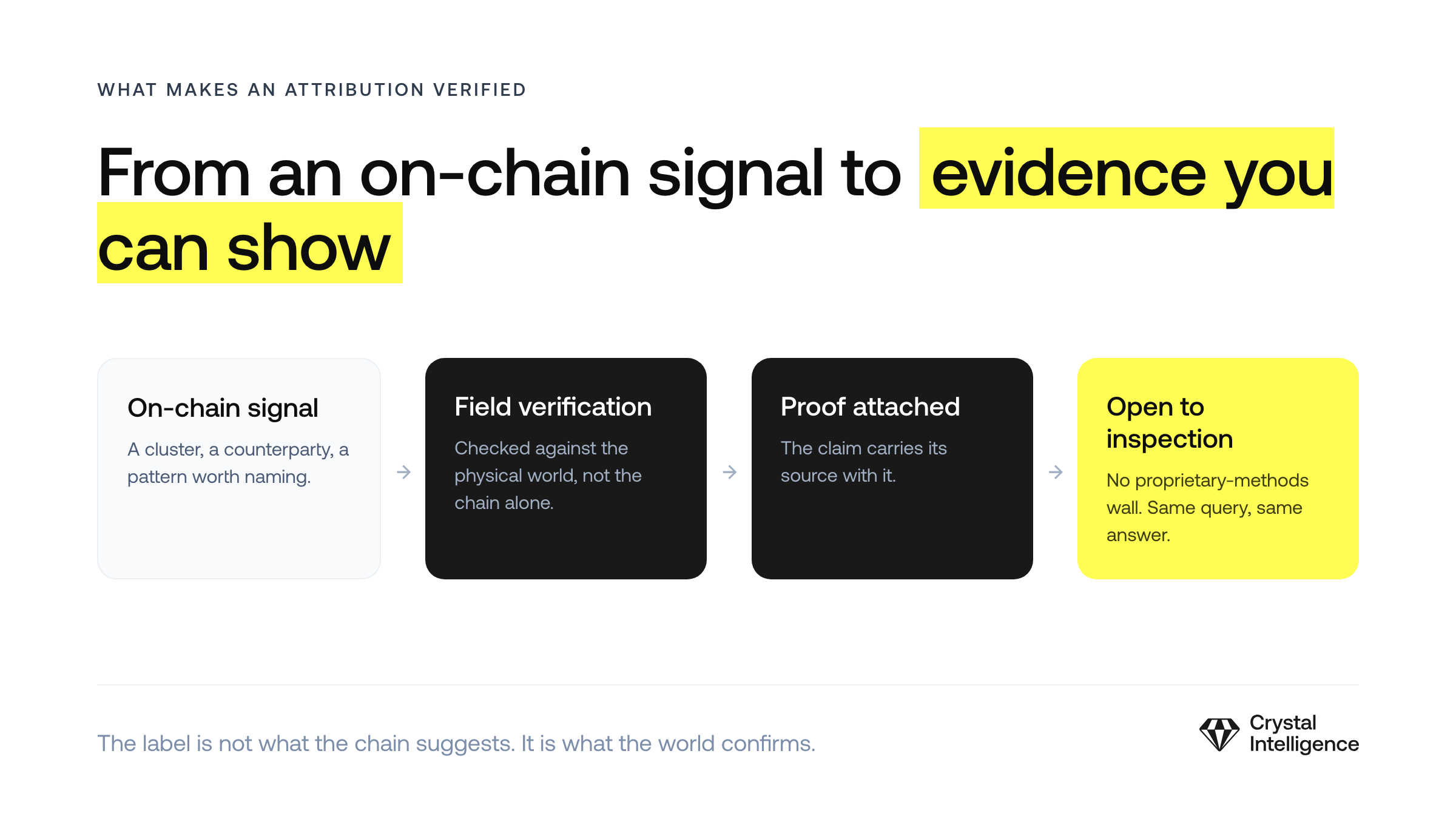
Verification is not a stronger opinion. It is a different kind of work, and it has three properties.
Checked against the physical world. Verification starts where the chain ends. A company register confirms the legal entity behind an exchange. A licence record ties a service to a jurisdiction. A researcher on the ground in a high-threat region confirms who actually operates a platform that has no paperwork at all. The on-chain cluster is where the work begins; the label comes from what the world confirms, not from what the chain suggests.
Proof attached. The evidence travels with the claim. When a name is put on an address, the evidence shows where that name came from – the register entry, the field report, the corroborating source – so anyone relying on it can show exactly how they know. Without that, an attribution is an assertion. With it, it is evidence.
Open to inspection. There is no proprietary-methods wall between a decision and the evidence behind it. The method can be examined, and the underlying data holds up. That is the practical difference between a verified evidence-based and a probabilistic score. One invites scrutiny. The other hopes to avoid it.

How does verified attribution hold up under challenge?
The value of verification shows up on the worst day, when someone challenges the call. That day looks different depending on who you are.
For a compliance team, it is the examiner asking why a transfer was cleared. With verified attribution, the answer is already evidenced: the counterparty, the evidence behind the name, and the reasoning, all traceable to a source. The decision carries an audit trail instead of a memory of one.
For an investigator, it is the courtroom. An attribution built on a closed model invites a simple attack: how do you know, and can anyone check? Verified attribution is built for that question. Every claim traces to its source, and the method can be laid out step by step in the courtroom – evidence to examine, not a score the court is asked to trust.
For a technical evaluator running platform due diligence, it is the test set. A verified evidence base can be tested directly: run your own queries, trace how each attribution was reached, and check that the answer does not change between runs. The evaluation does not have to take anyone’s word for anything, which is the point.
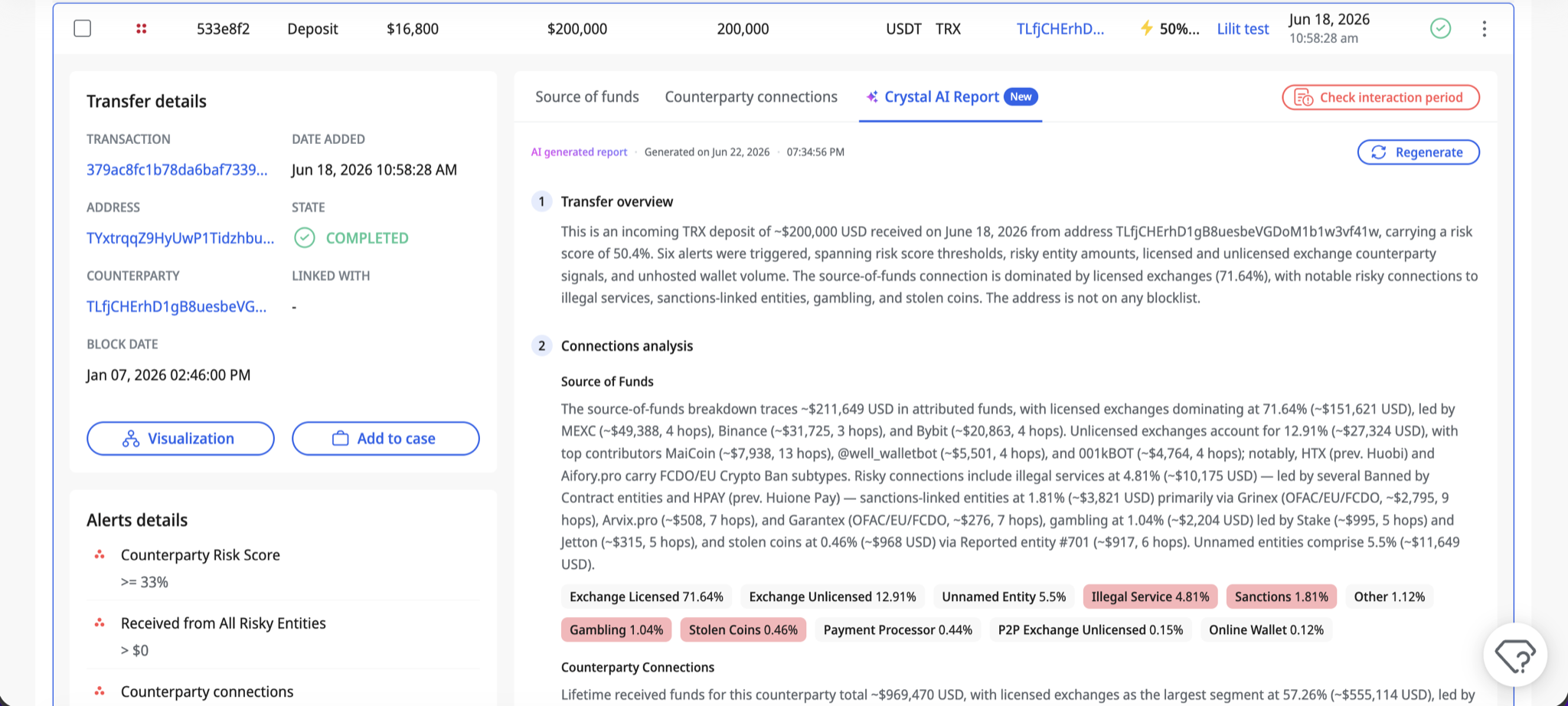

This is also where verified attribution meets the evidence standard blockchain intelligence has to meet. The standard is the argument; verification is how you satisfy it.
Where does verified attribution fit in decision intelligence?
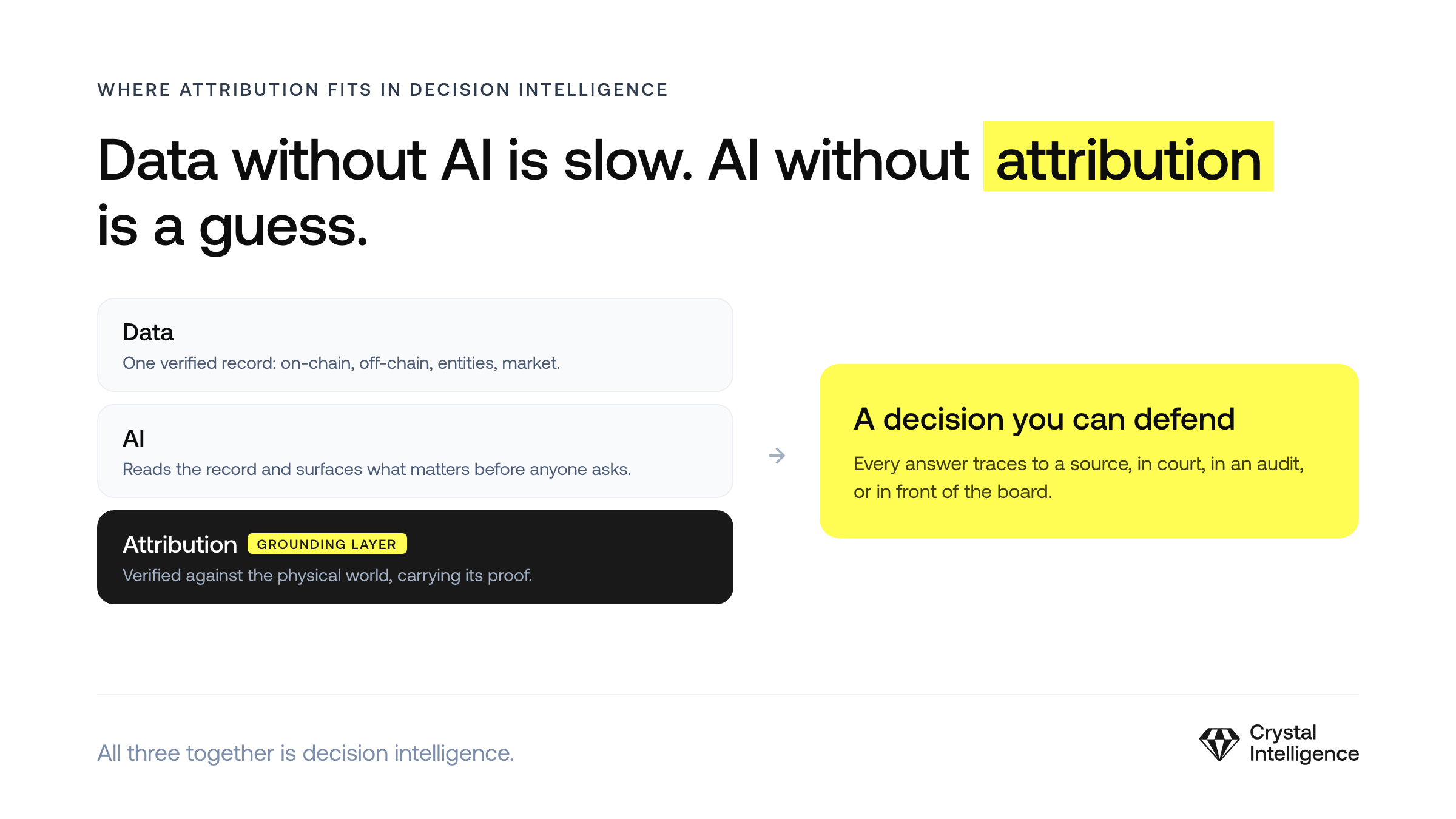
Decision intelligence for digital assets runs on three components working together: data, AI, and attribution. Data without AI is slow. AI without attribution is a guess. All three together is decision intelligence.
Attribution is the layer the AI stands on, and the AI is only as good as the evidence base it reads. Crystal’s evidence base is verified in the field, so when its AI surfaces a risk before anyone asks, the answer traces to a source rather than being generated from nothing. The scale is what makes that hold: 330+ blockchains and 10,000+ digital assets resolved into a single evidence base, with more than 130,000 of the entities behind it verified in the field.
The same grounding is what makes the next shift workable. As agentic payments move money at machine speed, Know Your Agent checks have to verify both the agent behind a transaction and the principal it acts for, per decision, continuously. That only works if attribution is verified before the question arrives. A guess at machine speed is still a guess. It is just faster.
The same holds for decision intelligence for threat detection: a surfaced threat is only actionable when the entity behind it is evidenced.

Frequently asked questions
What is verified attribution?
Verified attribution is evidence tying an address to a real-world identity, checked against the physical world and open to inspection. Instead of inferring who is behind an address from on-chain behavior alone, it confirms the entity against real-world evidence and keeps that evidence with the claim.
How is verified attribution different from address labels or clustering?
Clustering and labeling infer identity from on-chain patterns and scraped tags, and they produce a probability. Verified attribution confirms identity against the physical world and produces evidence. The practical test: an inferred label asks to be trusted, a verified attribution can be examined.
Why does attribution need to be checked against the physical world?
Because on-chain data alone cannot tell you who controls an address. Behavior suggests, but only real-world checks confirm: field research, registered entity records, and local intelligence. More than 130,000 entities in Crystal’s evidence base have been verified in the field.
What makes an attribution defensible in court or an audit?
The claim traces to a source and Crystal’s team is happy to provide the evidence. That is what lets an attribution survive cross-examination instead of being dismissed as a probabilistic guess.
How does verified attribution work for autonomous agents?
Know Your Agent checks have to verify both the agent behind a transaction and the principal it acts for, per decision, continuously. That only works if attribution already exists by the time the payment moves.
Attribution you can defend is attribution you can act on
Every digital-asset decision rests on a claim about who is behind an address. If that claim is inferred, the decision inherits the guess. If it is verified, the decision carries its evidence, and it stands when the examiner, the court, or the review board asks how you knew. That is the test worth applying to any attribution you are offered: if it were challenged tomorrow, what would stand behind it? Crystal Expert is built on verified attribution across 330+ blockchains, so the answer is already in the evidence base.