

Much of an investigation is still set up by hand. An investigator opens every address, sets up each analysis by hops, chains, timeframes, and direction, and traces funds hop by hop through intermediaries and services. Then the results have to be correlated and written up, and the write-up is often the slowest step. On November 18, 2026, Crystal is previewing Ask Crystal AI Investigator, its next step in AI blockchain investigation: an AI investigator that works your case on Crystal’s proven tracing engine and leaves the final approval to you.
AI Investigator is an AI agent on the Crystal Expert Visualization canvas that plans an investigation, runs Crystal’s tracing tools, and returns findings with the evidence behind each one. The investigator describes the objective in plain language and provides the addresses and transactions to work from, typed in or as a CSV file. The investigator then reviews the findings and decides what goes on the graph.
This is a preview, and AI Investigator is not live yet. Crystal customers get early access from December 2026, and the waiting list is open now.
Key takeaways
AI Investigator takes over the setup, searches, and correlation work in a case in Crystal Expert Visualization, and the investigator keeps the judgment.
It runs on Crystal’s tracing engine, so every result comes from the same data and algorithms investigators already use.
Early access starts with two use cases: finding connections between addresses and transactions, and tracing funds to a known entity.
Findings arrive as a list to review. Nothing goes on the graph until the investigator selects it.
AI Investigator is announced as a preview on November 18, 2026, with early access for Crystal customers from December 2026.
What has Ask Crystal added to Crystal Expert since June 2026?
Since June 2026, AI help for investigators has arrived in Crystal Expert one release at a time. Ask Crystal is the name for Crystal’s AI across the product, and from November 18 the AI reports in Crystal Expert carry the Ask Crystal name.
On June 9, an AI summary of a flagged transfer arrived in Crystal Expert Monitor, first for internal teams and selected customers. Ask Crystal was announced publicly in July 2026. On August 18, analysts could export Ask Crystal summaries as PDF, with their history.
On October 19, Visualization began finding common sources and destinations of funds and showing them as Insights. On October 26, Path Analysis came to Ask Crystal, explaining which paths behind an alert look relevant and why. On November 10, Auto-Detected Connections arrived in Visualization, looking for connections in the background when a graph opens. Each release added a piece, and AI Investigator now works the case.
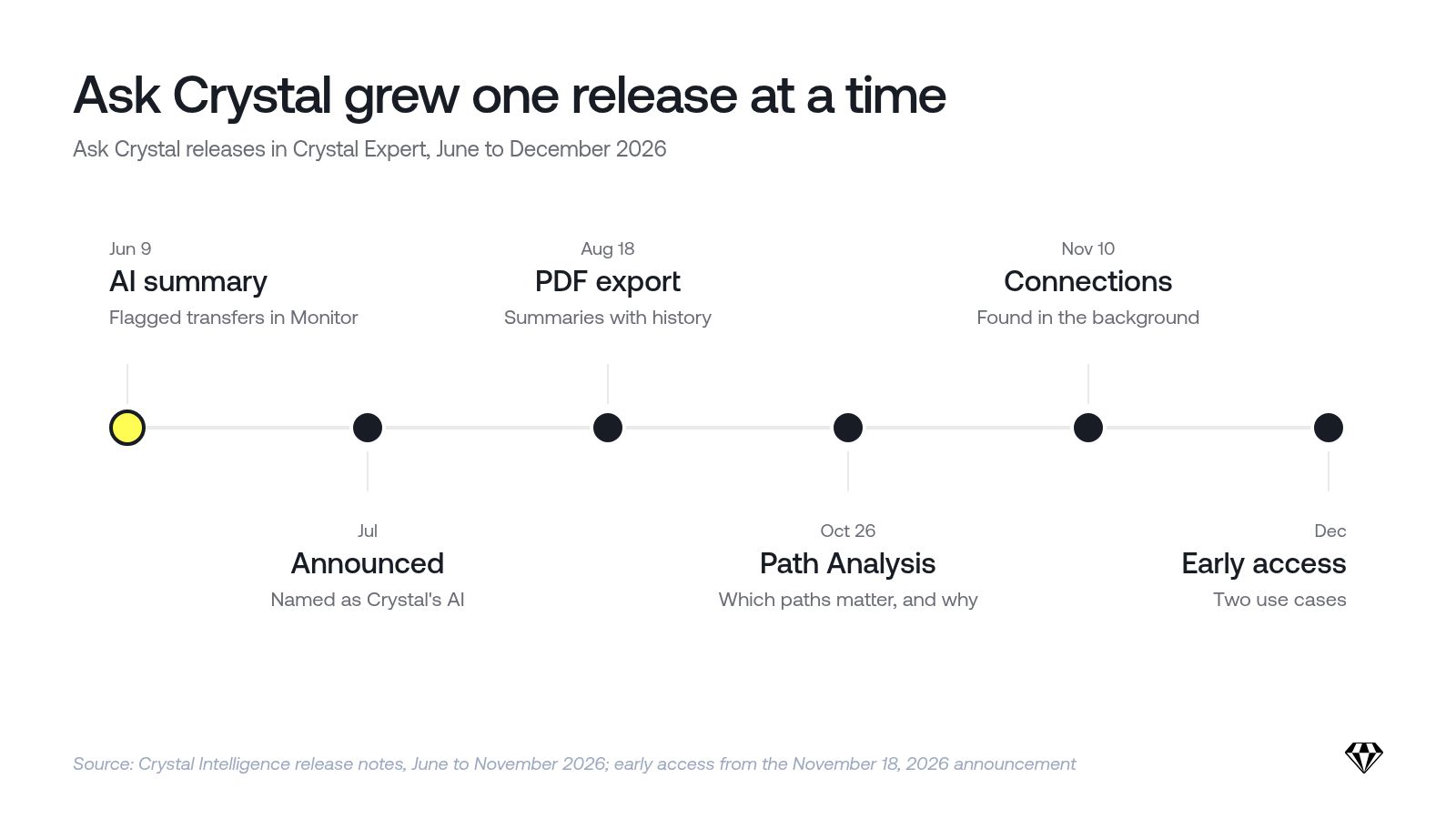
What Ask Crystal added to Crystal Expert, June to December 2026
How does AI Investigator work?
AI Investigator works a case in five steps. The investigator makes a request, and the agent plans, executes, analyzes, and delivers.
The request is the objective in plain language, with the addresses and transactions to work from. The agent plans a strategy and picks the Crystal tools the case needs. It executes the searches in parallel, tracing funds and finding connections. It analyzes what comes back, correlating and ranking the findings and checking them for gaps and limits. Finally it delivers a summary with the evidence, the key findings, and recommended next steps.
The agent drives Crystal’s tracing engine: the exposure graph, address-level lookups, and entity attribution, from the same database Visualization uses. It does not generate the flow of funds with AI. Every result comes from the same data and algorithms investigators already use, including Crystal’s 130,000+ attributed entities.
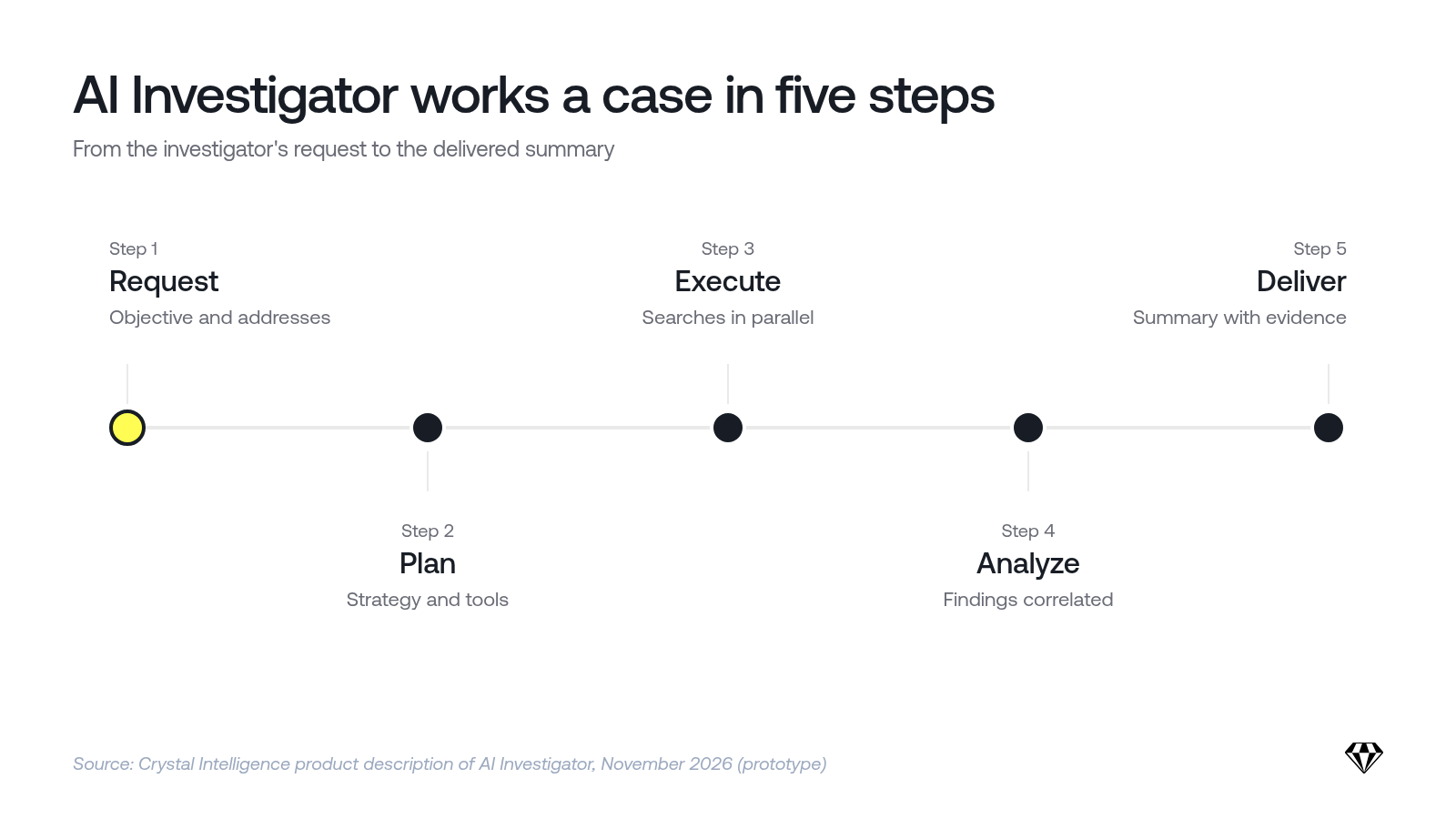
Request, plan, execute, analyze, deliver
What will AI Investigator do in early access?
In early access, AI Investigator does two things. It finds connections between addresses and transactions, and it traces funds to a known entity.
For connections, the agent takes a mixed list of addresses and transactions and looks for direct and indirect paths within the hop limit, common sources and common destinations of funds, and connected groups. Duplicates are consolidated, and different routes are kept. In the prototype, a run reports “Found 2 connections between 3 of 4 objects”.
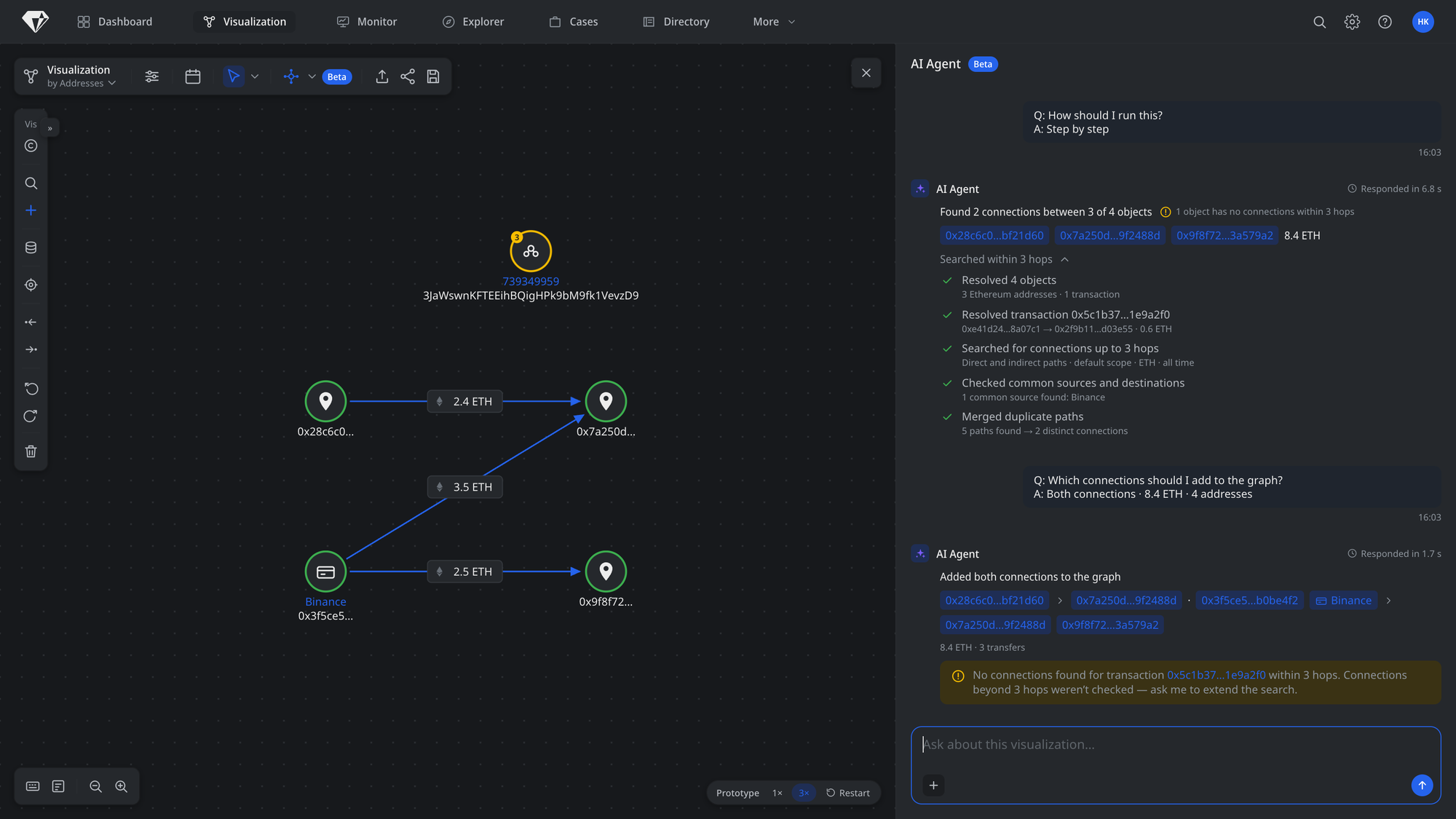
Prototype: finding connections between objects
For tracing, each path to the entity comes with its intermediate addresses, hashes, amounts, timestamps, and hop count, plus the entity’s name, category, attribution, and available risk score. The exposure of each deposit address is checked at address level, as well as at cluster level. Intermediate nodes that look like unnamed services are flagged, with the reasoning attached on the graph.
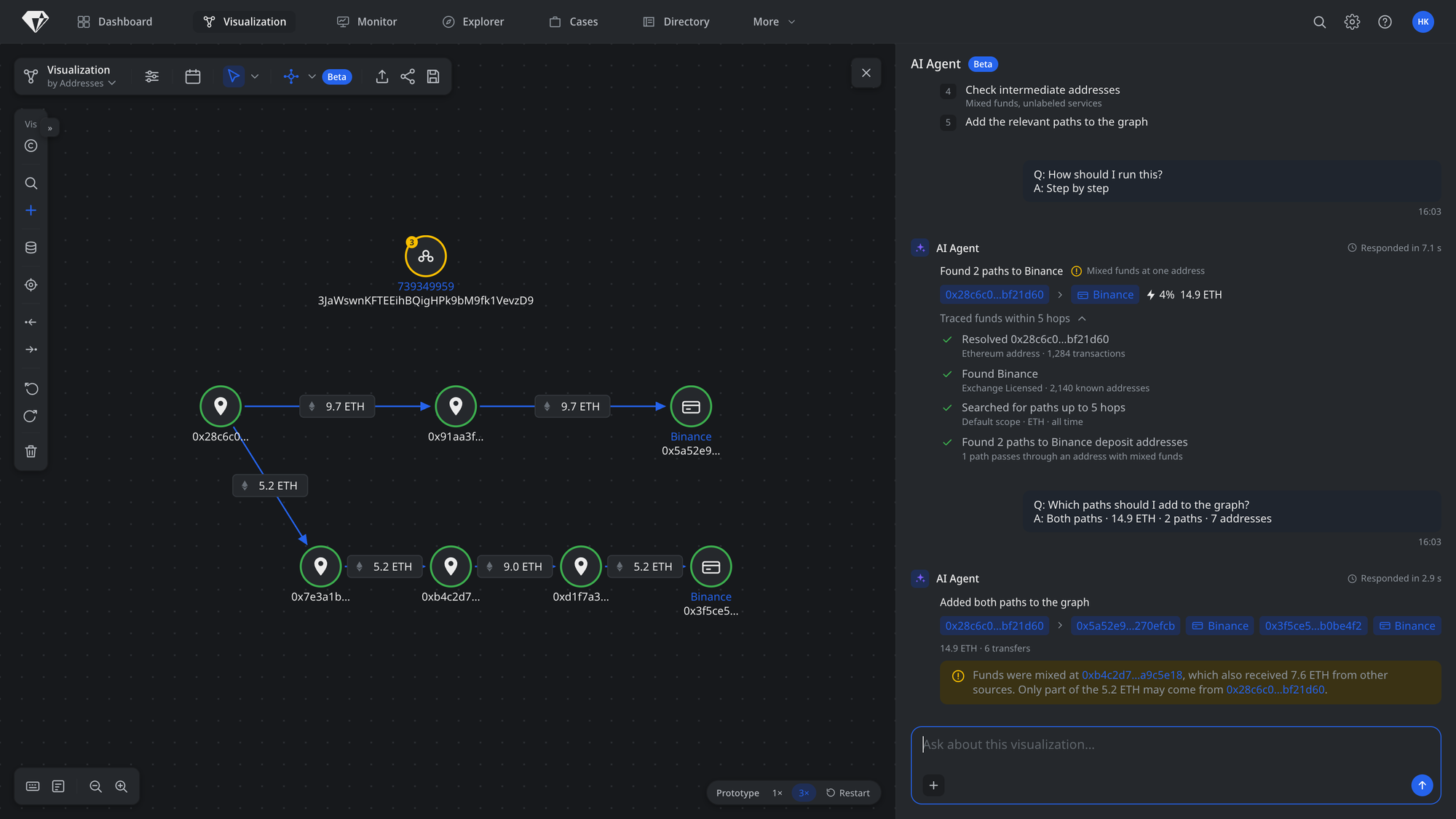
Prototype: tracing funds to a known entity
Investigating a single address or transaction and generating the investigation report as a PDF follow in a later release.
Why can investigators rely on the findings?
“No connection found within the analyzed scope” is reported separately from “data or search capability was insufficient”. That distinction matters to an investigator, because an empty result and an incomplete search call for different next steps. When a search fails or times out, the partial results are still returned and are never described as complete. In the prototype that reads as “Extended search to 6 hops – incomplete”.
AI Investigator does not fabricate transactions, paths, attributions, or risk indicators, and every finding points to the Crystal data behind it.
The investigator stays in control of the case. Findings arrive as a structured list, and only the ones the investigator selects are added to the graph. In the prototype it reads “Results come back as Insights – you choose what to add to the graph”. Every tool call, decision, and result is logged within the user’s permissions, so a reviewer can follow how each finding was reached.
FAQ
When can I use AI Investigator?
AI Investigator is announced as a preview on November 18, 2026, and it is not live yet. Crystal customers get early access from December 2026. Join the waiting list to hear when access opens.
What is in the first release?
The first release of AI Investigator covers two use cases, finding connections between addresses and transactions and tracing funds to a known entity. Investigating a single address or transaction and generating the investigation report follow in a later release.
What does the investigator still decide?
The investigator decides. AI Investigator takes over the manual setup of a case, such as configuring each analysis, running the searches, and correlating the results. The investigator reviews the findings, chooses what goes on the graph, and gives the final approval.
How do I know a finding is right?
Every finding points to the Crystal data behind it and comes from the same tracing engine investigators already use. The agent reports what it could not cover, never describes partial results as complete, and logs every tool call and decision.
Does Crystal train AI models on my data?
Crystal does not train AI models on your data. AI Investigator orchestrates Crystal’s existing investigation tools. At company level, Crystal holds ISO 27001 and SOC 2 Type II, is GDPR compliant, and has EU-based data governance.
How do I join the waiting list?
Use the waiting-list form. Early access opens to Crystal customers from December 2026.
The judgment calls in a case are where an investigator’s time matters most. AI Investigator lets an investigator hand over the setup, the searches, and the correlation, so that time goes to deciding what the evidence shows. The agent works on the tracing engine Crystal customers already use, and every finding comes with the evidence behind it, ready for the investigator to check.