


Every flagged transfer starts the same way. An analyst opens a case, then opens another screen, then another. Transfer details sit in one place. Fund connections sit in another. Alerts, counterparty history, and trusted-list status each live somewhere else. The analyst reads, correlates, and writes a view. Then the next alert arrives.
Multiply that across thousands of alerts a day, and the cost adds up fast. Ask Crystal is an AI blockchain analyst built into Crystal Expert. It reads the full on-chain picture behind any transfer and returns one clear, evidence-backed narrative in seconds. This post explains why that matters, what it does, and how it saves both time and budget.
Key insights:
Manual transaction review costs compliance teams time and money, because every alert needs a human check even though most turn out clean.
Ask Crystal is an AI blockchain analyst inside Crystal Expert that turns any transfer into one clear, evidence-backed narrative in seconds.
It covers five checks in a single read: transfer details, fund connections, alert history, trusted-list status, and every flagged alert.
It works around the clock across 330+ blockchains, so risk review never waits for a shift change.
Faster reviews mean teams handle rising volume without adding headcount, which keeps cost per case down.
Why does doing multiple transaction reviews cost so much?
Crypto never stops. Money moves across hundreds of blockchains at every hour, in every time zone. Alert volumes rise with that activity, and most alerts lead nowhere. Analysts still have to check each one, because the few that matter carry real risk.
The numbers tell the story. The LexisNexis True Cost of Compliance study puts global financial crime compliance spend above $206B a year, and reports that 70 percent of institutions plan to cut compliance cost in the next year. First-line reviews take 30 to 45 minutes each, and 85 to 90 percent of those alerts are false positives. Teams spend most of their day reading activity that turns out to be clean. See the LexisNexis study for the full data.
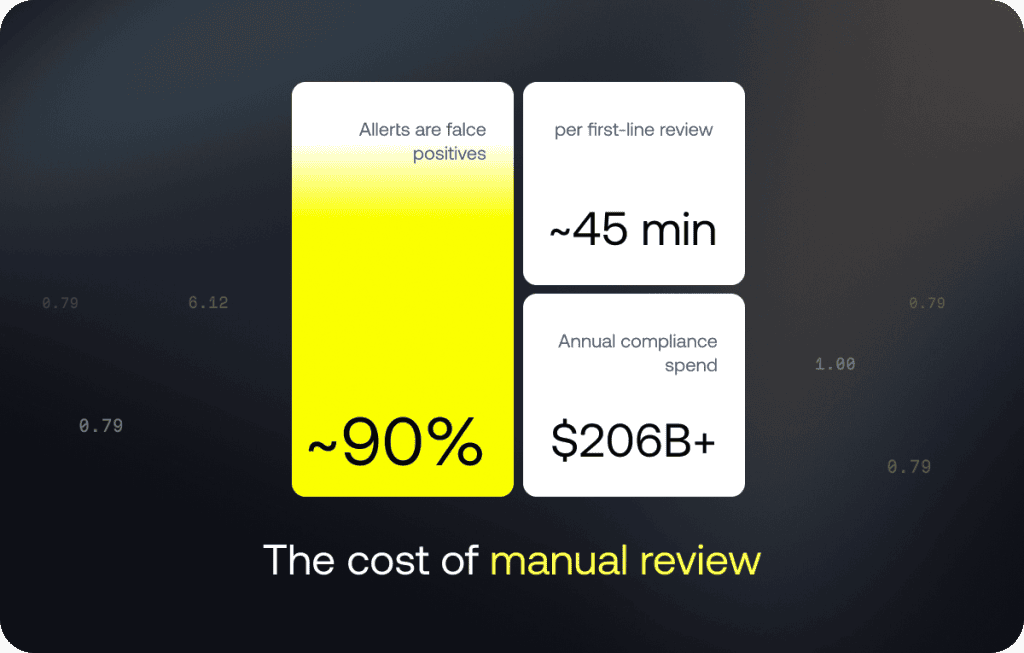
This is a budget problem as much as a time problem. Every extra minute per case means more analyst hours, larger teams, and higher cost per review. When volume spikes, the only manual answer is to hire. That does not scale, and it does not get faster.
What does an AI blockchain analyst actually do?
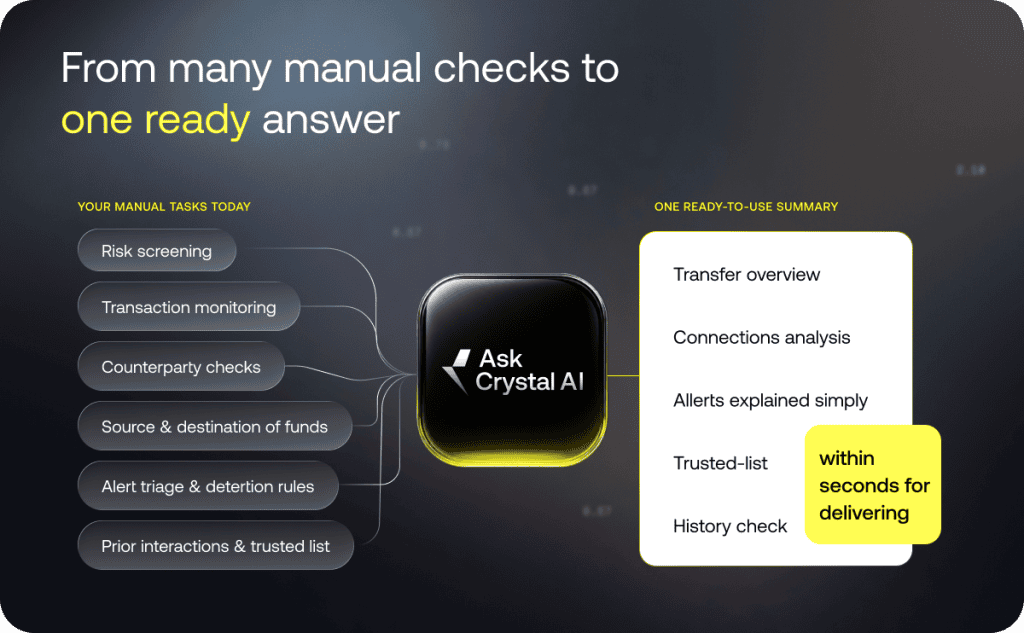
Ask Crystal is an AI blockchain analyst that works inside Crystal Expert. On any transfer, a single tab generates a plain-language summary on demand. The analyst reads one narrative instead of jumping across tabs and screens. Every answer is backed by verifiable on-chain evidence.
Five reads, one analysis
The manual review is a sequence of checks. Ask Crystal runs the same sequence in seconds and writes it up in plain language: one clear narrative you can read at a glance.
1. The transfer, at a glance
It opens with the whole transfer in one read: amount and asset, the participants, their source and destination addresses, the chain it moved on, the transfer type, and the surrounding context. You know what happened before you read another word.
2. Connections, in plain language
Connections shows how funds spread across counterparties, as deposit distribution or as left and right exposure on a pre-check, in a graph you have to read. Ask Crystal turns that distribution into a sentence: where the money came from, where it went, and how much sits with each counterparty. No manual parsing of the exposure chart.
3. The history behind the alert
Before you judge an alert, Ask Crystal checks whether you have met this counterparty before. It searches by customer and by address for related transfers, and whether those were previously reviewed and cleared, then surfaces it as context, not a task. For example: “This customer has interacted with this counterparty 4 times before; 3 were reviewed and unflagged.”
4. Trusted-list awareness
When an expected flag is missing, it is usually a Trusted list doing its job. Whitelisting a counterparty address or a customer ID both suppress the transfer’s risk grade. Ask Crystal recognises when a flag was suppressed for that reason and says so plainly, so an absent alert reads as intentional, never a gap.
5. Every alert, explained
Beyond exposure, it explains every alert on the transfer. It reads the alert IDs to name each alert type and the rule behind it. For blocklist alerts, it goes one step further, looking up the block lists directly and naming the exact list the address appears on: attribution you would otherwise have to open a separate link to find.
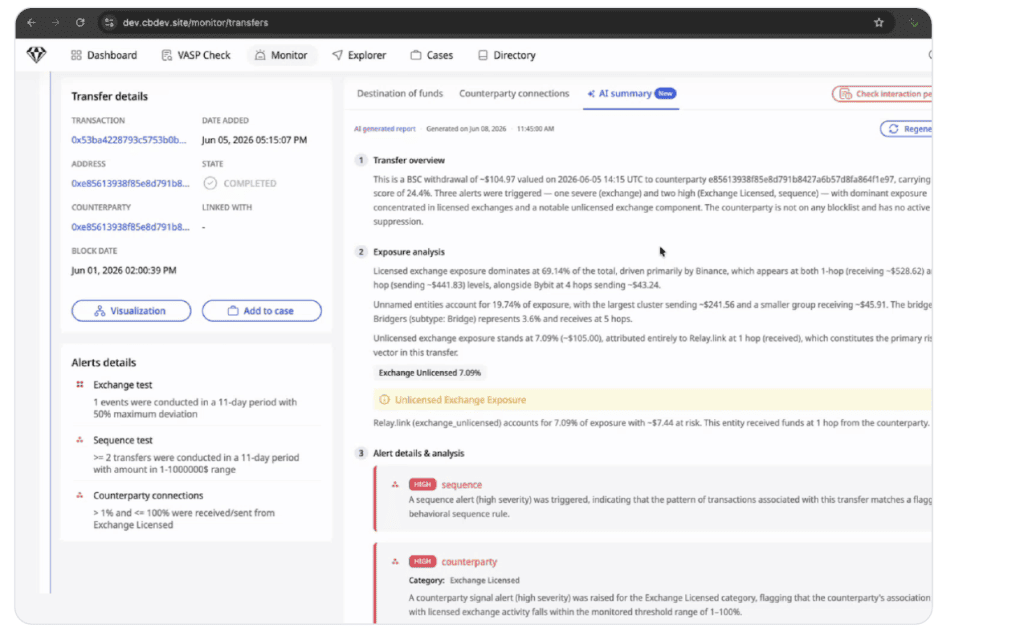
Alert details & analysis. Each alert named, graded, and enriched, with the exact blocklist and its tags inlined, no separate lookup.
Five reads, correlated into one narrative, grounded in deterministic on-chain data: the same evidence, every time. The analyst can regenerate the summary any time a fresh view is needed. The reading is done. The decision is still yours.
An analyst who never clocks off
People need rest. Crypto risk does not wait. That gap is where backlogs build and where real threats slip past tired reviewers late in a shift.
Ask Crystal is always on. It reviews a transfer at three in the morning the same way it does at midday, across more than 330 blockchains. It does not get tired, it does not rush the last case before a deadline, and it reads every transfer with the same method. That consistency is its own form of risk control, because two analysts no longer interpret the same case in two different ways.
Think of it as an analyst who is ready to work 24 hours a day, 7 days a week, and who never needs onboarding. When volume doubles overnight, the summary still arrives in seconds. The team scales with demand instead of scrambling to keep up.
Faster review
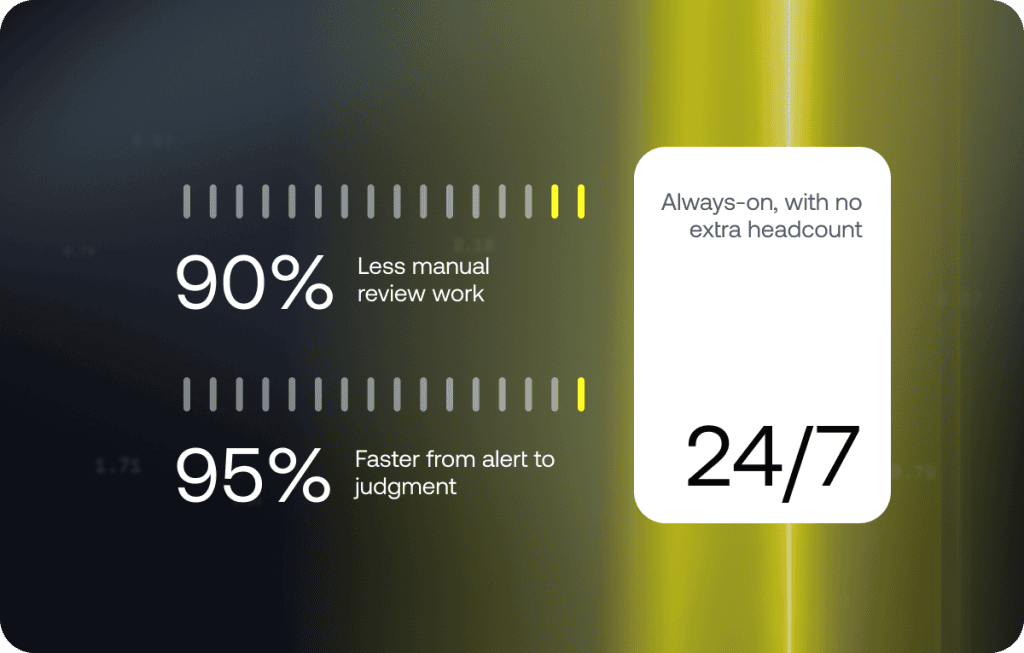
This is where the value shows up on the balance sheet. Ask Crystal shortens the first-line review by surfacing the relevant evidence immediately, instead of leaving an analyst to manually correlate it on a case-by-case basis. That means less time spent assembling the picture and more time spent making the call — every finding still comes with the underlying verified evidence attached, so the analyst is reviewing and confirming, not taking Ask Crystal’s word for it.
That changes the cost math. As case volume grows, teams can keep pace without lowering the bar on review quality — Ask Crystal augments the analyst’s judgment on every case, it doesn’t stand in for it.. Analysts spend their time on the cases that carry real risk, not on reading clean activity. Cost per review falls, and onboarding gets faster because new hires learn from a clear, guided narrative.
The wider market is moving the same way. AI review tools have cut per-case investigation time across the industry, letting teams process several times more cases with the same staff. Ask Crystal brings that gain inside Crystal Expert, where the on-chain evidence already lives. For more on the cost pressure driving this shift, see this industry analysis.
How to put Ask Crystal to work
Getting started is simple, because Ask Crystal lives where your team already works. Open any transfer in Crystal Expert. Generate an AI summary on demand. Regenerate it whenever you need a fresh read. Access is controlled through role-based permissions, so the right people see the right cases.
Ask Crystal is part of Crystal Expert, the institutional-grade platform used by compliance teams, investigators, financial institutions, and regulators to detect crypto risk, trace funds, and prove compliance. To see it in action, request a demo. For the bigger picture of why the shift from risk scores to evidence-backed narratives matters, read AI in crypto compliance: from scoring to deciding.
The takeaway
Manual review is slow and expensive, and crypto risk runs 24/7. Ask Crystal answers both problems at once. It is an AI blockchain analyst that turns any transfer into one clear, evidence-backed narrative in seconds, and it works 24 hours a day, 7 days a week. Teams save time, hold cost flat as volume grows, and keep their judgment firmly in human hands.
This is what decision intelligence looks like in practice: verified evidence in front of every decision, at the speed an investigation actually moves. Ask Crystal doesn’t change what evidence is required — it changes how quickly an analyst can get it in front of them.
Frequently asked questions
What is Ask Crystal? Ask Crystal is an AI blockchain analyst built into Crystal Expert. On any transfer, it generates a plain-language summary that pulls together transfer details, fund connections, alert history, and trusted-list status into one evidence-backed narrative.
How does Ask Crystal reduce compliance review time? Ask Crystal runs the same five checks a human analyst would and writes them up in seconds instead of the 30 to 45 minutes a manual first-line review typically takes.
Does Ask Crystal replace human analysts? No. Ask Crystal handles the reading and correlating so analysts can focus on judgment. The narrative is generated for review, but the decision on each case stays with the analyst.
How many blockchains does Ask Crystal cover? Ask Crystal works across more than 330 blockchains inside Crystal Expert, the same coverage as the core platform.
What happens when an alert is missing that I expected to see? Ask Crystal checks whether a Trusted list suppressed the alert, whether through a whitelisted counterparty address or customer ID, and states this explicitly so an absent alert reads as intentional rather than a gap.
How do I access Ask Crystal? Open any transfer inside Crystal Expert and generate an AI summary on demand. You can regenerate the summary any time you need a fresh read.