



Crypto-funded payment cards let users spend crypto wherever the cards are accepted. The merchant sees an ordinary purchase; the sponsor bank, an approved crypto program. Neither sees the funds’ on-chain history.
Crystal Intelligence now tracks 343 crypto card services, up from about 100 in April 2026 Of 100 providers analyzed, 67.7% offer low or no identity verification. No-KYC cards aren’t just a crypto problem. They expose a structural gap in card issuing: compliance is split across four or five layers, and no party oversees both funding and spending. For compliance teams at banks, EMIs, card issuers, BIN sponsors, and program managers, the exposure now rivals what exchanges already face.
That gap was the focus of Crystal’s Compliance Blind Spots webinar on October 28, 2026, “Payment cards, no questions asked.” Nick Smart, Chief Intelligence Officer at Crystal, moderated. He was joined by Corbin Duncan, Global correspondent at The Economist; Firas Hamad, MENA Research Lead at Crystal; and Jason Mikula, Publisher of Fintech Business Weekly.
Only got time for a quick tap? Don’t let it become a blind spot – watch the key takeaways here.
Key takeaways
Crystal tracks 343 crypto card services. Of 100 providers analyzed, 67.7% offer low- or no-ID verification.
On-chain analysis of inflows to this sample of card providers exceeds $1.18B – up 66% year on year – of which $166.4M came from high-risk sources. Meanwhile, total volumes are likely much higher.
Up to five layers can sit between the cardholder and the bank. Each holds part of the compliance duty, and none sees the full chain.
Once a business is onboarded to some corporate card programs, it can issue extra cards with no cardholder-level KYC.
Card businesses earn revenue on every transaction, so incentives across the chain favor volume over scrutiny.
BIN sponsors that take direct control of customer onboarding are best placed to fix this.
How big is the no-KYCcrypto card market?
Criminals need to turn stolen crypto into usable money. After studying in-person cash exchanges, Crystal found crypto debit cards to be a newer and far more convertible route.
Firas Hamad said Crystal’s database grew to 343 card services over the past 10 months. More of these services now accept privacy coins, which is a high-risk indicator, and more are moving to non-custodial models.
Crystal’s research traced more than $1.18B in on-chain inflows to card providers, up 66% year-on-year. Of this, $166.4M came from high-risk sources. Gambling accounted for 92.4% of the high-risk total, with smaller shares linked to sanctions, stolen coins, scams, and mixers. Of the 54 BINs reviewed across nine jurisdictions, 32 issued cards with no KYC. Hong Kong accounted for 47% of no-KYC records, and a single BIN sponsor was linked to 48.4% of issuer entities.
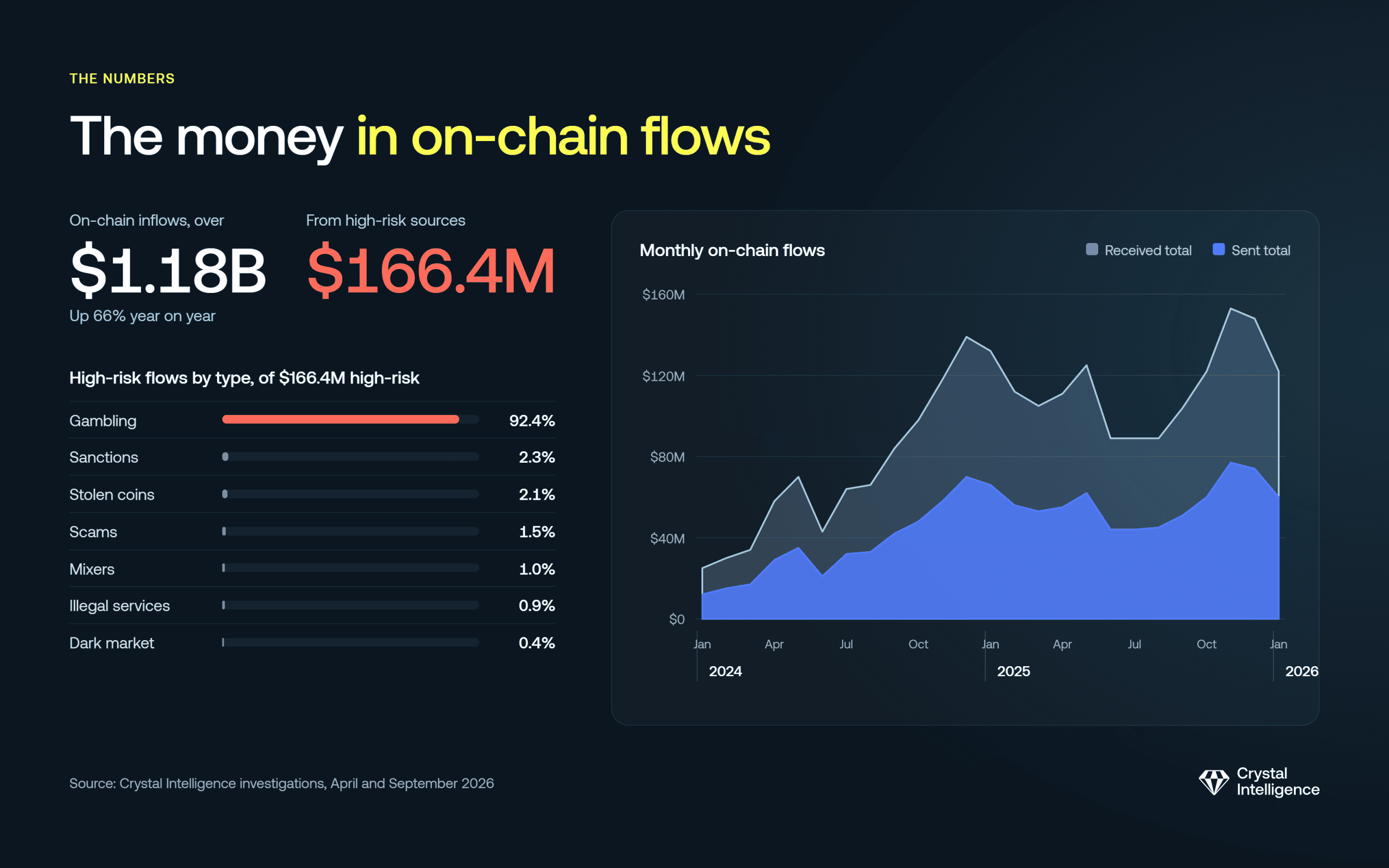
Above: Crystal traced over $1.18B in on-chain inflows to card providers, up 66% year-on-year. Of this, $166.4M came from high-risk sources, mostly gambling. Source: Crystal Intelligence.
Access is fast. Many services operate through Telegram bots. A user pays a setup fee of $25 to $50, usually with a stablecoin, and receives a virtual card that can be used almost immediately. Nick Smart said Crystal has seen monthly limits of $2 million on cards with no KYC. On some services, Crystal was able to issue its own cards without providing any identity information.
The data has limits. Not every payment can be linked to illicit activity, and a large share may be ordinary spending.
Why can’t the issuing bank see where the money comes from?
The user funds the card in crypto. The provider receives the crypto and converts it to fiat through its own counterparty. A BIN sponsor issues the card, the network routes the payment, and the user spends at a merchant or ATM. At no point does a regulated entity onboard the cardholder.
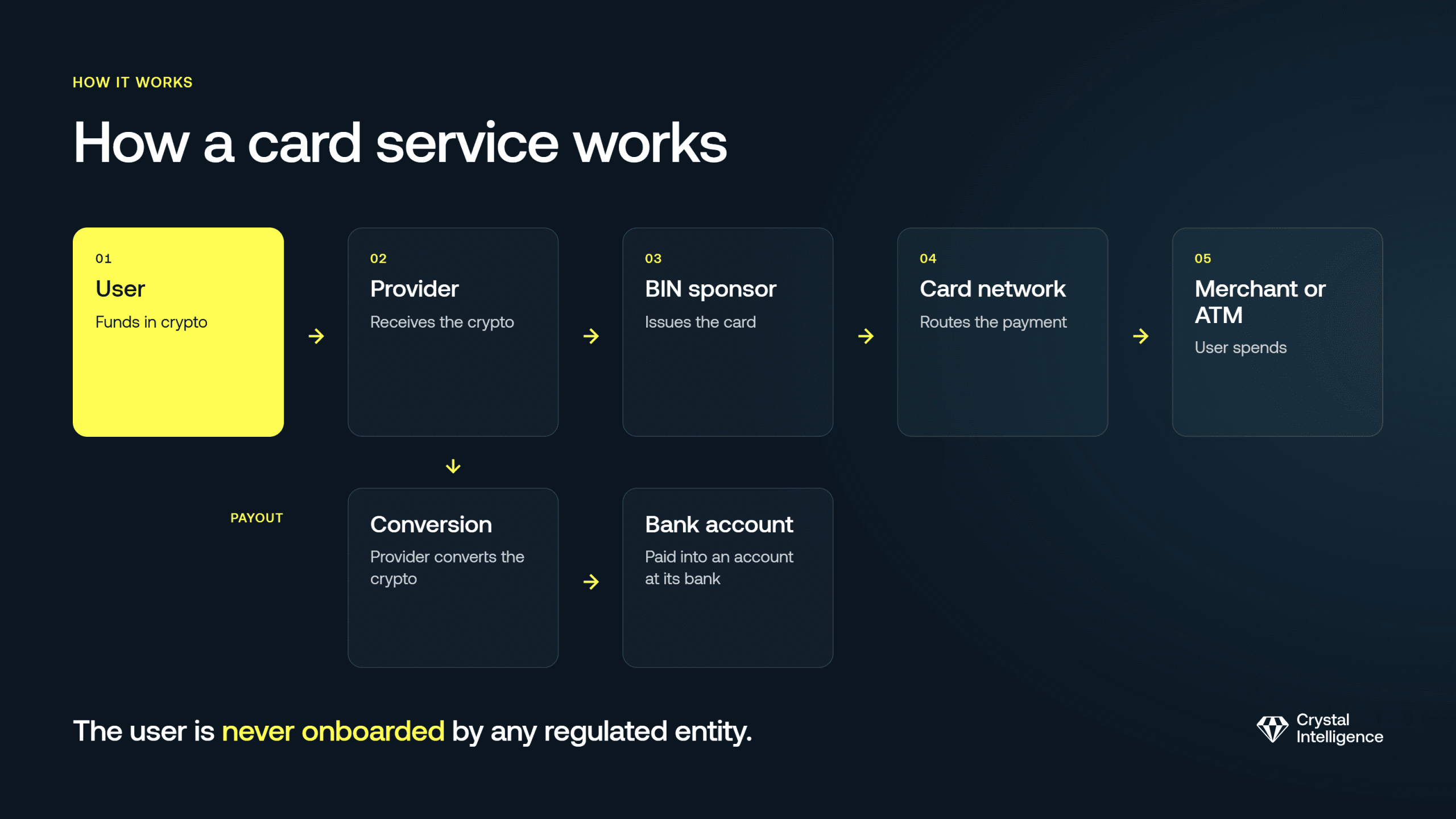
Above: Funds move from the user’s wallet through the provider, BIN sponsor and card network to the merchant. No regulated entity ever onboards the cardholder. Source: Crystal Intelligence.
Corbin Duncan compared these cards to physical prepaid cards, which have long worried law enforcement. A prepaid card sold over the counter may carry a $500 limit and can’t be reloaded, because it requires no KYC. Some crypto cards carry limits of $200,000 to $500,000 a month and are fully reloadable. Jason added that providers can spin up hundreds or thousands of virtual cards through an API, each usable through Apple Pay and Google Pay.
Non-custodial services can remove an important layer of identity visibility. Firas explained that self-hosted wallets such as MetaMask and Trust Wallet do not, by themselves, identify the individual controlling a wallet address. Blockchain analytics can attribute addresses to services or entities where reliable evidence exists, but an individual self-hosted wallet generally remains pseudonymous unless additional information links it to a specific person.
Under the EU General Data Protection Regulation, once a wallet address can be associated with an identified or identifiable individual, it may constitute personal data. This means that personal-level attribution and processing must have an appropriate legal basis and comply with applicable data protection requirements.
Jason noted that non-custodial wallet providers typically position themselves as software providers rather than custodians, creating a different regulatory relationship from that of a custodial exchange
The structure of card programs adds even more distance. Several layers can sit between the client and the bank, and each one disperses both responsibility and visibility. A user rejected by one provider can move to another on the same BIN sponsor, which has no record of the earlier rejection. “Nobody has full visibility over the chain,” Corbin said.
How does the corporate card loophole work?
Jason has covered bank-fintech partnerships since 2020. Between 2020 and about 2023, he said, 15 to 20 US banks faced enforcement actions linked to those partnerships. The most common failings were weak anti-money laundering controls and weak third-party risk management.
He described a route that remains open on the issuing side. A company is set up that looks credible on paper, often an LLC in a state such as Wyoming, with incorporation documents and named beneficial owners. It applies to a corporate card or spend management platform that presents itself, for example, as a media consultancy. The platform, its program manager, and its BIN sponsor should underwrite that business.
Once the business is approved, issuing an extra card for an “employee” often follows no defined process and requires no cardholder-level KYC. Jason called this one of the biggest gaps in card issuing. The BIN sponsor may not know the business is distributing cards to third parties, so it has no reason to review how those cards are marketed.
Why do criminals concentrate on a few issuers?
Jason said the concentration of no-KYC cards around one issuer did not surprise him. Criminals find the weakest institution, use it until its controls tighten, and then move on. Data from a leaked US bank file he reviewed showed thousands of shell companies registered at one Wyoming address, using phone numbers from Russia, Pakistan and Syria. The pattern was visible without specialist tools.
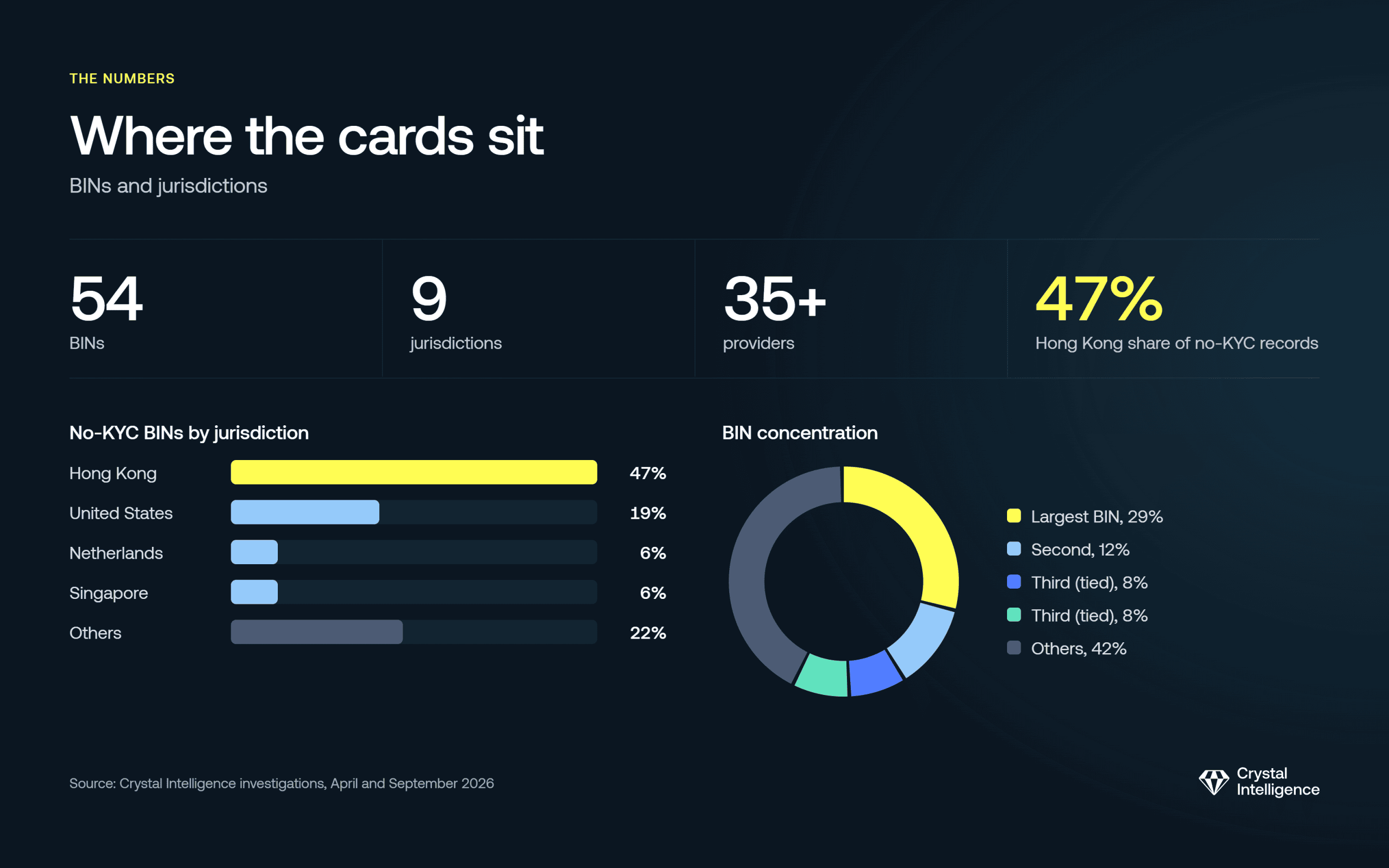
Above: Across 54 BINs in nine jurisdictions, no-KYC cards cluster in a few places. Hong Kong holds 47% of no-KYC records, and the largest single BIN 29%. Source: Crystal Intelligence.
What are these cards being used for?
Corbin came to the topic through AI. Frontier American models such as ChatGPT and Claude are not available in China under their providers’ terms of service. Tutorials on Chinese social media showed users how to obtain a card with a major network logo, which hides their location. Corbin said his reporting found that a large share of new payment flows on these cards goes to Chinese efforts to distill American AI models, using their outputs to train domestic ones.
Nick said Crystal has seen the same services marketed to Russian-speaking users and to Farsi-speaking users in Iran. Jason described a website that explicitly urged users to use its card to evade US sanctions on Iran.
Corbin cited crypto card spending of about $1.2B per month among providers that report their volumes. He stressed that while most of this is probably not abuse, some red flags are clear. Providers told him about users with Shenzhen IP addresses who submitted Chinese identity cards, gave addresses in Bolivia, then spent $50,000 on ChatGPT subscriptions as their next transaction.
Is the problem negligence or ignorance?
In Crystal’s view, the answer starts with incentives. Jason noted that many firms in the chain are venture-backed and built for fast growth, while their sponsor banks may have a lower risk appetite. In lending, fraud causes an immediate loss. In payments, revenue comes from interchange on each transaction, so facilitating questionable spend still earns money. Any regulatory penalty may come years later, or not at all.
Corbin agreed and was careful to say this does not describe every issuer or BIN sponsor. However, he found the abuse openly discussed on social media, where large players could monitor it. “Negligence is possibly the kindest label that you could give to some of the actors in the system,” he said. In his view, current safeguards do not match the scale of the problem, and the regulatory response so far has been limited.
What should card issuers, exchanges, and regulators do now?
The panel agreed that the problem is not the existence of crypto cards. It is whether the controls around them are strong enough. Four steps stood out.
Know your counterparty’s counterparty. Nick advised firms that give partners access to retail clients to review who those partners market to, and through which channels.
Bring onboarding closer to the BIN sponsor. Corbin said some BIN sponsors are already becoming joint program managers, controlling the API through which customers are onboarded and cards issued.
Reduce the layers. The more steps between the BIN sponsor and the party onboarding the customer, Jason said, the more likely these failures become.
Resource compliance before a regulator requires it. Jason noted that compliance is often treated as a cost center and remains under-resourced until supervisory findings or penalties are issued.
The crypto side shares the exposure. Exchanges and other VASPs that send funds to card providers should treat those providers as high-risk counterparties. For regulators and policy bodies, corporate card issuance and layered programs are where oversight has not kept pace.
Crystal expects scrutiny of card issuing chains to increase as volumes grow. Issuers and sponsors will need to connect the card side with the funding side. Crystal does not see individual card transactions; the card networks hold that merchant data. What blockchain intelligence adds is the funding picture: tracing on-chain flows into card providers, as Crystal Expert does, and monitoring where and to whom cards are marketed.
Frequently asked questions
What is a no-KYC crypto card?
It is a payment card funded with crypto that requires little or no identity verification yet works wherever the card network is accepted.
What is a BIN sponsor?
A BIN sponsor is the bank, EMI or other licensed institution that issues cards on a network. It holds core responsibility for KYC, even when program managers onboard customers.
Are all crypto card payments illicit?
No. Much crypto card spend is likely legitimate. The risk lies in programs that combine weak verification with high, reloadable limits.
What warning signs should issuers watch for?
Public marketing of no-KYC access or sanctions evasion, mismatched identity and location data, and corporate programs issuing many cards without cardholder checks.
What comes next?
No-KYC crypto cards show what happens when responsibility is shared, but visibility is not. Closing the gap will depend on BIN sponsors seeing more of who their programs serve, and on linking card data with on-chain intelligence.
Watch the full webinar here. Crystal’s Compliance Blind Spots series continues on November 18, 2026, with “Seconds to move, weeks to freeze,” on where crypto investigations stall. Be sure not to miss out by registering to attend it here.
DISCLAIMER: Statements by individual guests and panelists reflect their own personal views, are not fact-checked or endorsed by Crystal, and do not represent Crystal’s opinions or positions. Nothing discussed constitutes legal, compliance, financial, or investment advice.