

Key takeaways
Scoring-era AI in crypto compliance gives you a conclusion but not the evidence behind it, so it cannot be defended to a regulator or reused in a report.
Decision-era AI reads the full on-chain record and returns a structured, evidence-backed narrative that an analyst reviews and confirms.
Crystal’s AI made that transition across five 2026 releases, from an AI assistant inside Monitor to reports that can be exported and kept against the exact version of the transfer they describe.
For compliance leads, the gain is consistency and defensibility: every transfer is read the same way, and every sentence points to verifiable on-chain data.
Decision intelligence for digital assets is the discipline of putting verified evidence in front of every decision an organization makes about digital assets. AI belongs inside that discipline, not above it.
Why is a risk score no longer enough for AI in crypto compliance?
Because a score is the end of a reasoning chain, and compliance work happens along the chain, not at its end. When a transfer is graded high risk, your analyst still has to open the transfer details, read the exposure graph, check the alert rules, look up prior interactions with the counterparty, and confirm whether a trusted list suppressed anything. The score saved none of that work. It only told them where to start.
The cost is real. The LexisNexis True Cost of Financial Crime Compliance study puts global spend above $206B a year and finds that 85 to 90 percent of first-line alerts are false positives, each taking 30 to 45 minutes to clear. See the LexisNexis study for the full data. A model that only scores does not shorten that review. It adds one more signal to correlate.
There is a second, quieter cost. A score cannot be audited. If an examiner asks why a transfer was cleared, “the model said 23” is not an answer. No amount of model accuracy fixes that.
What changes when AI supports the decision instead of replacing it?
The output changes shape. Instead of a number, the analyst receives a structured narrative: what moved, where the funds came from and went, which detection rules fired and why, and whether this counterparty has been seen and cleared before. Each sentence is grounded in on-chain data the analyst can click through and verify. The reading is done. The judgment stays human.
This is the line Crystal drew for its own AI. Ask Crystal augments analyst judgment. It does not automate the decision and it does not act unsupervised. As Navin Gupta, Chief Executive Officer of Crystal Intelligence, put it at launch: “We are not automating the decision. We are giving every decision the full picture it deserves.”
That framing matters more than any single feature. A scoring model is optimized to be right on average. A decision-support model is optimized to be checkable on every case. You will be asked to defend one specific case, not an average.
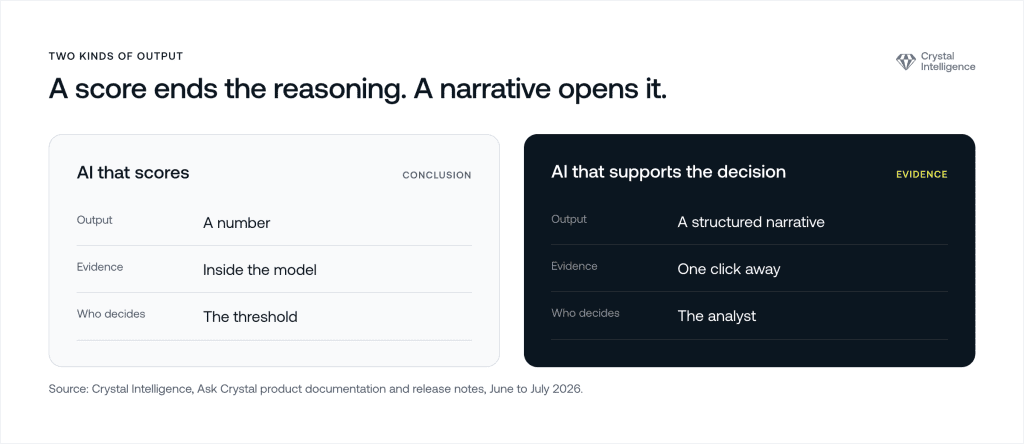
Scoring-era AI vs decision-support AI in crypto compliance
What you get | AI that scores | AI that supports the decision |
|---|---|---|
Output | A number or label per wallet or transfer | A structured narrative: transfer, connections, alerts, prior interactions |
Evidence | Hidden inside the model | Attached to every statement, one click from the on-chain data |
Auditability | “The model said 23” | Each section traceable to verifiable blockchain evidence |
Consistency | Depends on the analyst who reads the score | Same method on every transfer, every time |
Suppressed alerts | Silent | Named and explained, including trusted-list suppression |
Who decides | Often the threshold | Always the analyst. The AI augments, it does not decide |
Governance | Separate tool, separate data path | Inside Crystal Expert, under role-based permissions |
Source: Crystal Intelligence, Ask Crystal product documentation and release notes, June to August 2026. Download the comparison as CSV
How Crystal’s AI moved from scoring to deciding in 2026
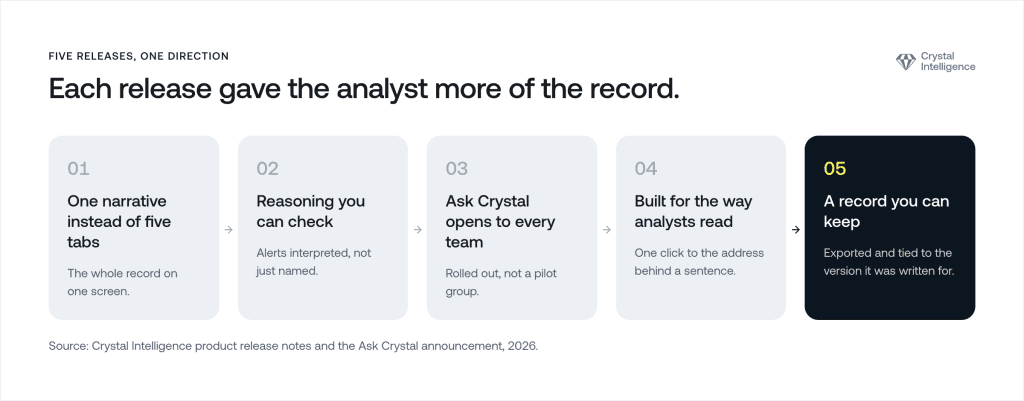
The shift did not happen in one release. It happened across five of them, and the direction never changed: give the analyst more of the record, and make more of that record checkable.
Step | What shipped | What changed | What it means for the analyst |
|---|---|---|---|
1 | One narrative instead of five tabs | An AI summary on any transfer, covering the transfer itself, its connections, every alert, and prior interactions with a trusted-list check; role-based access, regenerate on demand | The whole record on one screen before the analyst opens anything else |
2 | Reasoning you can check, alert by alert | Connections Analysis reasoning rebuilt; blocklist alerts interpreted, not just named; unflagged transfers marked | Assertions replaced by checkable explanations |
3 | Ask Crystal opens to every Crystal Expert team | The capability is named and rolled out to Crystal Expert customers | Available to the whole team, not a pilot group |
4 | Built for the way analysts read | Report reorganized for navigation, with pagination and collapsible views for large tables; entity subtypes added to risky-amount and counterparty analysis; direct navigation to any address or entity | The narrative becomes the front door to the evidence |
5 | A record you can keep, version by version | PDF export of any report; every report retained against the version of the transfer it was written for, and generatable for earlier versions | The reasoning behind a decision can be filed, shared, and retrieved later |
Source: Crystal Intelligence product release notes (June 9, June 23, July 21, and August 18, 2026) and the Ask Crystal announcement (July 14, 2026). Download the release record as CSV
One narrative instead of five tabs
Crystal’s AI began inside Monitor, the transaction monitoring module of Crystal Expert, as an AI summary on any transfer. From that first release it covered the ground an analyst covers: what the transfer was, where the funds came from or where they went, what every alert means and which rule produced it, and whether this counterparty has been seen before and sits on a trusted list. Every figure in the summary is computed by Crystal; the model writes only the sentences around them, and the summary is produced on request, when an analyst opens the tab. Role-based permissions applied from the start, and an analyst could regenerate the summary whenever the context moved.
That shape has held ever since, and it is why the releases after it build on each other. Each one deepened what the narrative can say without moving the ground the analyst reads from.
Reasoning you can check, alert by alert
The Connections Analysis section was improved to reason more accurately about counterparty connections, source of funds, and destination of funds. The alert analysis was improved for blocklist alerts, so the report presents and interprets the interaction data behind each one. And the report began stating when a transfer had been unflagged. Each change gave the analyst more of the reasoning to check.
Ask Crystal opens to every Crystal Expert team
Crystal Intelligence then announced Ask Crystal, an on-demand AI analyst built into Crystal Expert. On any transfer, one tab produces a plain-language, evidence-backed narrative, and regenerates it whenever a fresh read is needed. Access is controlled through role-based permissions, so the AI follows the same governance as the rest of the platform. The Ask Crystal product update covers what it does on each transfer.
Built for the way analysts read
The report was reorganized so it can be navigated rather than only read top to bottom, with pagination and collapsible views where the underlying tables run long. Entity subtypes were added to the risky-amount and counterparty analysis, so a detail that previously meant a separate request to the data intelligence team now arrives inside the narrative. And direct navigation lets an investigator jump from any sentence to the address or entity behind it. The narrative became the front door to the evidence, not a substitute for it.
A record you can keep, version by version
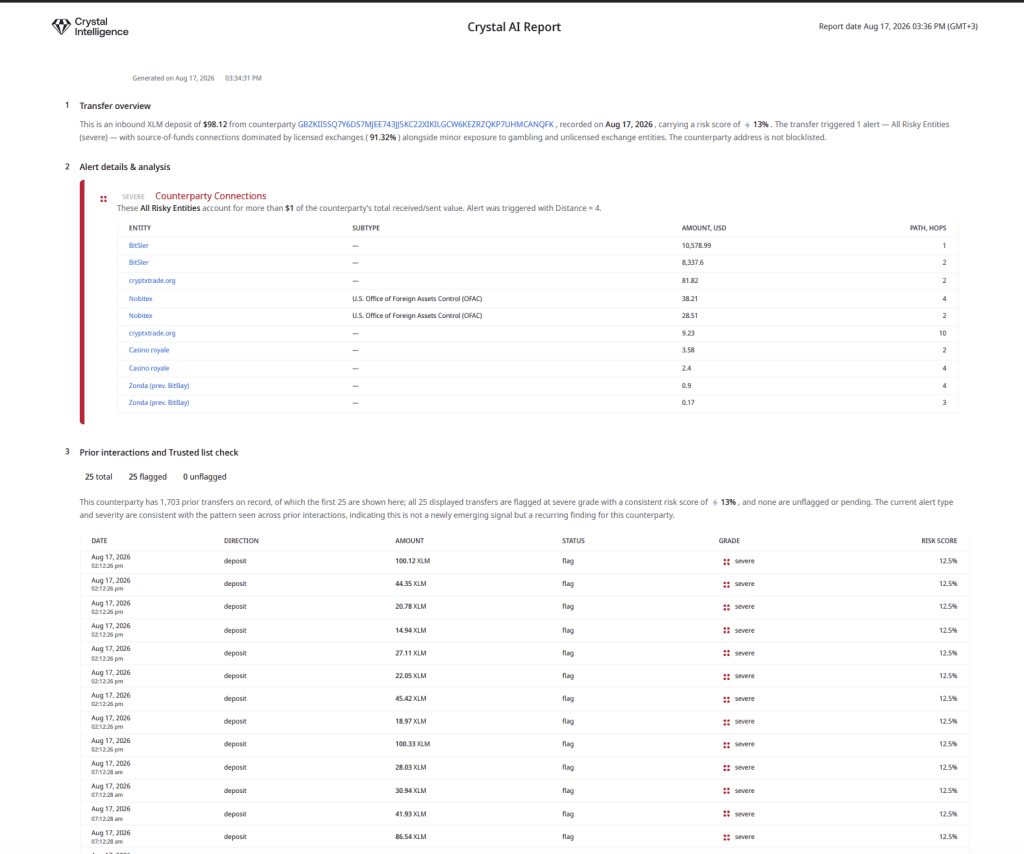
An exported Ask Crystal report: the same narrative the analyst read, filed as a document.
A report can now be exported to PDF, and every report stays tied to the version of the transfer it was written against, visible in that transfer’s check history. Where no report exists for an earlier version, an analyst can generate one from that version’s data.
This is the release that matters most for defensibility. The reasoning behind a decision can be filed with the case, handed to a colleague or an examiner, and retrieved months later in the form it had on the day the call was made. A score never had that property. A narrative you can export and version does.
The direction across all five releases is the same: less telling the analyst what to think, more showing the analyst what is there, and now keeping the proof that it was shown.
What this means for the people who own the decision
If you lead compliance or hold the MLRO role, the gain is control. Every transfer is read with the same method, so two analysts no longer reach two conclusions from one case. Every narrative draws on the same evidence base of 130,000+ attributed entities across 330+ blockchains, so case notes and reports share one accurate reference. New analysts learn from a guided read, not from trial and error.
If you run investigations, the gain is speed without loss of rigor. The narrative names specific addresses and entities, and you can move to them in one click to trace further. Nothing in it is unsourced, which keeps the record court-ready as the case grows.
If you sit in a bank or a payment institution, the gain is governance. Ask Crystal runs inside a platform that is ISO 27001 and SOC 2 Type II certified, GDPR compliant, with EU-based data governance. The AI inherits those controls instead of adding a new data path to explain to your risk committee.
Where AI belongs in decision intelligence for digital assets
Decision intelligence for digital assets is the discipline of putting verified evidence in front of every decision an organization makes about digital assets. That definition puts the evidence first and the decision second. AI belongs in between, as the fastest way to bring the evidence to the person who decides. Read the full framing in What is decision intelligence for digital assets?
This is also why the quality of the record matters more than the quality of the model. An AI reading a thin or unverified record will write a confident narrative about the wrong thing. Ask Crystal reads Crystal’s own verified evidence base, so what it writes can be checked against the same data your analysts already use in Crystal Expert.
Frequently asked questions
What is AI in crypto compliance?
AI in crypto compliance is the use of machine learning and language models to help teams review blockchain activity for money laundering, sanctions, and fraud risk. Early tools produced risk scores. Newer tools, such as Ask Crystal inside Crystal Expert, produce evidence-backed narratives that an analyst reviews and confirms.
What is the difference between AI scoring and AI decision support?
Scoring returns a number or label that summarizes risk without showing the evidence. Decision support returns a structured explanation of what happened, which rules fired, and what the history shows, with each point traceable to on-chain data. The first tells you a conclusion. The second lets you reach and defend your own.
Does Ask Crystal make compliance decisions on its own?
No. Ask Crystal augments analyst judgment. It reads and correlates the on-chain evidence behind a transfer and writes it up in plain language, but the decision on every case stays with the analyst. It does not act unsupervised.
How has Ask Crystal changed since launch?
It started as an AI assistant inside Monitor, summarizing a transfer, its connections, its alerts, and the counterparty history behind it. Its connections reasoning and blocklist explanations were then deepened and unflagged transfers marked. It was announced as Ask Crystal in July 2026, gained entity subtypes and direct navigation to any address or entity, and its reports can now be exported to PDF and are retained against each version of a transfer.
Is an AI-generated narrative defensible to a regulator?
It is defensible when every statement can be traced to verifiable on-chain evidence and a named analyst has reviewed and confirmed it. Ask Crystal is designed for that: it links each section to the data behind it, runs inside role-based permissions, and leaves the final judgment with your team.
The evidence is the product, the AI is the reader
The move from scoring to deciding is not a feature release. It is a change in what compliance teams should expect from AI: not a verdict, but the full, verifiable picture behind one. Every Crystal release in 2026, from the first assistant in Monitor to reports a team can export and keep, was a step toward that expectation.
Two things to take with you. Judge any compliance AI by whether you can check it, not by how confident it sounds. And ask what evidence sits underneath before you ask what model sits on top.