



Fintechs are advertising 7% to 15% on your dollars. On-chain, the same vaults are paying 1% to 4%, and the difference is almost all temporary subsidy.
A new wave of “earn” products has turned stablecoin yield into a consumer feature. Robinhood, Coinbase and World App now offer a rate on your dollars from inside the app, no DeFi knowledge required. The headline numbers are eye-catching: an estimated 7% at Robinhood, “up to 10.8%” at Coinbase, “over 15%” at World App.
Almost all of these products route deposits into the same place: lending vaults on Morpho, a DeFi lending protocol. These vaults are curated by a handful of firms, including Steakhouse, Gauntlet and Re7. Because those vaults settle on-chain, we don’t have to take the marketing on faith. We can measure the return depositors actually earned from each vault’s own price-per-share growth, with no oracle and no press release in the loop. This is what our Earn Programs data shows across 25 tracked vaults holding $1.75B.
The short version: the advertised rate and the realized rate are two different numbers, and the gap is widest exactly where the marketing is loudest.
At a glance | |
$1.75B | stablecoin earn TVL (total value locked) tracked on-chain |
3.4% | median realized rate across the set |
$5.8M | kept by curators in performance fees |
0–25% | range of performance fees charged |
Key findings
- Across the tracked set, the median realized rate is 3.4%, roughly a high-yield savings account, not a headline. The full range runs from 0% to 7.9%.
- Robinhood Earn advertised an estimated 7% on USDG. On-chain, its vault has realized 2.4% over the past week, a gap of more than four points.
- World App advertises “over 15%,” but that rate is a capped promotion on the first $1,000 per verified user. The vault’s blended realized rate we observe is about 1.1%.
- The honest exception: the underlying DeFi curator vaults advertise what they pay. Gauntlet Prime shows 4.31% and realized 4.2%; Steakhouse USDC shows 3.21% and realized 3.1%.
- Same headline, opposite risk. Robinhood’s yield is paid entirely by stablecoin carry. Coinbase’s High Yield vault is backed 89% by leveraged XRP and other altcoin longs, and it realizes a higher 4.9% for taking that risk.
- Curators have quietly kept $5.8M in performance fees across the tracked Morpho vaults: 14.5 cents of every dollar of interest earned.
Why doesn’t the advertised rate match what you actually earn?
Because the advertised number is a target the vault hopes to reach, not a receipt for what depositors have already earned. Every retail headline rate carries the same small print: variable, estimated, “up to.” That language is doing more work than it looks.
Take Robinhood Earn, which began rolling out to US users on July 1, 2026 as the first lending product inside the main Robinhood app. It advertised an estimated 7% APY (annual percentage yield) on USDG, the Paxos-issued Global Dollar, with deposits flowing into a Steakhouse-curated Morpho vault. The 7% is real as a target. As a realized return, our data reads the vault’s price-per-share growing at 2.4% annualized over the past week and 2.0% over the past month. That is the return actually credited to depositors, net of fees.
Some of that gap is timing: the vault is young, and early rates on a ramping vault can understate a later steady state. But a four-to-five-point gap is structural, not noise. The 7% headline describes a rate the product hopes to reach when borrower demand is strong and incentives are flowing. It is not the rate sitting in depositors’ balances today.
World App makes the pattern explicit. Its “over 15% APY” offer applies only to the first $1,000 in USDC per World ID–verified user (World App’s identity check), funded from a roughly $5M World Foundation incentive pool. In practice, it’s a customer-acquisition boost rather than a return on real balances. Above the cap, deposits earn the underlying vault rate. The blended realized rate we observe on its World Chain vault is about 1.1%. The 15% is a hook; the vault is the product.
Coinbase sits in between. Its plain USDC balance pays about 4.1% (4.5% for Coinbase One members). Its DeFi lending product launched at “up to 10.8%,” but reporting at the time noted roughly half of that was a temporary Morpho protocol subsidy layered on about 6% of organic borrower demand. Strip the boost, and the two vaults Coinbase actually routes into read far lower on-chain today. Its conservative Prime tier realizes 3.9%; its High Yield tier realizes 4.9%. Once the launch subsidy fades, what’s left is the vault’s own rate.
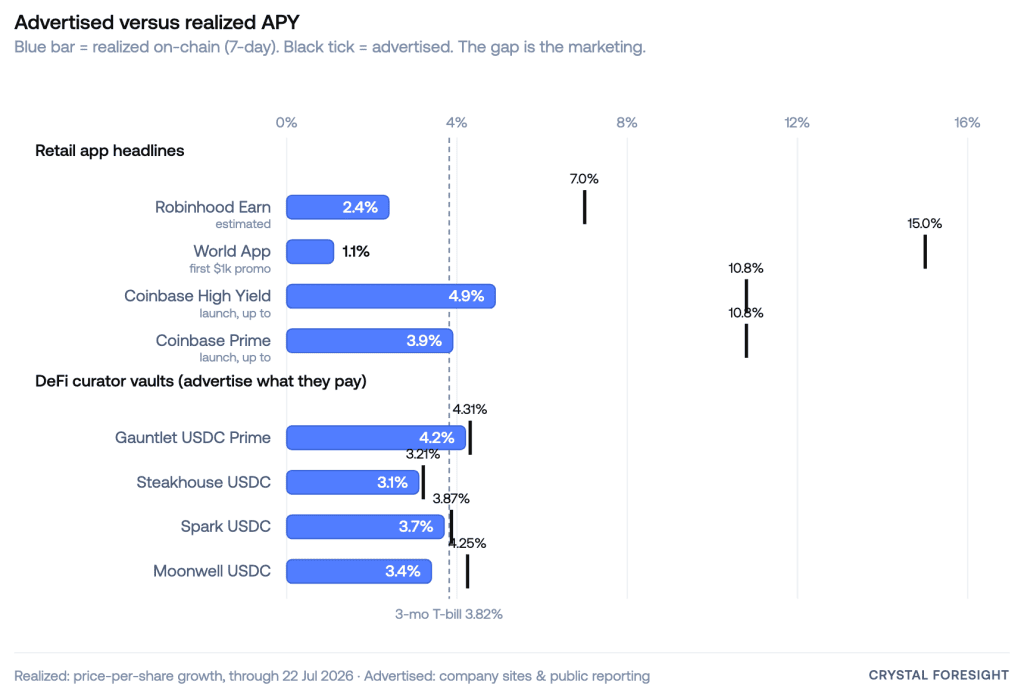
Realized rates from Crystal Foresight, price-per-share growth through July 22, 2026. Advertised rates from company sites and public reporting, July 2026. Retail headlines are marketed as variable, “up to,” or promotional. For reference, the 3-month US Treasury bill yields 3.82%.
The bottom four rows are the tell. When a DeFi curator advertises a rate directly, the advertised and realized numbers line up within a fraction of a point: Gauntlet’s 4.31% is 4.2% on-chain, Steakhouse’s 3.21% is 3.1%. These vaults quote what they pay. The distortion appears one layer up, in the consumer app that wraps them, where a temporary subsidy or a capped promo turns a ~4% product into a 7%-to-15% headline.
Program | Advertised | Realized (on-chain, 7d) | What explains the gap |
Robinhood Earn (USDG) | ~7% | 2.4% | Variable target; young vault; carry-funded |
World App (USDC) | 15%+ | ~1.1% | 15% is a capped first-$1,000 promo |
Coinbase High Yield | up to 10.8% | 4.9% | ~5 pts was a temporary Morpho subsidy |
Coinbase Prime | up to 10.8% | 3.9% | Conservative BTC-collateral tier |
Gauntlet USDC Prime | 4.31% | 4.2% | Matches, no promo layer |
Steakhouse USDC | 3.21% | 3.1% | Matches |
Spark USDC | 3.87% | 3.7% | Matches |
Moonwell USDC | 4.25% | 3.4% | ~0.6 pt is token rewards, rest matches |
For context: the 3-month US Treasury bill yields 3.82% and top high-yield savings accounts pay 4.1% to 4.5%. The real DeFi rate is competitive with cash; the gap between that and the marketing is the story.
Does the same advertised yield mean the same risk?
No. Two products can advertise nearly identical “~7% on stablecoins” pitches while resting on completely different collateral, one on stable, low-volatility carry, the other on leveraged crypto. A rate tells you what you might earn. It does not tell you who is paying it, or what happens if they stop. On-chain, we can trace the collateral behind each vault’s yield to see which is which.
Robinhood Earn is a stablecoin carry loop. Its collateral book is essentially all yield-bearing stablecoins: about 67% Ethena’s USDe, 26% Maple’s syrupUSDG and 7% Spark’s spUSDG. Savers are paid by borrowers looping one stablecoin strategy into another. The yield holds as long as that carry stays attractive: an endogenous, self-referential structure.
Coinbase’s High Yield vault is leveraged crypto. Its book is roughly 89% XRP, held via Coinbase’s wrapped cbXRP, with the rest in SOL, ADA, BTC and DOGE. It holds no Ethena collateral at all, despite the “Ethena-powered” label attached to it in commentary. Savers there are paid by traders borrowing dollars against volatile crypto. That is directional market risk, distinct from a stable carry. It is why the vault realizes 4.9% against Robinhood’s 2.4%: the extra points are the price of the extra risk, sitting in plain sight on-chain.
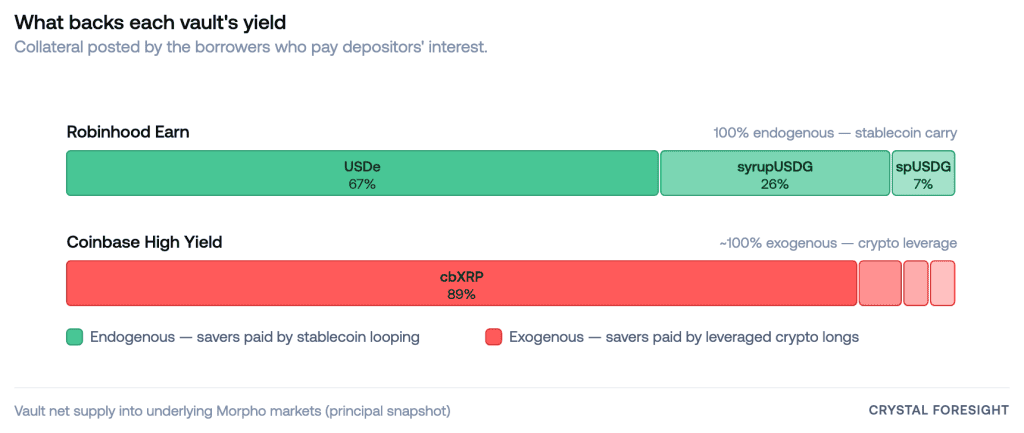
Vault net supply into underlying Morpho markets (principal snapshot), via Crystal Foresight. Commentary described both programs as “USDe looping,” true for Robinhood, false for Coinbase.
Who keeps the fees, and who actually holds the deposits?
Curators keep a slice of every vault’s interest as a performance fee, and the deposit base itself is a barbell: thousands of small wallets alongside a handful of large ones holding most of the money. Two more things the on-chain view makes plain.
First, fees. Across the twelve tracked Morpho vaults where we decode the fee structure, curators have kept $5.8M in performance fees: about 14.5% of all interest earned. The rate varies sharply, even within one curator. Steakhouse runs one $185M USDC vault at a 25% performance fee, $3.2M skimmed to date. It runs another, larger vault at 0%, passing every dollar of interest to depositors. Robinhood’s vault also charges 0%, sending all $181k of interest earned so far to savers. The fee is not visible in the advertised rate, but it is the difference between the gross yield and yours.
Second, who these programs actually reach. The deposit base is a barbell. In Robinhood’s vault, 71% of wallets hold under $1,000, together just 1.5% of the dollars. At the other end, 248 wallets holding $100k or more control roughly 60% of the balances. These campaigns are genuinely reaching retail in headcount. The dollars, as always, are concentrated in a few whales.
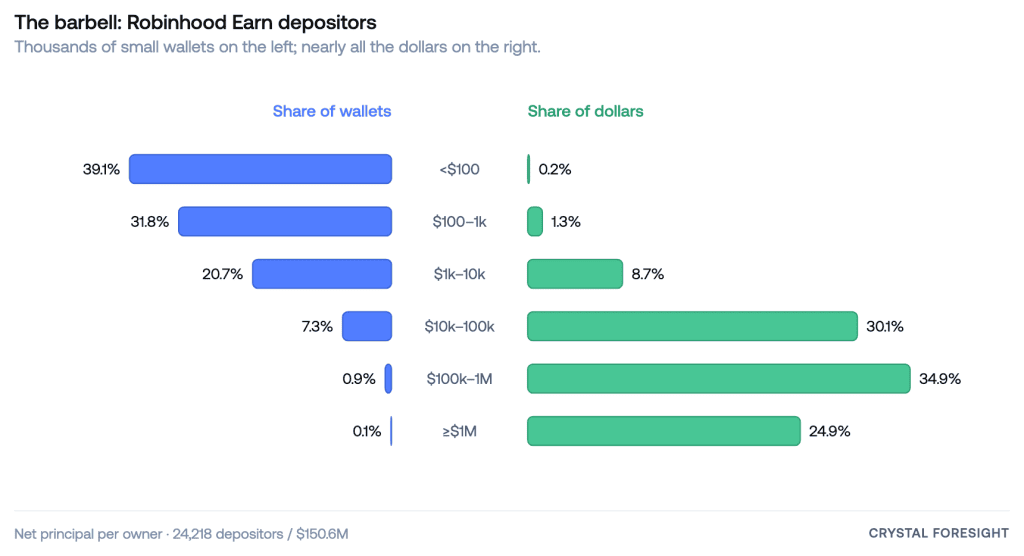
Net principal per owner, 24,218 depositors / $150.6M, via Crystal Foresight.
The takeaway
None of this means the products are bad, or that the rates are fake. It means the advertised number is the start of the question, not the answer. On-chain, a fintech “earn” rate resolves into three separate things: the underlying vault yield (usually a competitive ~4%), a temporary or capped subsidy (the flashy part), and a fee the curator keeps (the quiet part). The vault yield is what you can count on. The subsidy and the fee are what to watch.
The advertised rate is a claim. The chain is where you check it.
Frequently asked questions
Is a 7% advertised stablecoin rate misleading?
Not necessarily misleading, but it is incomplete. Regulatory and marketing language like “estimated,” “variable,” or “up to” signals that the figure is a goal, not a guarantee. Crystal Foresight’s on-chain data shows the same vaults realizing 1 to 4 percentage points less than the headline in most cases.
What is a Morpho vault?
Morpho is a DeFi lending protocol. Firms called curators, including Steakhouse, Gauntlet, and Re7, build lending vaults on top of it and set the terms, including performance fees. Most fintech “earn” products route deposits into one of these vaults rather than running their own lending infrastructure.
Why does Coinbase’s High Yield vault pay more than Robinhood Earn?
The two vaults take on different kinds of risk. Robinhood Earn’s yield comes almost entirely from stablecoin carry, savers being paid by borrowers looping one stablecoin strategy into another. Coinbase’s High Yield vault is backed roughly 89% by leveraged XRP, so its higher 4.9% realized rate compensates for taking on volatile-asset risk, not a better version of the same product.
Are performance fees disclosed to depositors?
The fee is built into the vault’s terms but is not part of the advertised headline rate. Across the twelve tracked Morpho vaults where Crystal Foresight can decode the fee structure, curators have kept $5.8M, about 14.5% of all interest earned, with individual vault fees ranging from 0% to 25%.
Does a capped promotional rate, like World App’s 15%, apply to my whole balance?
No. World App’s “over 15%” offer applies only to the first $1,000 per verified user and is funded from a roughly $5M incentive pool, not from the underlying vault’s own yield. Above that cap, deposits earn the underlying vault rate, which Crystal Foresight measures at about 1.1% blended.
How is “realized APY” actually measured?
Crystal Foresight calculates realized APY from a vault’s price-per-share growth: the actual increase in value each deposited dollar has earned, net of fees. This measurement comes directly from on-chain deposit, withdrawal, and interest events, so it doesn’t depend on a company’s own reporting.
This analysis is for informational purposes only and does not constitute investment, legal, or tax advice.