

The blockchain records every transaction and never says where anyone is. By reading the daily rhythm of on-chain activity, we can place a stablecoin’s users on the world’s clocks, and the ten largest turn out to keep very different times.
Key takeaways
- The clock, not the country. On-chain data cannot show where a stablecoin’s users live, but it can show when they are active. That timing lines up with a 30-minute UTC offset, a clock rather than a border.
- The method checks out. Three coins built for a single country, a ruble coin, a real coin and a naira coin, land on exactly the clock their real-world users keep when tested blind.
- DAI is the most concentrated of the ten largest stablecoins. More than three-quarters of its human wallets sit on UTC+8, the clock shared by mainland China, Singapore, and Hong Kong.
- USDC looks the most global, but that is not fully settled. Its flat, around-the-clock profile is also exactly what widespread automation would produce, so this is the least certain result in the analysis.
- A clock is a signal, not proof of exposure. Knowing which hours a stablecoin’s users keep helps issuers, exchanges, and compliance teams see where real activity concentrates, even though a clock alone cannot identify a jurisdiction.
Why on-chain geography is hard, and how we read it
Location is the hardest thing to know on a blockchain. The data is famously transparent about what moved and when, but it carries no IP address, no country, no name. Most published claims about where a token is used fall back on off-chain surveys or stretched inference.
We take a different route and use what the chain actually does show: the timing of activity. Aggregate a coin’s transactions across the day and a rhythm appears: quiet through a population’s night, busy through its working hours. That rhythm places the users on a UTC offset.
Two things are worth being clear about. This resolves to a clock, not a border; it tells you the offset a coin’s users keep, not their country, and it can’t tell north from south. But because the world runs UTC so unevenly (India at +5:30, Iran at +3:30, the whole of China on a single +8), the clock itself carries a surprising amount of specificity. We resolve to 30-minute offsets to catch exactly those quirks.
The method behind this is rigorous and validated, and we don’t lay it out here. If you’d like to understand how it works, reach out. Throughout, we show only human-rhythm activity: we remove the obvious bots and the named institutions, and map what’s left.
Start where we already know the answer
The cleanest test of a geography method is a set of coins whose users are known to have a geographic focus.
Three stablecoins are built for a single market: a ruble-referenced coin, a Brazilian real coin, and a Nigerian naira coin. If the clock is real, it should find each of them. It does.
- A7A5‘s activity peaks at UTC+3, Moscow’s clock, keeping Russian and Eastern-European hours.
- BRLA centers on UTC-3, Brazil, where more than half of its human wallets sit.
- cNGN wakes with UTC+1, the Lagos and West-African working day; its region band, the spread of offsets that light up around its peak, reads broadly, but the clock and the Lagos anchor pin it. Each of these reads its own chain over a full year.
Chart legend: fewer users → more users. In every map and histogram, brighter and taller means more of a coin’s human users keep that clock.
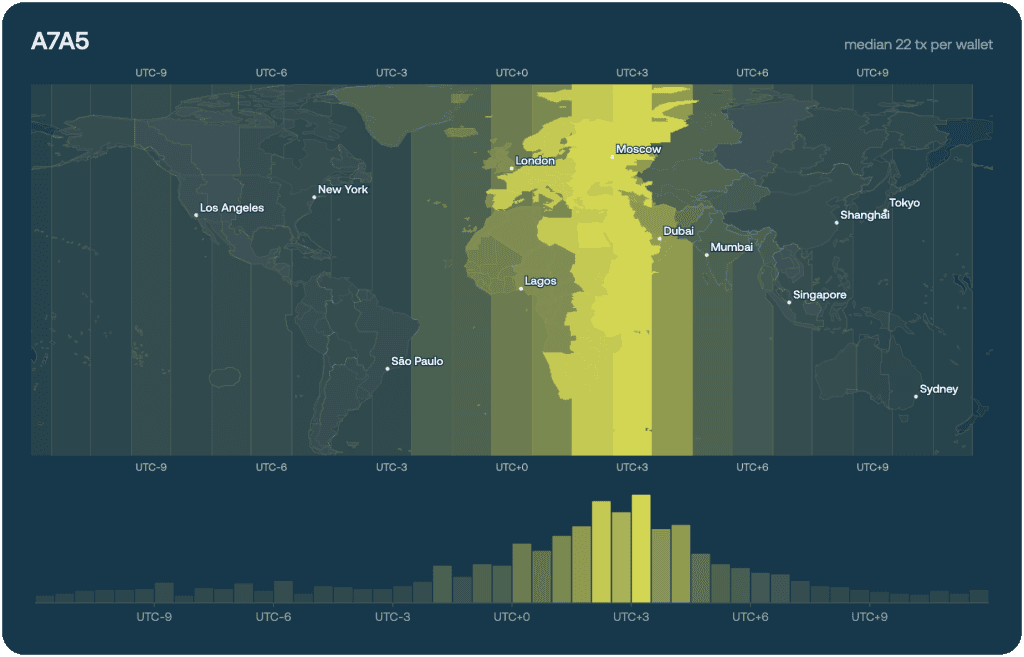
Above: A7A5 — median 22 tx each
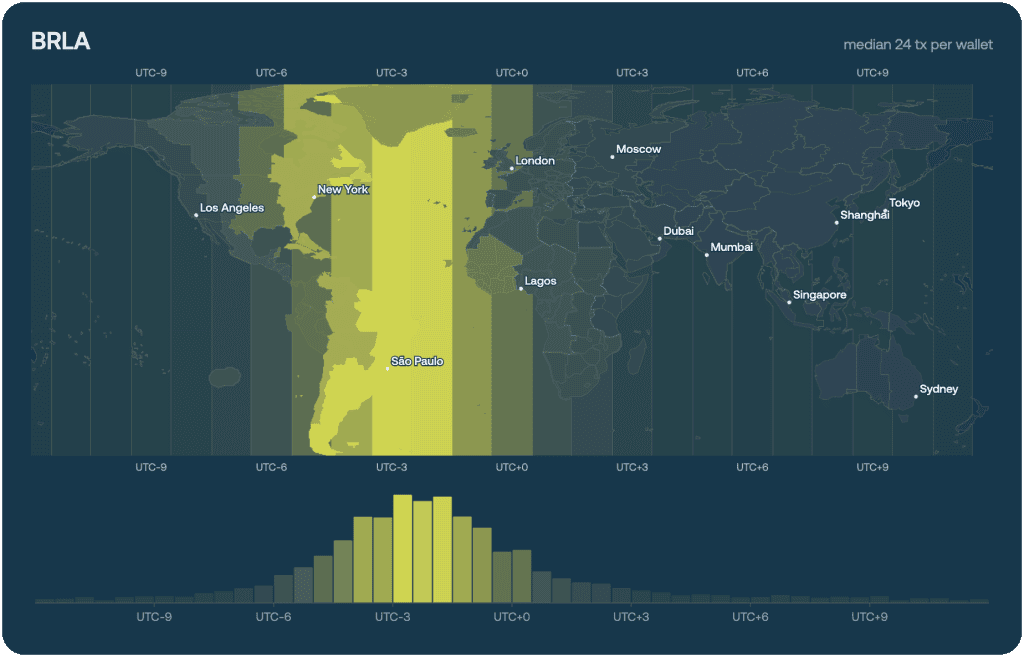
Above: BRLA — median 24 tx each
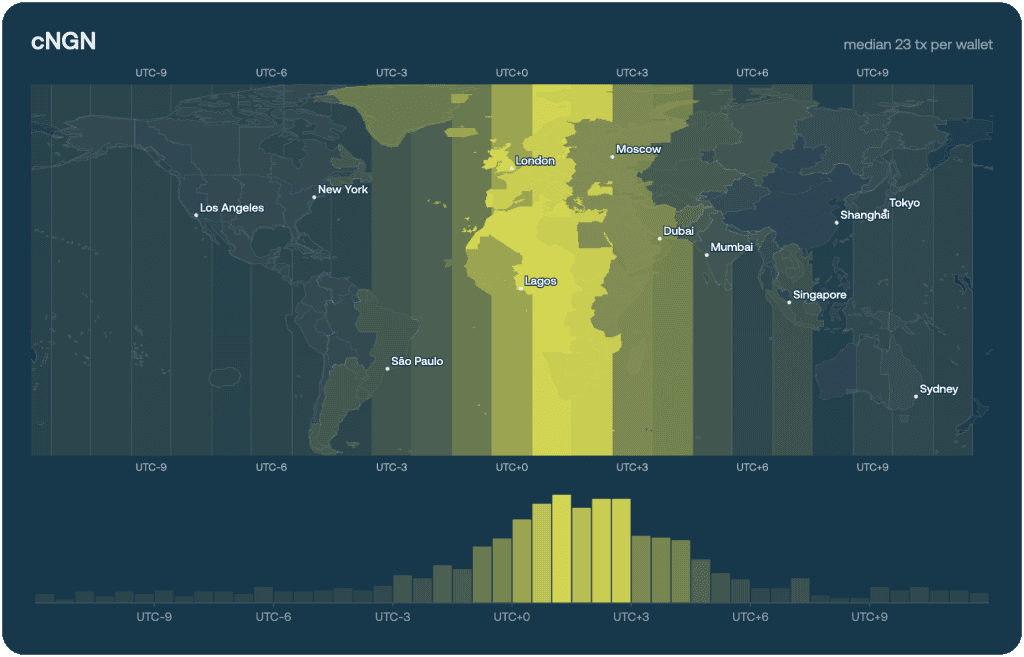 Above: cNGN — median 23 tx each
The ten largest, by the clock they keep
Now the same lens on the ten biggest stablecoins. Grouping them by the shape of their daily rhythm, not by any single region percentage, sorts them into three kinds of coin.
Chart legend: fewer users → more users. In every map and histogram, brighter and taller means more of a coin’s human users keep that clock.
Coins that keep one clock
For these four, a single offset dominates the day: one working population drives the coin, and the map lights a single band.
- DAI shows the sharpest profile in the set: one spike at UTC+8, the clock shared by mainland China, Singapore, and Hong Kong, where more than three-quarters of its human wallets live.
- USD1 sits just east of it, on the UTC+8-to-+9 trading day.
- PYUSD is the mirror image across the world, clustering on UTC-4 to -5, the US East Coast and the Americas.
- EURC bells cleanly over UTC+2, continental European summer time. Four coins, four home clocks.
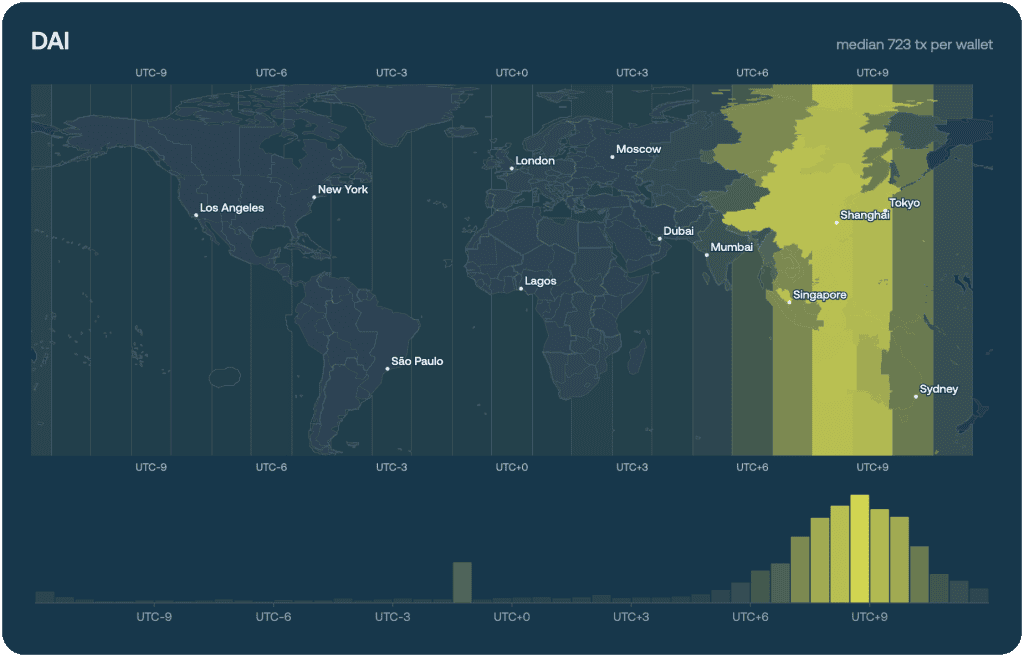
Above: DAI — median 723 tx each
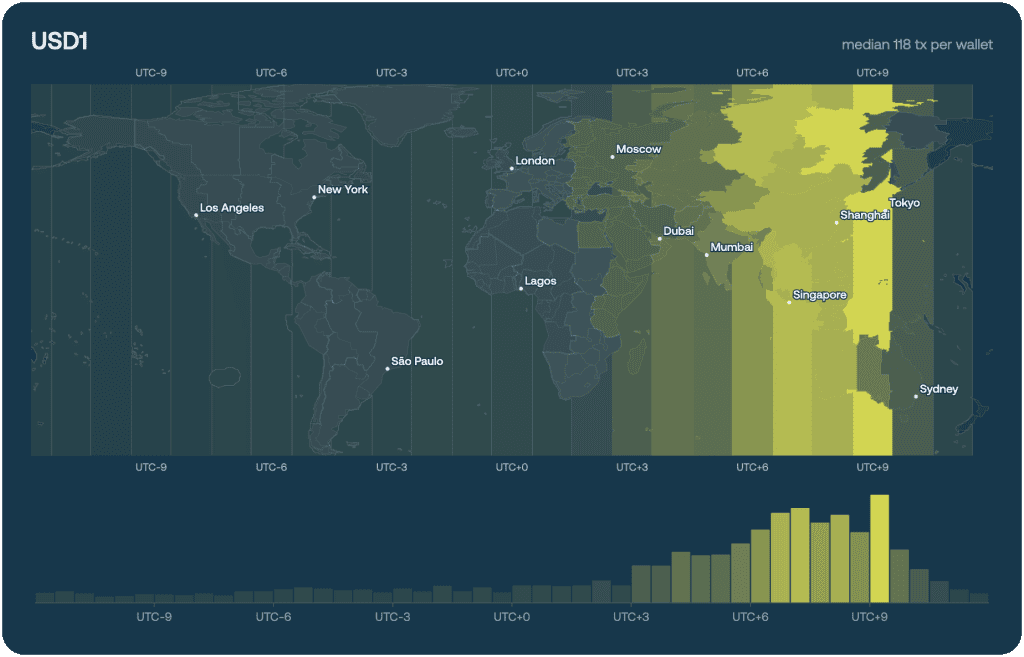
Above: USD1 — median 118 tx each
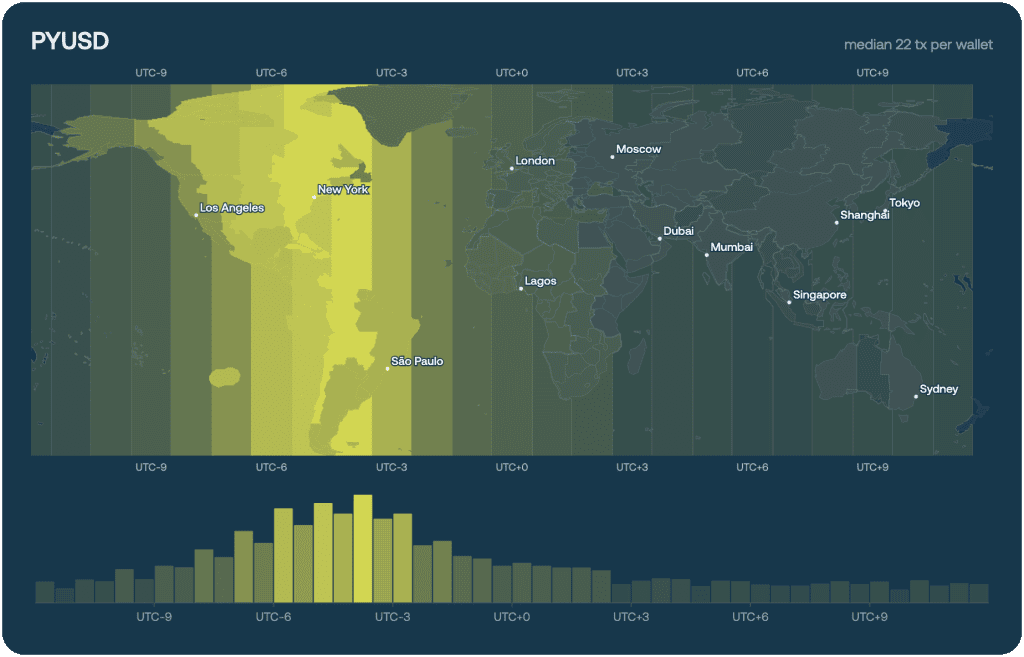 Above: PYUSD — median 22 tx each
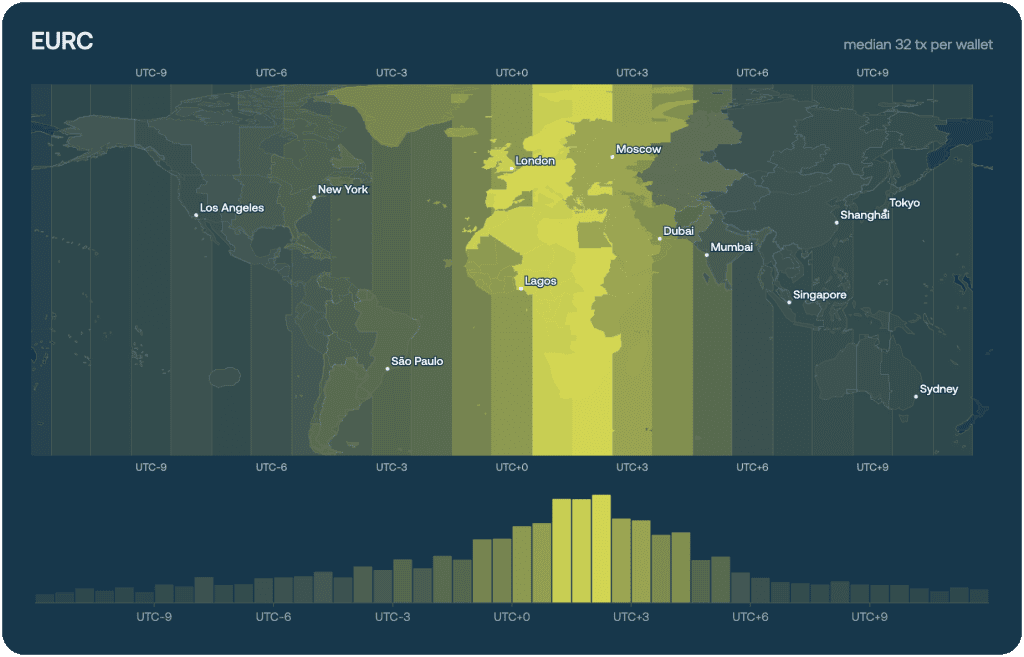 Above: EURC — median 32 tx each
Coins with a main clock
These two have a clear center of gravity but a wide skirt around it: one region leads while the coin is genuinely used across many.
- USDT, the largest stablecoin of all, is used almost everywhere, yet its weight forms a broad hump from the Gulf through South Asia to East Asia, peaking near UTC+7.
- USDG looks even by region, but the same right-leaning shape sits underneath it, with an Asian-Pacific center near UTC+7 to +8.
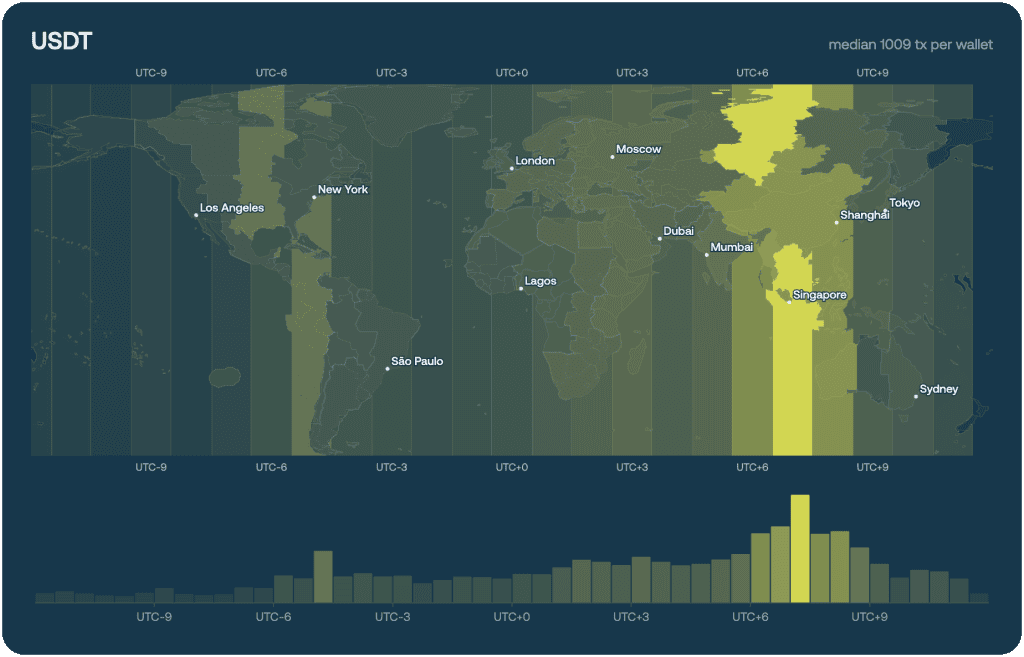
Above: USDT — median 1009 tx each
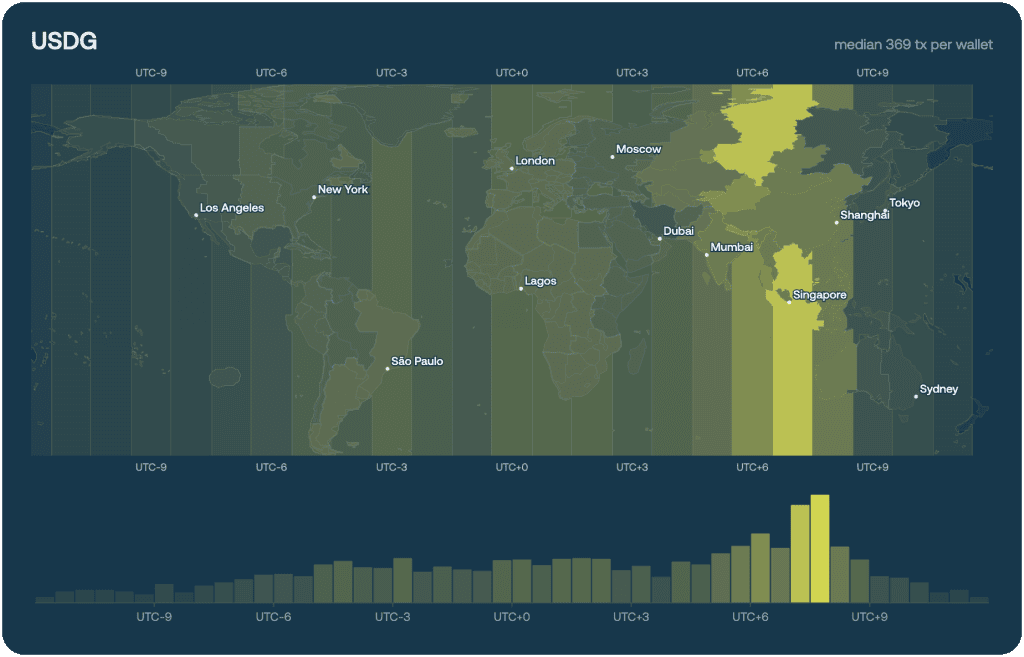
Above: USDG — median 369 tx each
Coins that keep every clock
For these, the profile fills the whole day, and the map lights up edge to edge: no single offset takes over.
- USDC is the flattest of all: its slight American lean is really just a bit more of an otherwise even, around-the-clock base, the closest thing to a truly global stablecoin.
- USDe, USDS, and RLUSD spread the same way, their thin human-paced activity scattered across every clock rather than settling anywhere.
One point is worth stating plainly. USDC and USDS are known to be mostly machine-driven, always-on money. We remove the obvious bots and named institutions and keep only human-looking rhythms, but an always-on profile this flat is exactly what automation spread thinly across the globe would also produce. So some of what still reads as human here may be machines, not people in every time zone. Read the flattest maps as the least certain.
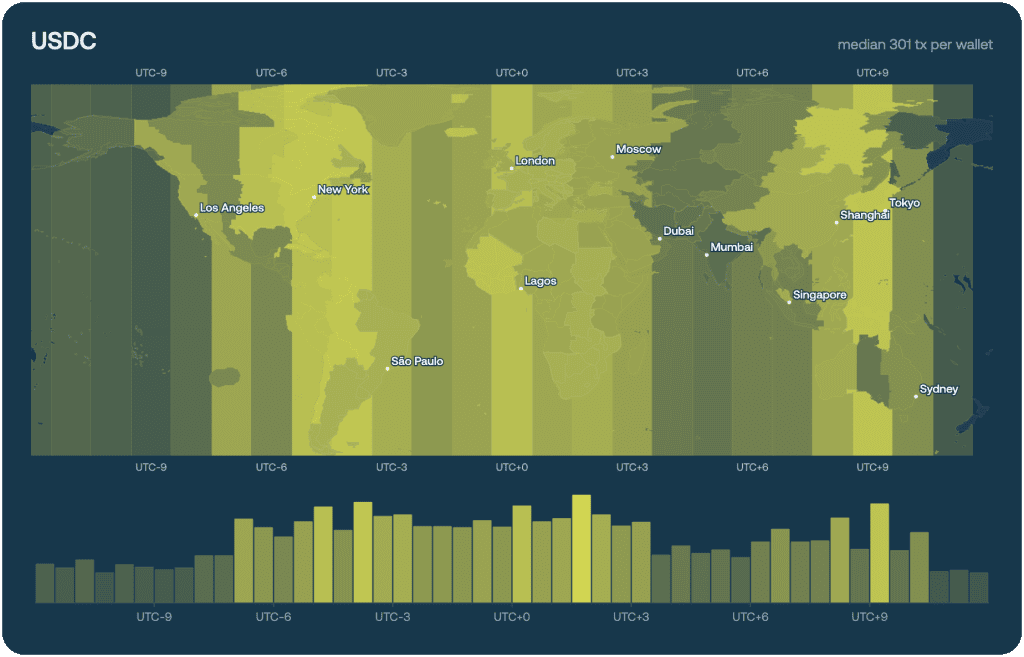
Above: USDC — median 301 tx each
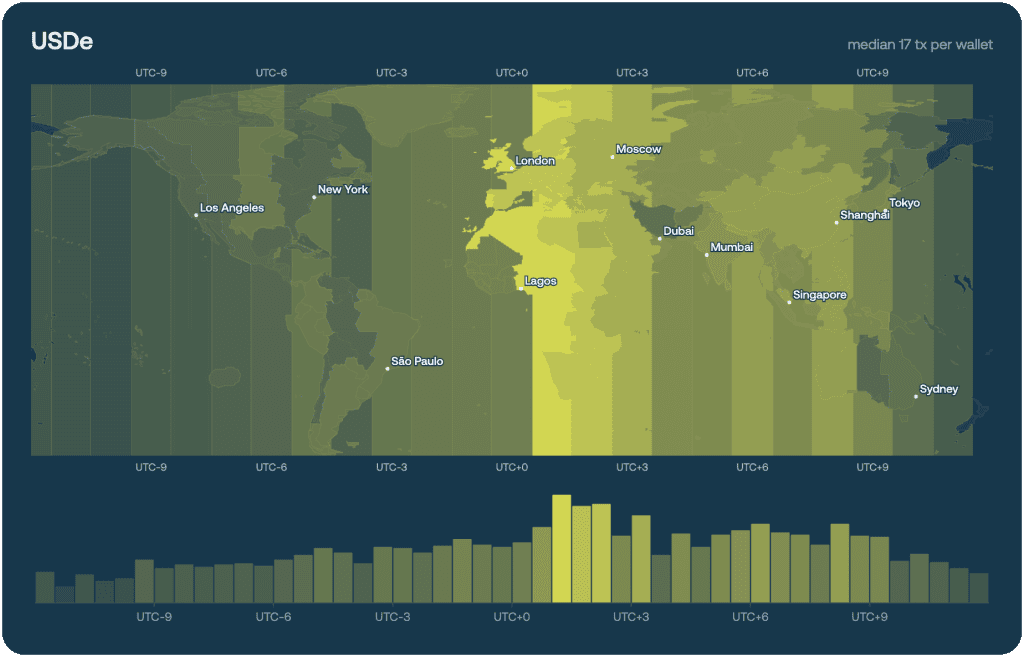
Above: USDe — median 17 tx each
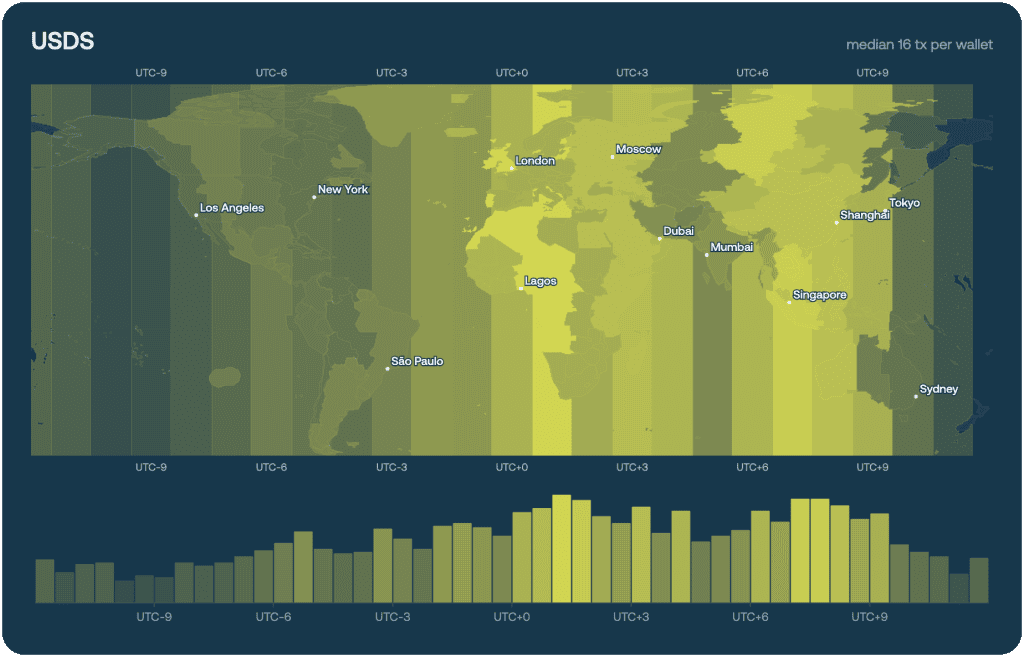
Above: USDS — median 16 tx each
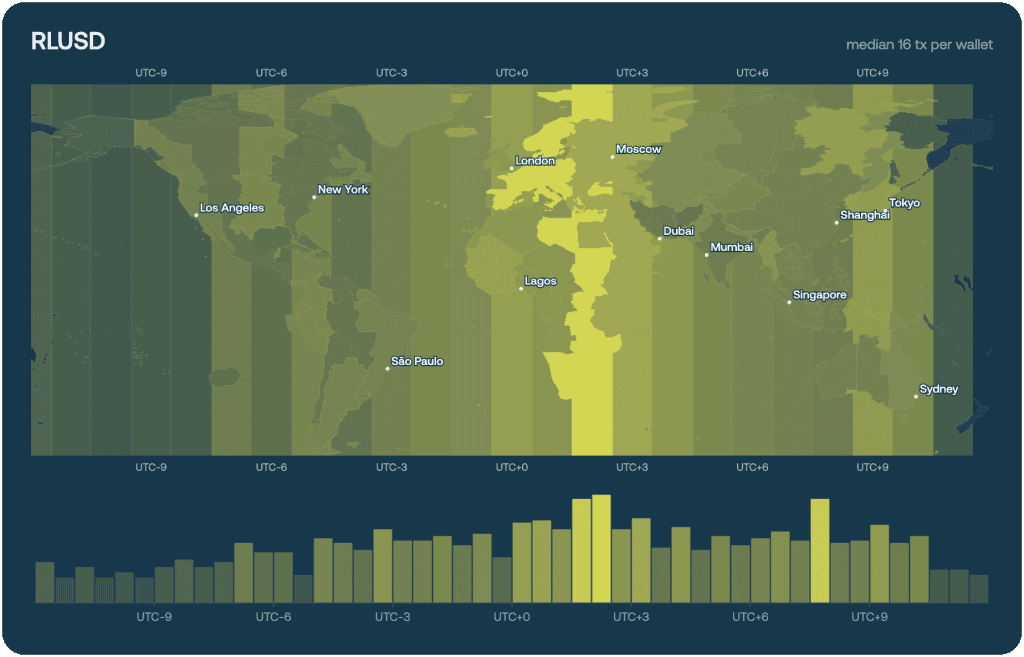
Above: RLUSD — median 16 tx each
Method & scope
Regions are inferred from the timing of on-chain activity, mapped to 30-minute UTC offsets observed in summer (so European hours read as CEST, US hours as EDT). Offsets resolve to roughly ±1 hour and describe a clock, not a country. A bright band can span every place on that offset (UTC+3 is Moscow and East Africa alike). Figures cover the most active human-rhythm wallets per coin, with bots and named institutions removed; the largest coins are sampled over a recent two-week window, the rest over about four months, and the three region-native coins over a full year on their own chains. Crystal Foresight turns on-chain behavior into market intelligence: research, not investment advice.
Frequently asked questions
What does a UTC offset tell you about a stablecoin’s users?
It shows the working hours its human wallets keep, resolved to a 30-minute-wide clock. It is a rhythm, not an address, so it cannot name a country and cannot tell north from south.
How do you know the method actually works?
It was tested against three stablecoins built for a single market: a ruble coin, a real coin, and a naira coin. Each landed on its real-world home clock, which is the method’s ground truth.
Why do USDC, USDe, USDS, and RLUSD show no dominant clock?
Their activity spreads evenly across every offset rather than clustering anywhere. For USDC and USDS, that flatness is also consistent with automated, machine-driven activity, so it is the least certain result in this analysis.
Does this analysis identify individual users or wallets?
No. It aggregates transaction timing across each coin’s most active human-rhythm wallets, after removing obvious bots and named institutions, to find a population-level rhythm. It does not identify any individual holder.
How much data does this cover?
The largest coins are sampled over a recent two-week window, the rest over about four months, and the three region-native control coins over a full year on their own chains.
Data as of August 12, 2026. All figures derived from Crystal Intelligence on-chain analytics. Regions are inferred from transaction timing and describe a clock, not a jurisdiction or an individual user. This report is for informational purposes only and does not constitute investment advice.